

(4) Gas pressure and characteristic diameter: The gas pressure at the nozzle inlet
depends on the ratio of grain diameter to nozzle throat diameter, or the ratio of
characteristic diameter.
(5) Change rate of burning pressure and relative change rate of characteristic
diameter: The change rate of gas pressure at nozzle inlet depends on the ratio of
grain diameter to relative change rate of nozzle diameter, or the ratio of relative
change rate of characteristic diameter.
9.3.1.3 Derivation of Equations
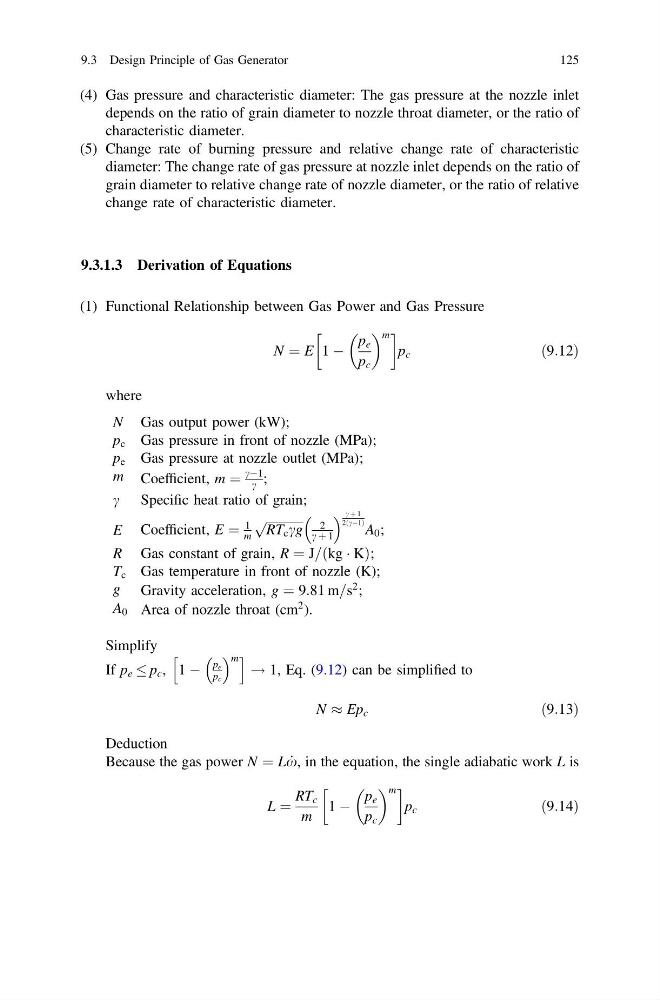
(1) Functional Relationship between Gas Power and Gas Pressure
N ¼ E 1 À
p e
p c
m !
p c
ð9:12Þ
where
N Gas output power (kW);
p c Gas pressure in front of nozzle (MPa);
p e Gas pressure at nozzle outlet (MPa);
m Coefficient, m ¼
cÀ1
c ;
c Specific heat ratio of grain;
E Coefficient, E ¼
1
m
ffiffiffiffiffiffiffiffiffiffiffiffi
RT c cg
p
2
c þ 1
cþ1
2 cÀ1
ð
Þ A 0 ;
R Gas constant of grain, R ¼ J= kg Á K
ð
Þ;
T c Gas temperature in front of nozzle (K);
g Gravity acceleration, g ¼ 9:81 m=s
2 ;
A 0 Area of nozzle throat (cm
2 ).
Simplify
If p e p c , 1 À
p e
p c
m
h
i
! 1, Eq. (9.12) can be simplified to
N % Ep c
ð9:13Þ
Deduction
Because the gas power N ¼ L _
x, in the equation, the single adiabatic work L is
L ¼
RT c
m
1 À
p e
p c
m !
p c
ð9:14Þ
9.3 Design Principle of Gas Generator
125
depends on the ratio of grain diameter to nozzle throat diameter, or the ratio of
characteristic diameter.
(5) Change rate of burning pressure and relative change rate of characteristic
diameter: The change rate of gas pressure at nozzle inlet depends on the ratio of
grain diameter to relative change rate of nozzle diameter, or the ratio of relative
change rate of characteristic diameter.
9.3.1.3 Derivation of Equations
(1) Functional Relationship between Gas Power and Gas Pressure
N ¼ E 1 À
p e
p c
m !
p c
ð9:12Þ
where
N Gas output power (kW);
p c Gas pressure in front of nozzle (MPa);
p e Gas pressure at nozzle outlet (MPa);
m Coefficient, m ¼
cÀ1
c ;
c Specific heat ratio of grain;
E Coefficient, E ¼
1
m
ffiffiffiffiffiffiffiffiffiffiffiffi
RT c cg
p
2
c þ 1
cþ1
2 cÀ1
ð
Þ A 0 ;
R Gas constant of grain, R ¼ J= kg Á K
ð
Þ;
T c Gas temperature in front of nozzle (K);
g Gravity acceleration, g ¼ 9:81 m=s
2 ;
A 0 Area of nozzle throat (cm
2 ).
Simplify
If p e p c , 1 À
p e
p c
m
h
i
! 1, Eq. (9.12) can be simplified to
N % Ep c
ð9:13Þ
Deduction
Because the gas power N ¼ L _
x, in the equation, the single adiabatic work L is
L ¼
RT c
m
1 À
p e
p c
m !
p c
ð9:14Þ
9.3 Design Principle of Gas Generator
125