

have multiple allosteric pathways, which may preexist without effector binding at
allosteric site [79]. Various pathways may be involved depending on the different
changes in allosteric site.
However, RINs constructed based on a single structure do not take into account
the structural changes in protein globule. Therefore, the combination of molecular
dynamics simulation (MD) followed by RINs design frequently has been used to
detect and to analyze allosteric pathways. In these cases, the edges in RINs are
defined using various parameters obtained from MD. The edges may reflect the
correlation of displacements of the residues [74, 80], the fluctuation of distances
[81], interaction energy [82], etc.
Aminoacyl-tRNA synthetases are convenient objects for analysis of allosteric
communication. The combination of MD with RIN was used for discovering
pathways from anticodon region to the aminoacylation region for methionyl-tRNA
synthetase [74, 83], glutaminyl-tRNA synthetase [84], cysteinyl-tRNA synthetase
[35], and tryptophanyl-tRNA synthetase [85, 86]. Particularly, analysis of
tryptophanyl-tRNA synthetase showed changes of flexibility around the active
site induced by allosteric ligands binding and allowed to explain the molecular
mechanism of half-of-the-sites reactivity (tryptophanyl-tRNA synthetase is a
homodimer).
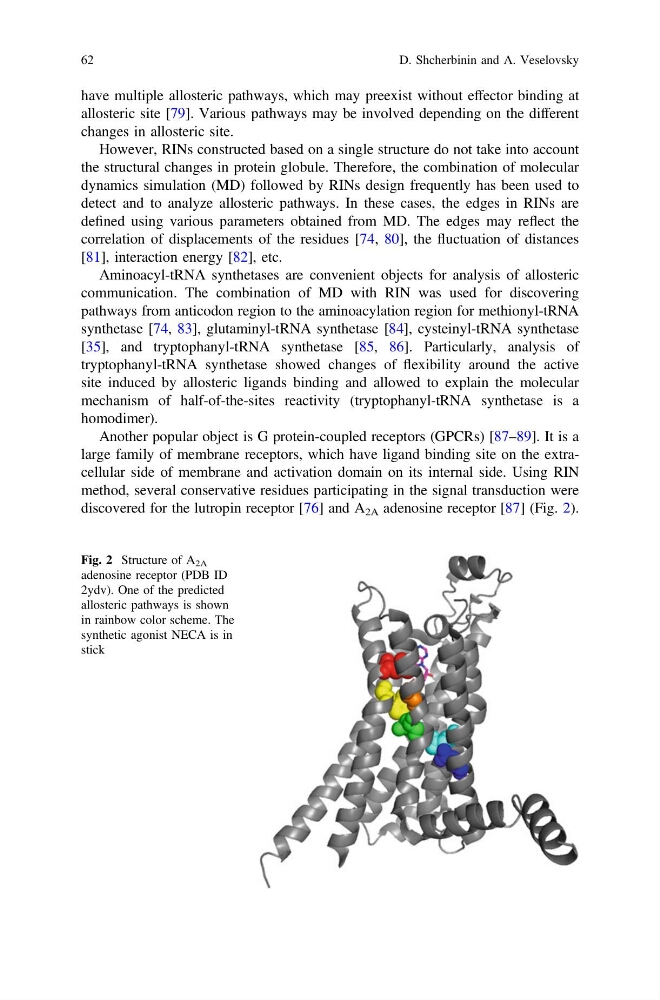
Another popular object is G protein-coupled receptors (GPCRs) [87–89]. It is a
large family of membrane receptors, which have ligand binding site on the extracellular side of membrane and activation domain on its internal side. Using RIN
method, several conservative residues participating in the signal transduction were
discovered for the lutropin receptor [76] and A 2A adenosine receptor [87] (Fig. 2).
Fig. 2 Structure of A 2A
adenosine receptor (PDB ID
2ydv). One of the predicted
allosteric pathways is shown
in rainbow color scheme. The
synthetic agonist NECA is in
stick
62
D. Shcherbinin and A. Veselovsky
allosteric site [79]. Various pathways may be involved depending on the different
changes in allosteric site.
However, RINs constructed based on a single structure do not take into account
the structural changes in protein globule. Therefore, the combination of molecular
dynamics simulation (MD) followed by RINs design frequently has been used to
detect and to analyze allosteric pathways. In these cases, the edges in RINs are
defined using various parameters obtained from MD. The edges may reflect the
correlation of displacements of the residues [74, 80], the fluctuation of distances
[81], interaction energy [82], etc.
Aminoacyl-tRNA synthetases are convenient objects for analysis of allosteric
communication. The combination of MD with RIN was used for discovering
pathways from anticodon region to the aminoacylation region for methionyl-tRNA
synthetase [74, 83], glutaminyl-tRNA synthetase [84], cysteinyl-tRNA synthetase
[35], and tryptophanyl-tRNA synthetase [85, 86]. Particularly, analysis of
tryptophanyl-tRNA synthetase showed changes of flexibility around the active
site induced by allosteric ligands binding and allowed to explain the molecular
mechanism of half-of-the-sites reactivity (tryptophanyl-tRNA synthetase is a
homodimer).
Another popular object is G protein-coupled receptors (GPCRs) [87–89]. It is a
large family of membrane receptors, which have ligand binding site on the extracellular side of membrane and activation domain on its internal side. Using RIN
method, several conservative residues participating in the signal transduction were
discovered for the lutropin receptor [76] and A 2A adenosine receptor [87] (Fig. 2).
Fig. 2 Structure of A 2A
adenosine receptor (PDB ID
2ydv). One of the predicted
allosteric pathways is shown
in rainbow color scheme. The
synthetic agonist NECA is in
stick
62
D. Shcherbinin and A. Veselovsky