

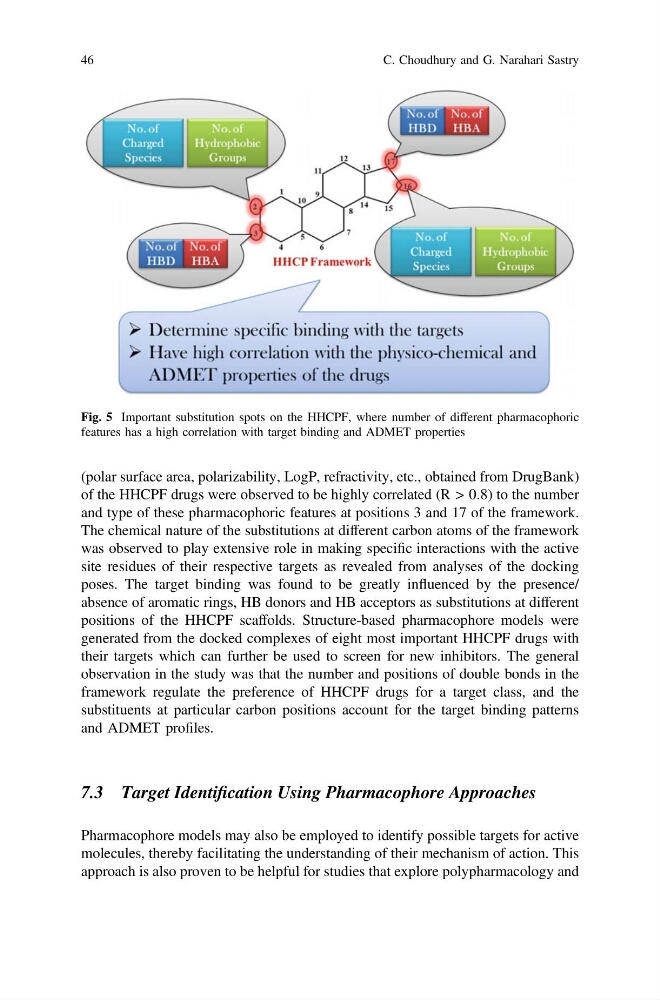
(polar surface area, polarizability, LogP, refractivity, etc., obtained from DrugBank)
of the HHCPF drugs were observed to be highly correlated (R > 0.8) to the number
and type of these pharmacophoric features at positions 3 and 17 of the framework.
The chemical nature of the substitutions at different carbon atoms of the framework
was observed to play extensive role in making specific interactions with the active
site residues of their respective targets as revealed from analyses of the docking
poses. The target binding was found to be greatly influenced by the presence/
absence of aromatic rings, HB donors and HB acceptors as substitutions at different
positions of the HHCPF scaffolds. Structure-based pharmacophore models were
generated from the docked complexes of eight most important HHCPF drugs with
their targets which can further be used to screen for new inhibitors. The general
observation in the study was that the number and positions of double bonds in the
framework regulate the preference of HHCPF drugs for a target class, and the
substituents at particular carbon positions account for the target binding patterns
and ADMET profiles.
7.3 Target Identification Using Pharmacophore Approaches
Pharmacophore models may also be employed to identify possible targets for active
molecules, thereby facilitating the understanding of their mechanism of action. This
approach is also proven to be helpful for studies that explore polypharmacology and
Fig. 5 Important substitution spots on the HHCPF, where number of different pharmacophoric
features has a high correlation with target binding and ADMET properties
46
C. Choudhury and G. Narahari Sastry
of the HHCPF drugs were observed to be highly correlated (R > 0.8) to the number
and type of these pharmacophoric features at positions 3 and 17 of the framework.
The chemical nature of the substitutions at different carbon atoms of the framework
was observed to play extensive role in making specific interactions with the active
site residues of their respective targets as revealed from analyses of the docking
poses. The target binding was found to be greatly influenced by the presence/
absence of aromatic rings, HB donors and HB acceptors as substitutions at different
positions of the HHCPF scaffolds. Structure-based pharmacophore models were
generated from the docked complexes of eight most important HHCPF drugs with
their targets which can further be used to screen for new inhibitors. The general
observation in the study was that the number and positions of double bonds in the
framework regulate the preference of HHCPF drugs for a target class, and the
substituents at particular carbon positions account for the target binding patterns
and ADMET profiles.
7.3 Target Identification Using Pharmacophore Approaches
Pharmacophore models may also be employed to identify possible targets for active
molecules, thereby facilitating the understanding of their mechanism of action. This
approach is also proven to be helpful for studies that explore polypharmacology and
Fig. 5 Important substitution spots on the HHCPF, where number of different pharmacophoric
features has a high correlation with target binding and ADMET properties
46
C. Choudhury and G. Narahari Sastry