

3D model is obtained using experimental methods or by finding the relative orientations of 2D projection averages (and hence the particles) by computational
methods. Assigning orientations by programs involves finding the location and
Euler angles of the particles in the boxed region. The earliest one among them was
the popular angular reconstitution method [70] by Marin van Heel, which uses
real-space implementation of “common lines” principle to get relative orientations
of the class averages as implemented in the program IMAGIC [51]. Thus, the Euler
angles assigned 2D class averages can be used to get the starting 3D model. This
method does not require reference for assigning relative orientation, while another
program Spider by Joachim Frank and co-workers uses projection matching and
cross-correlation approach [63, 71]. This method requires a starting 3D model
which is generated from ab initio random conical tilt method [72] from EM images
taken at a pair of know angles. Most of the present-day programs generate the
starting 3D model by using statistical approach and comparison with
back-projections to assign the Euler angles to a subset of manually selected good
class averages. For example, EMAN2 uses a Monte Carlo method, RELION uses
Bayesian methods, and VIPER [73] a module in SPHIRE suite (http://sphire.mpg.
de/) uses a stochastic hill-climbing algorithm. Iterative rounds of projection
matching with the references generated from starting 3D model (called as 3D
projection matching procedure) followed by subsequent 3D reconstruction (using
various algorithms) are used until the resolution of the reconstruction during subsequent refinement cycles does not further improve. This will lead to the final 3D
reconstruction with the best possible resolution.
Figure 4 shows an asymmetric (C1 symmetry) 3D reconstruction carried out
using IMAGIC and Spider. The non-native RuBisCO bound to GroEL is shown
[74]. Figure 5 is another example of 1.9 Å high-resolution cryo-EM reconstruction
with inhibitor phenylethyl b-D-thiogalactopyranoside (PETG) bound to
b-galactosidase enzyme [75]. The quality of the final 3D reconstruction not only
depends on the quality of the projection images and implementation of the clever
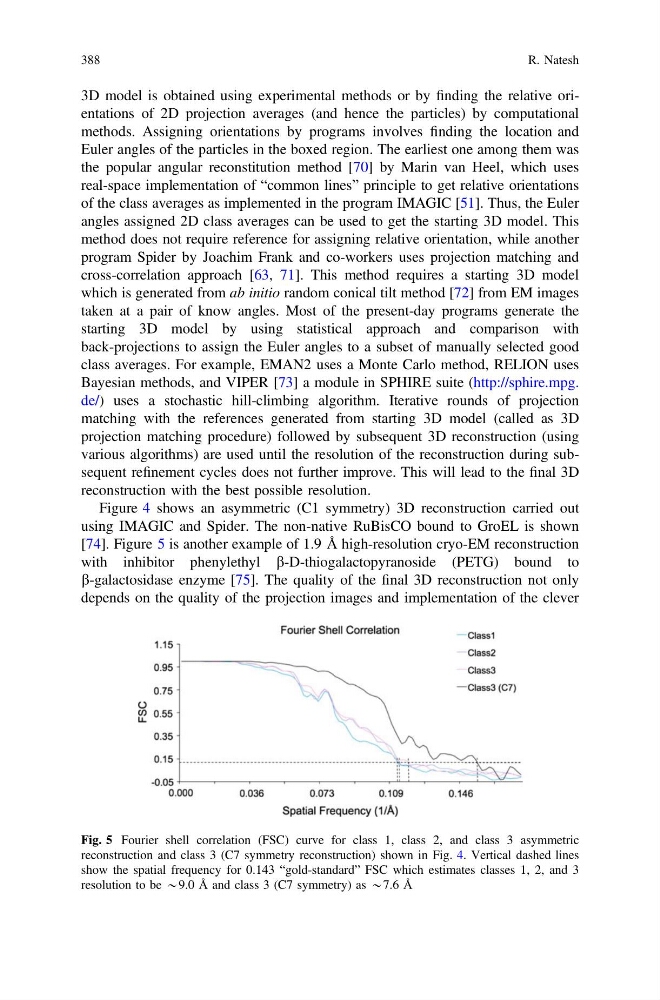
Fig. 5 Fourier shell correlation (FSC) curve for class 1, class 2, and class 3 asymmetric
reconstruction and class 3 (C7 symmetry reconstruction) shown in Fig. 4. Vertical dashed lines
show the spatial frequency for 0.143 “gold-standard” FSC which estimates classes 1, 2, and 3
resolution to be *9.0 Å and class 3 (C7 symmetry) as *7.6 Å
388
R. Natesh
methods. Assigning orientations by programs involves finding the location and
Euler angles of the particles in the boxed region. The earliest one among them was
the popular angular reconstitution method [70] by Marin van Heel, which uses
real-space implementation of “common lines” principle to get relative orientations
of the class averages as implemented in the program IMAGIC [51]. Thus, the Euler
angles assigned 2D class averages can be used to get the starting 3D model. This
method does not require reference for assigning relative orientation, while another
program Spider by Joachim Frank and co-workers uses projection matching and
cross-correlation approach [63, 71]. This method requires a starting 3D model
which is generated from ab initio random conical tilt method [72] from EM images
taken at a pair of know angles. Most of the present-day programs generate the
starting 3D model by using statistical approach and comparison with
back-projections to assign the Euler angles to a subset of manually selected good
class averages. For example, EMAN2 uses a Monte Carlo method, RELION uses
Bayesian methods, and VIPER [73] a module in SPHIRE suite (http://sphire.mpg.
de/) uses a stochastic hill-climbing algorithm. Iterative rounds of projection
matching with the references generated from starting 3D model (called as 3D
projection matching procedure) followed by subsequent 3D reconstruction (using
various algorithms) are used until the resolution of the reconstruction during subsequent refinement cycles does not further improve. This will lead to the final 3D
reconstruction with the best possible resolution.
Figure 4 shows an asymmetric (C1 symmetry) 3D reconstruction carried out
using IMAGIC and Spider. The non-native RuBisCO bound to GroEL is shown
[74]. Figure 5 is another example of 1.9 Å high-resolution cryo-EM reconstruction
with inhibitor phenylethyl b-D-thiogalactopyranoside (PETG) bound to
b-galactosidase enzyme [75]. The quality of the final 3D reconstruction not only
depends on the quality of the projection images and implementation of the clever
Fig. 5 Fourier shell correlation (FSC) curve for class 1, class 2, and class 3 asymmetric
reconstruction and class 3 (C7 symmetry reconstruction) shown in Fig. 4. Vertical dashed lines
show the spatial frequency for 0.143 “gold-standard” FSC which estimates classes 1, 2, and 3
resolution to be *9.0 Å and class 3 (C7 symmetry) as *7.6 Å
388
R. Natesh