

2.1 Specimen Preparation for Single-Particle Cryo-EM
The cryo-EM specimen preparation is the most challenging and a crucial step for
high-resolution data collection. Most of the time spent on single-particle cryo-EM
pipeline is in preparing the best protein specimen (which involves optimizing both
the biochemistry and vitrification of the sample) for high-resolution cryo-EM data
collection. Hence, it is worth to spend some time to get the best specimen out from
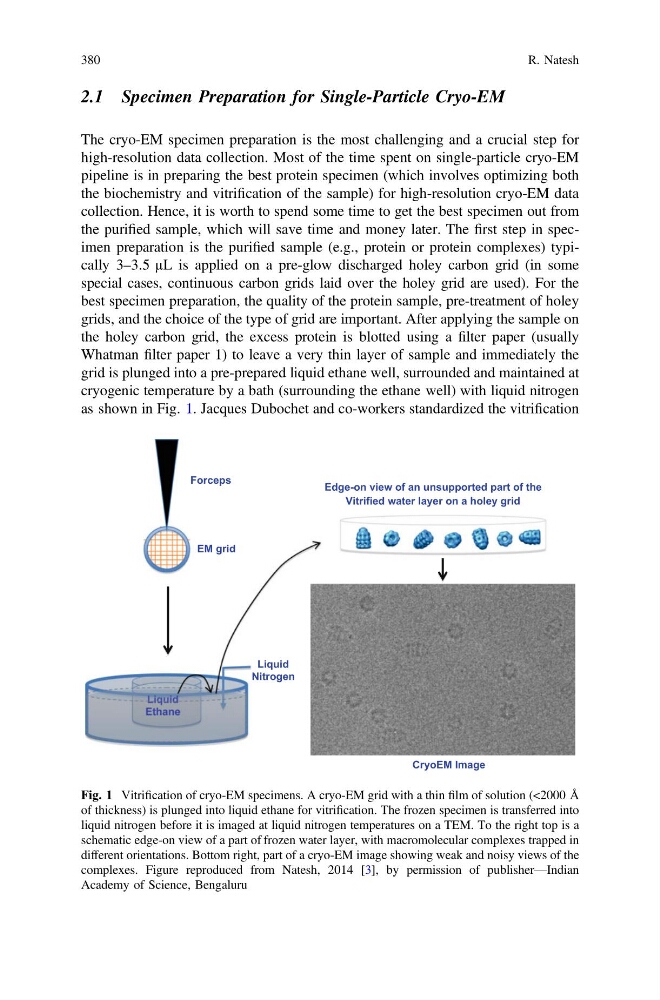
the purified sample, which will save time and money later. The first step in specimen preparation is the purified sample (e.g., protein or protein complexes) typically 3–3.5 µL is applied on a pre-glow discharged holey carbon grid (in some
special cases, continuous carbon grids laid over the holey grid are used). For the
best specimen preparation, the quality of the protein sample, pre-treatment of holey
grids, and the choice of the type of grid are important. After applying the sample on
the holey carbon grid, the excess protein is blotted using a filter paper (usually
Whatman filter paper 1) to leave a very thin layer of sample and immediately the
grid is plunged into a pre-prepared liquid ethane well, surrounded and maintained at
cryogenic temperature by a bath (surrounding the ethane well) with liquid nitrogen
as shown in Fig. 1. Jacques Dubochet and co-workers standardized the vitrification
Liquid
Nitrogen
Forceps
EM grid
Edge-on view of an unsupported part of the
Vitrified water layer on a holey grid
CryoEM Image
Fig. 1 Vitrification of cryo-EM specimens. A cryo-EM grid with a thin film of solution (<2000 Å
of thickness) is plunged into liquid ethane for vitrification. The frozen specimen is transferred into
liquid nitrogen before it is imaged at liquid nitrogen temperatures on a TEM. To the right top is a
schematic edge-on view of a part of frozen water layer, with macromolecular complexes trapped in
different orientations. Bottom right, part of a cryo-EM image showing weak and noisy views of the
complexes. Figure reproduced from Natesh, 2014 [3], by permission of publisher—Indian
Academy of Science, Bengaluru
380
R. Natesh
The cryo-EM specimen preparation is the most challenging and a crucial step for
high-resolution data collection. Most of the time spent on single-particle cryo-EM
pipeline is in preparing the best protein specimen (which involves optimizing both
the biochemistry and vitrification of the sample) for high-resolution cryo-EM data
collection. Hence, it is worth to spend some time to get the best specimen out from
the purified sample, which will save time and money later. The first step in specimen preparation is the purified sample (e.g., protein or protein complexes) typically 3–3.5 µL is applied on a pre-glow discharged holey carbon grid (in some
special cases, continuous carbon grids laid over the holey grid are used). For the
best specimen preparation, the quality of the protein sample, pre-treatment of holey
grids, and the choice of the type of grid are important. After applying the sample on
the holey carbon grid, the excess protein is blotted using a filter paper (usually
Whatman filter paper 1) to leave a very thin layer of sample and immediately the
grid is plunged into a pre-prepared liquid ethane well, surrounded and maintained at
cryogenic temperature by a bath (surrounding the ethane well) with liquid nitrogen
as shown in Fig. 1. Jacques Dubochet and co-workers standardized the vitrification
Liquid
Nitrogen
Forceps
EM grid
Edge-on view of an unsupported part of the
Vitrified water layer on a holey grid
CryoEM Image
Fig. 1 Vitrification of cryo-EM specimens. A cryo-EM grid with a thin film of solution (<2000 Å
of thickness) is plunged into liquid ethane for vitrification. The frozen specimen is transferred into
liquid nitrogen before it is imaged at liquid nitrogen temperatures on a TEM. To the right top is a
schematic edge-on view of a part of frozen water layer, with macromolecular complexes trapped in
different orientations. Bottom right, part of a cryo-EM image showing weak and noisy views of the
complexes. Figure reproduced from Natesh, 2014 [3], by permission of publisher—Indian
Academy of Science, Bengaluru
380
R. Natesh