

performance. This denotes a continuous need to have advanced analysis platform
and algorithms which can perform analysis of the biological data in a faster way.
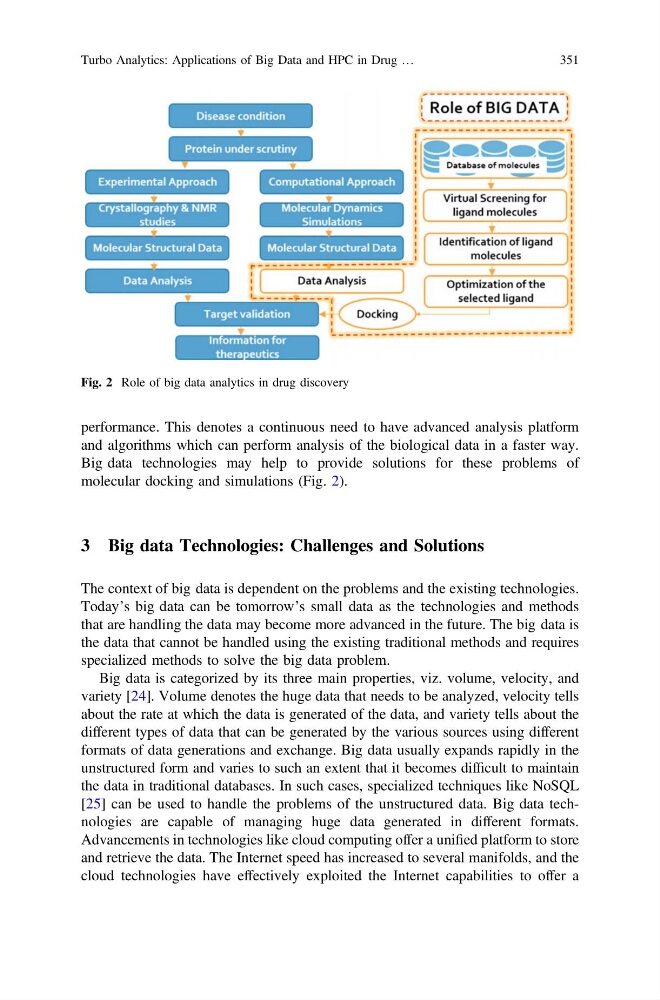
Big data technologies may help to provide solutions for these problems of
molecular docking and simulations (Fig. 2).
3 Big data Technologies: Challenges and Solutions
The context of big data is dependent on the problems and the existing technologies.
Today’s big data can be tomorrow’s small data as the technologies and methods
that are handling the data may become more advanced in the future. The big data is
the data that cannot be handled using the existing traditional methods and requires
specialized methods to solve the big data problem.
Big data is categorized by its three main properties, viz. volume, velocity, and
variety [24]. Volume denotes the huge data that needs to be analyzed, velocity tells
about the rate at which the data is generated of the data, and variety tells about the
different types of data that can be generated by the various sources using different
formats of data generations and exchange. Big data usually expands rapidly in the
unstructured form and varies to such an extent that it becomes difficult to maintain
the data in traditional databases. In such cases, specialized techniques like NoSQL
[25] can be used to handle the problems of the unstructured data. Big data technologies are capable of managing huge data generated in different formats.
Advancements in technologies like cloud computing offer a unified platform to store
and retrieve the data. The Internet speed has increased to several manifolds, and the
cloud technologies have effectively exploited the Internet capabilities to offer a
Fig. 2 Role of big data analytics in drug discovery
Turbo Analytics: Applications of Big Data and HPC in Drug …
351
and algorithms which can perform analysis of the biological data in a faster way.
Big data technologies may help to provide solutions for these problems of
molecular docking and simulations (Fig. 2).
3 Big data Technologies: Challenges and Solutions
The context of big data is dependent on the problems and the existing technologies.
Today’s big data can be tomorrow’s small data as the technologies and methods
that are handling the data may become more advanced in the future. The big data is
the data that cannot be handled using the existing traditional methods and requires
specialized methods to solve the big data problem.
Big data is categorized by its three main properties, viz. volume, velocity, and
variety [24]. Volume denotes the huge data that needs to be analyzed, velocity tells
about the rate at which the data is generated of the data, and variety tells about the
different types of data that can be generated by the various sources using different
formats of data generations and exchange. Big data usually expands rapidly in the
unstructured form and varies to such an extent that it becomes difficult to maintain
the data in traditional databases. In such cases, specialized techniques like NoSQL
[25] can be used to handle the problems of the unstructured data. Big data technologies are capable of managing huge data generated in different formats.
Advancements in technologies like cloud computing offer a unified platform to store
and retrieve the data. The Internet speed has increased to several manifolds, and the
cloud technologies have effectively exploited the Internet capabilities to offer a
Fig. 2 Role of big data analytics in drug discovery
Turbo Analytics: Applications of Big Data and HPC in Drug …
351