

the structure–activity relationship of numerous ligands toward single target.
Crystallography offers us glimpse into the stable and global minima structure and
the atomic details of catalytic domains. Thus, implementing a high-throughput
screening of bound ligands and analyzing their ability to bind crucial residues and
identification of different modes of binding for different fragment scaffolds of ligands are major outcomes that play crucial roles in SBDD. Identification of such
varied mechanisms in ligand binding, if exists, can throw light into aspects of
improving the ligand efficacy to accommodate key interactions. With speedy data
collection strategies and pipeline in structure solution and analysis, synchrotron
beamlines help in carrying out ligand-binding experiment in a high-throughput
manner. One such automation process is called DIMPLE [31]. High-throughput
workflow helps in employing the screening and analyzing in the crystallographic
readout for the presence of ligands and understanding their binding with the protein
domain. These structural screening methods have helped in identification of
fragment-based ligand scaffolds which are carried forward for further clinical
testing. Automation of these modules has been completed and can be executed
remotely without being at site of diffraction. For the identification of lead molecules, computational analysis is very much useful [32, 33]. Docking plays a major
role in this [34].
3 Docking
Molecular docking is a method of identification of binding mode of a small
molecule in the active site of the protein with more stability. In docking studies, the
score and energy associated with each binding pose are related to the activity. One
can refer a review article for molecular docking-related terminologies [35].
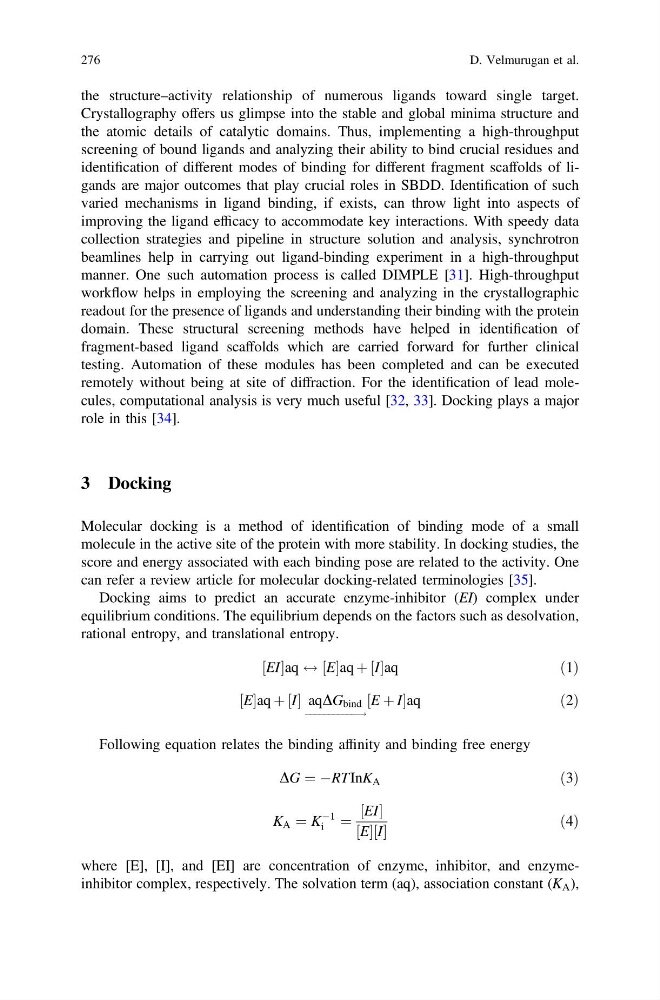
Docking aims to predict an accurate enzyme-inhibitor (EI) complex under
equilibrium conditions. The equilibrium depends on the factors such as desolvation,
rational entropy, and translational entropy.
EI
½ aq $ E
½ aq þ I
½ aq
ð1Þ
E
½ aq þ I
½ aqDG bind
À À À À À À À À À À À!
E þ I
½
aq
ð2Þ
Following equation relates the binding affinity and binding free energy
DG ¼ ÀRTInK A
ð3Þ
K A ¼ K
À1
i
¼
EI
½
E
½ I
½
ð4Þ
where [E], [I], and [EI] are concentration of enzyme, inhibitor, and enzymeinhibitor complex, respectively. The solvation term (aq), association constant (K A ),
276
D. Velmurugan et al.
Crystallography offers us glimpse into the stable and global minima structure and
the atomic details of catalytic domains. Thus, implementing a high-throughput
screening of bound ligands and analyzing their ability to bind crucial residues and
identification of different modes of binding for different fragment scaffolds of ligands are major outcomes that play crucial roles in SBDD. Identification of such
varied mechanisms in ligand binding, if exists, can throw light into aspects of
improving the ligand efficacy to accommodate key interactions. With speedy data
collection strategies and pipeline in structure solution and analysis, synchrotron
beamlines help in carrying out ligand-binding experiment in a high-throughput
manner. One such automation process is called DIMPLE [31]. High-throughput
workflow helps in employing the screening and analyzing in the crystallographic
readout for the presence of ligands and understanding their binding with the protein
domain. These structural screening methods have helped in identification of
fragment-based ligand scaffolds which are carried forward for further clinical
testing. Automation of these modules has been completed and can be executed
remotely without being at site of diffraction. For the identification of lead molecules, computational analysis is very much useful [32, 33]. Docking plays a major
role in this [34].
3 Docking
Molecular docking is a method of identification of binding mode of a small
molecule in the active site of the protein with more stability. In docking studies, the
score and energy associated with each binding pose are related to the activity. One
can refer a review article for molecular docking-related terminologies [35].
Docking aims to predict an accurate enzyme-inhibitor (EI) complex under
equilibrium conditions. The equilibrium depends on the factors such as desolvation,
rational entropy, and translational entropy.
EI
½ aq $ E
½ aq þ I
½ aq
ð1Þ
E
½ aq þ I
½ aqDG bind
À À À À À À À À À À À!
E þ I
½
aq
ð2Þ
Following equation relates the binding affinity and binding free energy
DG ¼ ÀRTInK A
ð3Þ
K A ¼ K
À1
i
¼
EI
½
E
½ I
½
ð4Þ
where [E], [I], and [EI] are concentration of enzyme, inhibitor, and enzymeinhibitor complex, respectively. The solvation term (aq), association constant (K A ),
276
D. Velmurugan et al.