

(continued)
Questions?
Why ask?
Do the compounds pass through the filters
for promiscuity and common sources of
assay artifacts?
Certain chemical moieties can interact
non-specifically with proteins in multiple
assays. It is crucial to weed out such
artifacts in order to avoid expenses on bad
lead molecules
What is the library size?
The library should fit as per the needs of
the project and should not be populated
unnecessarily. It is better to keep fewer
but useful compounds in the library.
However, larger libraries offer chemical
diversity for HTS
What is the clustering density of
compounds?
Clustering density can reveal interesting
patterns among the target specific
compounds synthesized over many
decades. The underexplored clusters can
be scaled up to synthesize the derivatives
The progress made so far in terms of epi-drugs is only the beginning of a revolution.
Implementing computational strategies in the selection and screening of chemical
libraries at an early stage of epigenetic drug discovery is vital for identifying promising
lead molecules. Furthermore, epigenetic specific databases such as EpiDBase, NCBI
Epigenomics, ChEMBL, and HEMD are powerful tools. For example, EpiDBase can
facilitate interactive exploring of epigenetic proteins, their curated ligands, SAR
studies, statistical analysis, and fragment-based drug design. The database can be
employed to study epigenetic ligands for their experimental IC 50 values, structural
data, toxicological, and chemoinformatic information. We have attempted to provide
an overview of the myriad of considerations to all researchers engaged in epigenetic
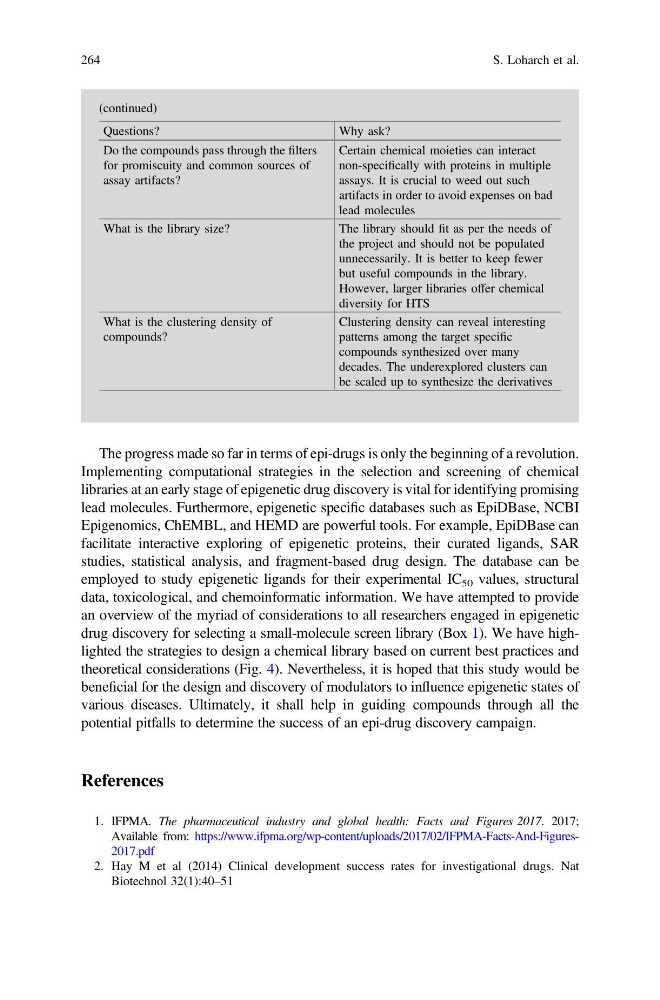
drug discovery for selecting a small-molecule screen library (Box 1). We have highlighted the strategies to design a chemical library based on current best practices and
theoretical considerations (Fig. 4). Nevertheless, it is hoped that this study would be
beneficial for the design and discovery of modulators to influence epigenetic states of
various diseases. Ultimately, it shall help in guiding compounds through all the
potential pitfalls to determine the success of an epi-drug discovery campaign.
References
1. IFPMA. The pharmaceutical industry and global health: Facts and Figures 2017. 2017;
Available from: https://www.ifpma.org/wp-content/uploads/2017/02/IFPMA-Facts-And-Figures2017.pdf
2. Hay M et al (2014) Clinical development success rates for investigational drugs. Nat
Biotechnol 32(1):40–51
264
S. Loharch et al.
Questions?
Why ask?
Do the compounds pass through the filters
for promiscuity and common sources of
assay artifacts?
Certain chemical moieties can interact
non-specifically with proteins in multiple
assays. It is crucial to weed out such
artifacts in order to avoid expenses on bad
lead molecules
What is the library size?
The library should fit as per the needs of
the project and should not be populated
unnecessarily. It is better to keep fewer
but useful compounds in the library.
However, larger libraries offer chemical
diversity for HTS
What is the clustering density of
compounds?
Clustering density can reveal interesting
patterns among the target specific
compounds synthesized over many
decades. The underexplored clusters can
be scaled up to synthesize the derivatives
The progress made so far in terms of epi-drugs is only the beginning of a revolution.
Implementing computational strategies in the selection and screening of chemical
libraries at an early stage of epigenetic drug discovery is vital for identifying promising
lead molecules. Furthermore, epigenetic specific databases such as EpiDBase, NCBI
Epigenomics, ChEMBL, and HEMD are powerful tools. For example, EpiDBase can
facilitate interactive exploring of epigenetic proteins, their curated ligands, SAR
studies, statistical analysis, and fragment-based drug design. The database can be
employed to study epigenetic ligands for their experimental IC 50 values, structural
data, toxicological, and chemoinformatic information. We have attempted to provide
an overview of the myriad of considerations to all researchers engaged in epigenetic
drug discovery for selecting a small-molecule screen library (Box 1). We have highlighted the strategies to design a chemical library based on current best practices and
theoretical considerations (Fig. 4). Nevertheless, it is hoped that this study would be
beneficial for the design and discovery of modulators to influence epigenetic states of
various diseases. Ultimately, it shall help in guiding compounds through all the
potential pitfalls to determine the success of an epi-drug discovery campaign.
References
1. IFPMA. The pharmaceutical industry and global health: Facts and Figures 2017. 2017;
Available from: https://www.ifpma.org/wp-content/uploads/2017/02/IFPMA-Facts-And-Figures2017.pdf
2. Hay M et al (2014) Clinical development success rates for investigational drugs. Nat
Biotechnol 32(1):40–51
264
S. Loharch et al.