

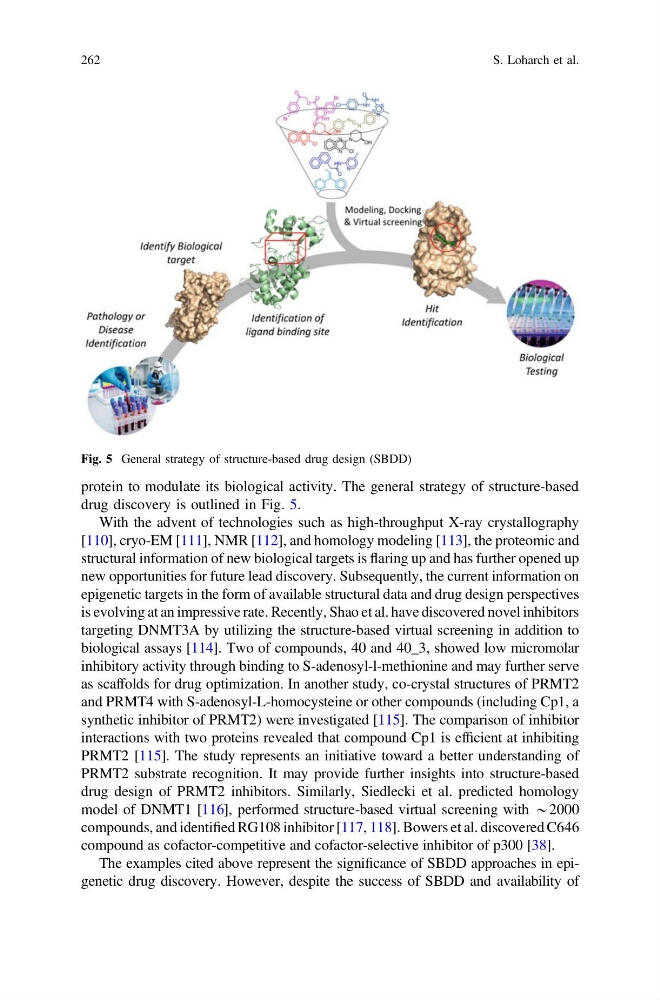
protein to modulate its biological activity. The general strategy of structure-based
drug discovery is outlined in Fig. 5.
With the advent of technologies such as high-throughput X-ray crystallography
[110], cryo-EM [111], NMR [112], and homology modeling [113], the proteomic and
structural information of new biological targets is flaring up and has further opened up
new opportunities for future lead discovery. Subsequently, the current information on
epigenetic targets in the form of available structural data and drug design perspectives
is evolving at an impressive rate. Recently, Shao et al. have discovered novel inhibitors
targeting DNMT3A by utilizing the structure-based virtual screening in addition to
biological assays [114]. Two of compounds, 40 and 40_3, showed low micromolar
inhibitory activity through binding to S-adenosyl-l-methionine and may further serve
as scaffolds for drug optimization. In another study, co-crystal structures of PRMT2
and PRMT4 with S-adenosyl-L-homocysteine or other compounds (including Cp1, a
synthetic inhibitor of PRMT2) were investigated [115]. The comparison of inhibitor
interactions with two proteins revealed that compound Cp1 is efficient at inhibiting
PRMT2 [115]. The study represents an initiative toward a better understanding of
PRMT2 substrate recognition. It may provide further insights into structure-based
drug design of PRMT2 inhibitors. Similarly, Siedlecki et al. predicted homology
model of DNMT1 [116], performed structure-based virtual screening with *2000
compounds, and identified RG108 inhibitor [117, 118]. Bowers et al. discovered C646
compound as cofactor-competitive and cofactor-selective inhibitor of p300 [38].
The examples cited above represent the significance of SBDD approaches in epigenetic drug discovery. However, despite the success of SBDD and availability of
Fig. 5 General strategy of structure-based drug design (SBDD)
262
S. Loharch et al.
drug discovery is outlined in Fig. 5.
With the advent of technologies such as high-throughput X-ray crystallography
[110], cryo-EM [111], NMR [112], and homology modeling [113], the proteomic and
structural information of new biological targets is flaring up and has further opened up
new opportunities for future lead discovery. Subsequently, the current information on
epigenetic targets in the form of available structural data and drug design perspectives
is evolving at an impressive rate. Recently, Shao et al. have discovered novel inhibitors
targeting DNMT3A by utilizing the structure-based virtual screening in addition to
biological assays [114]. Two of compounds, 40 and 40_3, showed low micromolar
inhibitory activity through binding to S-adenosyl-l-methionine and may further serve
as scaffolds for drug optimization. In another study, co-crystal structures of PRMT2
and PRMT4 with S-adenosyl-L-homocysteine or other compounds (including Cp1, a
synthetic inhibitor of PRMT2) were investigated [115]. The comparison of inhibitor
interactions with two proteins revealed that compound Cp1 is efficient at inhibiting
PRMT2 [115]. The study represents an initiative toward a better understanding of
PRMT2 substrate recognition. It may provide further insights into structure-based
drug design of PRMT2 inhibitors. Similarly, Siedlecki et al. predicted homology
model of DNMT1 [116], performed structure-based virtual screening with *2000
compounds, and identified RG108 inhibitor [117, 118]. Bowers et al. discovered C646
compound as cofactor-competitive and cofactor-selective inhibitor of p300 [38].
The examples cited above represent the significance of SBDD approaches in epigenetic drug discovery. However, despite the success of SBDD and availability of
Fig. 5 General strategy of structure-based drug design (SBDD)
262
S. Loharch et al.