

activity and different ADMET properties simultaneously to identify small molecules
with desired pharmacodynamic and pharmacokinetic properties at the same time.
Machine learning methods are also being used in ligand-based drug design projects .
The main goal of ligand-based drug design activities is to predict how a chemical
structure can be modified to achieve desired biological activity and/or ADMET
properties. The aim of QSAR, one of the major methodologies in ligand-based drug
design, is to generate a predictive regression model that gives a relationship between
biological activity (or any other property) and a set of molecular descriptors. Such an
exercise is inherently very suitable for traditional machine learning algorithms, and
hence it has been adopted very early [69]. Supervised learning algorithms such as
neural networks, random forest, SVMs and k-nearest neighbour have been used in
QSAR [55, 60, 61]. Similarly, application of unsupervised methods such as clustering methods, principal component analysis and independent component analysis
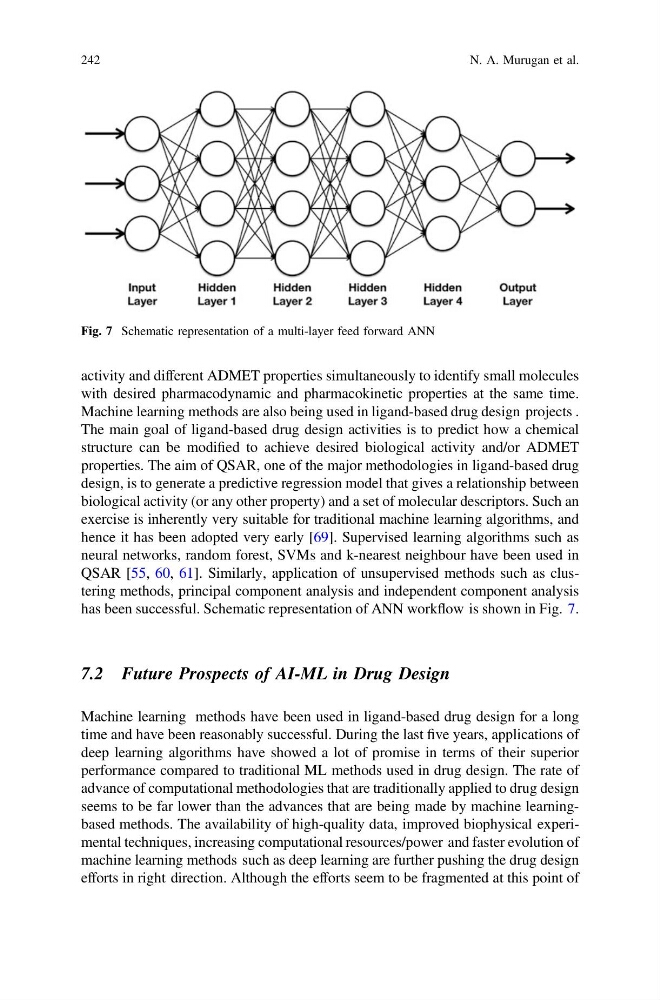
has been successful. Schematic representation of ANN workflow is shown in Fig. 7.
7.2 Future Prospects of AI-ML in Drug Design
Machine learning methods have been used in ligand-based drug design for a long
time and have been reasonably successful. During the last five years, applications of
deep learning algorithms have showed a lot of promise in terms of their superior
performance compared to traditional ML methods used in drug design. The rate of
advance of computational methodologies that are traditionally applied to drug design
seems to be far lower than the advances that are being made by machine learningbased methods. The availability of high-quality data, improved biophysical experimental techniques, increasing computational resources/power and faster evolution of
machine learning methods such as deep learning are further pushing the drug design
efforts in right direction. Although the efforts seem to be fragmented at this point of
Fig. 7 Schematic representation of a multi-layer feed forward ANN
242
N. A. Murugan et al.
with desired pharmacodynamic and pharmacokinetic properties at the same time.
Machine learning methods are also being used in ligand-based drug design projects .
The main goal of ligand-based drug design activities is to predict how a chemical
structure can be modified to achieve desired biological activity and/or ADMET
properties. The aim of QSAR, one of the major methodologies in ligand-based drug
design, is to generate a predictive regression model that gives a relationship between
biological activity (or any other property) and a set of molecular descriptors. Such an
exercise is inherently very suitable for traditional machine learning algorithms, and
hence it has been adopted very early [69]. Supervised learning algorithms such as
neural networks, random forest, SVMs and k-nearest neighbour have been used in
QSAR [55, 60, 61]. Similarly, application of unsupervised methods such as clustering methods, principal component analysis and independent component analysis
has been successful. Schematic representation of ANN workflow is shown in Fig. 7.
7.2 Future Prospects of AI-ML in Drug Design
Machine learning methods have been used in ligand-based drug design for a long
time and have been reasonably successful. During the last five years, applications of
deep learning algorithms have showed a lot of promise in terms of their superior
performance compared to traditional ML methods used in drug design. The rate of
advance of computational methodologies that are traditionally applied to drug design
seems to be far lower than the advances that are being made by machine learningbased methods. The availability of high-quality data, improved biophysical experimental techniques, increasing computational resources/power and faster evolution of
machine learning methods such as deep learning are further pushing the drug design
efforts in right direction. Although the efforts seem to be fragmented at this point of
Fig. 7 Schematic representation of a multi-layer feed forward ANN
242
N. A. Murugan et al.