

4.3 Limitations of Force-Field Methods and Need
for an Alternative Approach
In many occasions, force-field-based approaches were successful in explaining the
ligand binding to receptors, in predicting the relative binding affinities of structurally
similar ligands and in predicting the binding affinities towards various mutants of
same receptors. However, many failures of these methods go unnoticed as these are
not reported in general. We have noticed that the MM-GBSA and MM-PBSA
methods cannot explain the relative binding affinities of indole-Substituted benzothiazoles and benzoxazoles compounds towards monoamine oxidase B and their
binding specificity towards MOA-B when compared to MOA-A [32]. We have also
reported that in the case of thiabendazole-based compounds the correlation between
the experimental and computed binding affinities towards amyloid beta fibril using
molecular docking and MM-GBSA approach when compared to quantum
mechanics-based cluster model was not impressive [33].
The main reason behind is that force-field methods cannot account for the
changes in the electronic structure of ligands when they are bound to the target.
Usually, the charges for ligands are the same for the ligand in water as well as in the
binding site of target. This is not true, the electronic structure and molecular dipole
moment of the ligand can vary significantly depending upon the microenvironment
[34, 35], and such polarization due to environment should be accounted for in the
free energy calculations. Such a requirement automatically leads to the need for the
description of the ligand using a quantum mechanical theory where the electronic
degrees of freedom are treated explicitly and so the environment-specific changes in
electronic structure and molecular structure can be accounted accurately [36, 37].
However, electronic structure theory is not suitable to describe protein–ligand
complex systems as the number of electronic degrees of freedom is too many. So,
many approximations are employed to treat the interactions between the protein–
ligands in a quantum mechanical way.
5 Ab Initio Methods in Free Energy Calculations
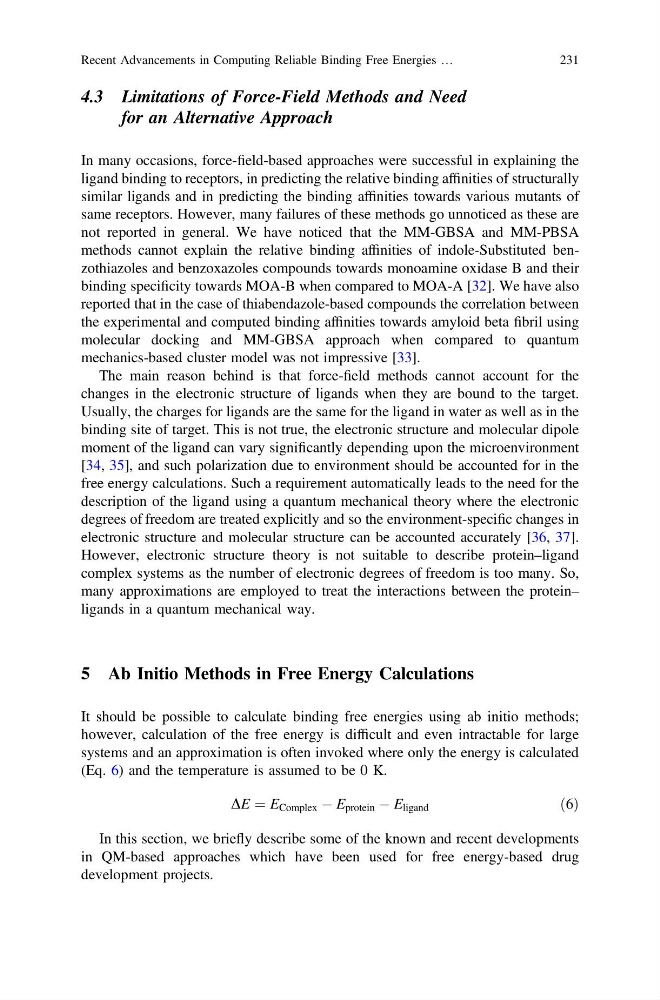
It should be possible to calculate binding free energies using ab initio methods;
however, calculation of the free energy is difficult and even intractable for large
systems and an approximation is often invoked where only the energy is calculated
(Eq. 6) and the temperature is assumed to be 0 K.
DE ¼ E Complex À E protein À E ligand
ð6Þ
In this section, we briefly describe some of the known and recent developments
in QM-based approaches which have been used for free energy-based drug
development projects.
Recent Advancements in Computing Reliable Binding Free Energies …
231
for an Alternative Approach
In many occasions, force-field-based approaches were successful in explaining the
ligand binding to receptors, in predicting the relative binding affinities of structurally
similar ligands and in predicting the binding affinities towards various mutants of
same receptors. However, many failures of these methods go unnoticed as these are
not reported in general. We have noticed that the MM-GBSA and MM-PBSA
methods cannot explain the relative binding affinities of indole-Substituted benzothiazoles and benzoxazoles compounds towards monoamine oxidase B and their
binding specificity towards MOA-B when compared to MOA-A [32]. We have also
reported that in the case of thiabendazole-based compounds the correlation between
the experimental and computed binding affinities towards amyloid beta fibril using
molecular docking and MM-GBSA approach when compared to quantum
mechanics-based cluster model was not impressive [33].
The main reason behind is that force-field methods cannot account for the
changes in the electronic structure of ligands when they are bound to the target.
Usually, the charges for ligands are the same for the ligand in water as well as in the
binding site of target. This is not true, the electronic structure and molecular dipole
moment of the ligand can vary significantly depending upon the microenvironment
[34, 35], and such polarization due to environment should be accounted for in the
free energy calculations. Such a requirement automatically leads to the need for the
description of the ligand using a quantum mechanical theory where the electronic
degrees of freedom are treated explicitly and so the environment-specific changes in
electronic structure and molecular structure can be accounted accurately [36, 37].
However, electronic structure theory is not suitable to describe protein–ligand
complex systems as the number of electronic degrees of freedom is too many. So,
many approximations are employed to treat the interactions between the protein–
ligands in a quantum mechanical way.
5 Ab Initio Methods in Free Energy Calculations
It should be possible to calculate binding free energies using ab initio methods;
however, calculation of the free energy is difficult and even intractable for large
systems and an approximation is often invoked where only the energy is calculated
(Eq. 6) and the temperature is assumed to be 0 K.
DE ¼ E Complex À E protein À E ligand
ð6Þ
In this section, we briefly describe some of the known and recent developments
in QM-based approaches which have been used for free energy-based drug
development projects.
Recent Advancements in Computing Reliable Binding Free Energies …
231