

interactions. This was followed by generation of CoMFA and CoMSIA models
(using genetic algorithm for optimization). The final two models were selected from
each CoMFA and CoMSIA studies, which showed good predictive r
2 value
(r pred
2
0.99 and 0.94, respectively) after test set (eight molecules) run. The
cross-validation coefficient was found to be q LOO
2
(leave-one-out) 0.841 for CoMFA
(0.757 for CoMSIA) and q
2 (cross-validated) to be 0.818 for CoMFA (0.653 for
CoMSIA). The total field contribution was determined to be 21.5% electrostatic
field and 78.5% steric field (for CoMFA). It was observed that for N-2-naphthylsubstituted triazolopyrimidine derivative, favorable steric contours surrounded the
naphthyl ring indicating good activity of the compounds with large steric bulk at
this position. The compounds with good activity observed negative electrostatic
contour at meta and para positions of the phenyl substituents indicating
electron-rich substituents at these positions enhanced the activity. These results
were also in correlation to Ojha et al. [89]. Molecular dynamics was also performed
for most active compounds (Fig. 14a; DSM125 (R = CH 3 , R 1 /R 2 /R 4 = H,
R 3 = 3-F-4-CF 3 -Ph); DSM1 (R = CH 3 , R 1 /R 2 /R 4 = H, R 3 = naphthyl)) using
GROMACS suite of programs with 2 ns of production run time. It was observed
that the hydrophobic residues (Lue197, Ile237, Leu240, Leu531, and Met536
showed greater fluctuation in case of DSM125 compared to DSM1. The m-fluoro
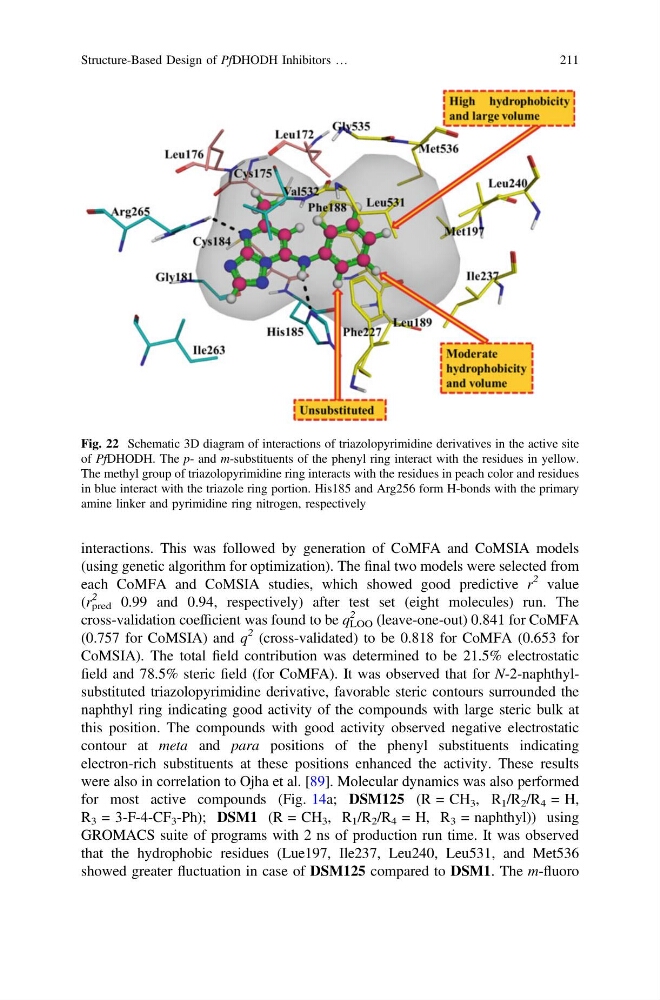
Fig. 22 Schematic 3D diagram of interactions of triazolopyrimidine derivatives in the active site
of PfDHODH. The p- and m-substituents of the phenyl ring interact with the residues in yellow.
The methyl group of triazolopyrimidine ring interacts with the residues in peach color and residues
in blue interact with the triazole ring portion. His185 and Arg256 form H-bonds with the primary
amine linker and pyrimidine ring nitrogen, respectively
Structure-Based Design of PfDHODH Inhibitors …
211
(using genetic algorithm for optimization). The final two models were selected from
each CoMFA and CoMSIA studies, which showed good predictive r
2 value
(r pred
2
0.99 and 0.94, respectively) after test set (eight molecules) run. The
cross-validation coefficient was found to be q LOO
2
(leave-one-out) 0.841 for CoMFA
(0.757 for CoMSIA) and q
2 (cross-validated) to be 0.818 for CoMFA (0.653 for
CoMSIA). The total field contribution was determined to be 21.5% electrostatic
field and 78.5% steric field (for CoMFA). It was observed that for N-2-naphthylsubstituted triazolopyrimidine derivative, favorable steric contours surrounded the
naphthyl ring indicating good activity of the compounds with large steric bulk at
this position. The compounds with good activity observed negative electrostatic
contour at meta and para positions of the phenyl substituents indicating
electron-rich substituents at these positions enhanced the activity. These results
were also in correlation to Ojha et al. [89]. Molecular dynamics was also performed
for most active compounds (Fig. 14a; DSM125 (R = CH 3 , R 1 /R 2 /R 4 = H,
R 3 = 3-F-4-CF 3 -Ph); DSM1 (R = CH 3 , R 1 /R 2 /R 4 = H, R 3 = naphthyl)) using
GROMACS suite of programs with 2 ns of production run time. It was observed
that the hydrophobic residues (Lue197, Ile237, Leu240, Leu531, and Met536
showed greater fluctuation in case of DSM125 compared to DSM1. The m-fluoro
Fig. 22 Schematic 3D diagram of interactions of triazolopyrimidine derivatives in the active site
of PfDHODH. The p- and m-substituents of the phenyl ring interact with the residues in yellow.
The methyl group of triazolopyrimidine ring interacts with the residues in peach color and residues
in blue interact with the triazole ring portion. His185 and Arg256 form H-bonds with the primary
amine linker and pyrimidine ring nitrogen, respectively
Structure-Based Design of PfDHODH Inhibitors …
211