

binding pocket of receptor in solvent to get free energy change (say A p ). Finally,
subtracting A p from A s gives the free energy change of the binding [255]. As early
as 1985, to test the concept, it was successfully applied to calculate relative solvation free energy of Cl
À and Br
À , and computed Helmholtz free energy
DDA (3.35 ± 0.15 kcal/mol) was shown to be in excellent agreement DDA hydr %
DDG hydr ¼ 3:3 kcal=mol with experimental value [256]. Further, the applicability
of the method was extended to non-trivial systems, e.g., amino acids and their side
chains, nucleic acid bases, and other small organic molecules; computed solvation
free energies of these molecules are found to be in agreement with experiment [257,
258].
Relative free energy or potential of mean force (pmf, w r c
ð Þ)-based methods
relate it to the distribution of a chosen reaction coordinate r c
ð Þ, the direct sampling
along r c , and constructing its distribution function g r c
ð Þ. The distribution function
of reaction coordinate g r c
ð Þ can be related to pmf w r c
ð Þ
ð
Þ as
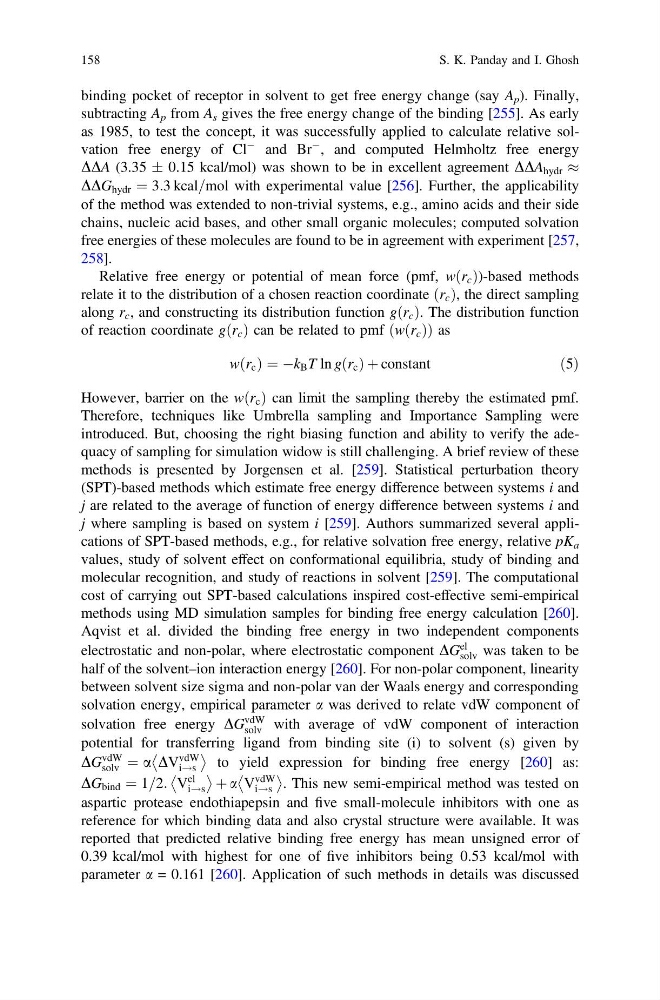
w r c
ð Þ ¼ Àk B T ln g r c
ð Þþconstant
ð5Þ
However, barrier on the w r c
ð Þ can limit the sampling thereby the estimated pmf.
Therefore, techniques like Umbrella sampling and Importance Sampling were
introduced. But, choosing the right biasing function and ability to verify the adequacy of sampling for simulation widow is still challenging. A brief review of these
methods is presented by Jorgensen et al. [259]. Statistical perturbation theory
(SPT)-based methods which estimate free energy difference between systems i and
j are related to the average of function of energy difference between systems i and
j where sampling is based on system i [259]. Authors summarized several applications of SPT-based methods, e.g., for relative solvation free energy, relative pK a
values, study of solvent effect on conformational equilibria, study of binding and
molecular recognition, and study of reactions in solvent [259]. The computational
cost of carrying out SPT-based calculations inspired cost-effective semi-empirical
methods using MD simulation samples for binding free energy calculation [260].
Aqvist et al. divided the binding free energy in two independent components
electrostatic and non-polar, where electrostatic component DG
el
solv was taken to be
half of the solvent–ion interaction energy [260]. For non-polar component, linearity
between solvent size sigma and non-polar van der Waals energy and corresponding
solvation energy, empirical parameter a was derived to relate vdW component of
solvation free energy DG
vdW
solv with average of vdW component of interaction
potential for transferring ligand from binding site (i) to solvent (s) given by
DG
vdW
solv ¼ a DV
vdW
i!s
to yield expression for binding free energy [260] as:
DG bind ¼ 1=2: V
el
i!s
þ a V
vdW
i!s
. This new semi-empirical method was tested on
aspartic protease endothiapepsin and five small-molecule inhibitors with one as
reference for which binding data and also crystal structure were available. It was
reported that predicted relative binding free energy has mean unsigned error of
0.39 kcal/mol with highest for one of five inhibitors being 0.53 kcal/mol with
parameter a = 0.161 [260]. Application of such methods in details was discussed
158
S. K. Panday and I. Ghosh
subtracting A p from A s gives the free energy change of the binding [255]. As early
as 1985, to test the concept, it was successfully applied to calculate relative solvation free energy of Cl
À and Br
À , and computed Helmholtz free energy
DDA (3.35 ± 0.15 kcal/mol) was shown to be in excellent agreement DDA hydr %
DDG hydr ¼ 3:3 kcal=mol with experimental value [256]. Further, the applicability
of the method was extended to non-trivial systems, e.g., amino acids and their side
chains, nucleic acid bases, and other small organic molecules; computed solvation
free energies of these molecules are found to be in agreement with experiment [257,
258].
Relative free energy or potential of mean force (pmf, w r c
ð Þ)-based methods
relate it to the distribution of a chosen reaction coordinate r c
ð Þ, the direct sampling
along r c , and constructing its distribution function g r c
ð Þ. The distribution function
of reaction coordinate g r c
ð Þ can be related to pmf w r c
ð Þ
ð
Þ as
w r c
ð Þ ¼ Àk B T ln g r c
ð Þþconstant
ð5Þ
However, barrier on the w r c
ð Þ can limit the sampling thereby the estimated pmf.
Therefore, techniques like Umbrella sampling and Importance Sampling were
introduced. But, choosing the right biasing function and ability to verify the adequacy of sampling for simulation widow is still challenging. A brief review of these
methods is presented by Jorgensen et al. [259]. Statistical perturbation theory
(SPT)-based methods which estimate free energy difference between systems i and
j are related to the average of function of energy difference between systems i and
j where sampling is based on system i [259]. Authors summarized several applications of SPT-based methods, e.g., for relative solvation free energy, relative pK a
values, study of solvent effect on conformational equilibria, study of binding and
molecular recognition, and study of reactions in solvent [259]. The computational
cost of carrying out SPT-based calculations inspired cost-effective semi-empirical
methods using MD simulation samples for binding free energy calculation [260].
Aqvist et al. divided the binding free energy in two independent components
electrostatic and non-polar, where electrostatic component DG
el
solv was taken to be
half of the solvent–ion interaction energy [260]. For non-polar component, linearity
between solvent size sigma and non-polar van der Waals energy and corresponding
solvation energy, empirical parameter a was derived to relate vdW component of
solvation free energy DG
vdW
solv with average of vdW component of interaction
potential for transferring ligand from binding site (i) to solvent (s) given by
DG
vdW
solv ¼ a DV
vdW
i!s
to yield expression for binding free energy [260] as:
DG bind ¼ 1=2: V
el
i!s
þ a V
vdW
i!s
. This new semi-empirical method was tested on
aspartic protease endothiapepsin and five small-molecule inhibitors with one as
reference for which binding data and also crystal structure were available. It was
reported that predicted relative binding free energy has mean unsigned error of
0.39 kcal/mol with highest for one of five inhibitors being 0.53 kcal/mol with
parameter a = 0.161 [260]. Application of such methods in details was discussed
158
S. K. Panday and I. Ghosh