

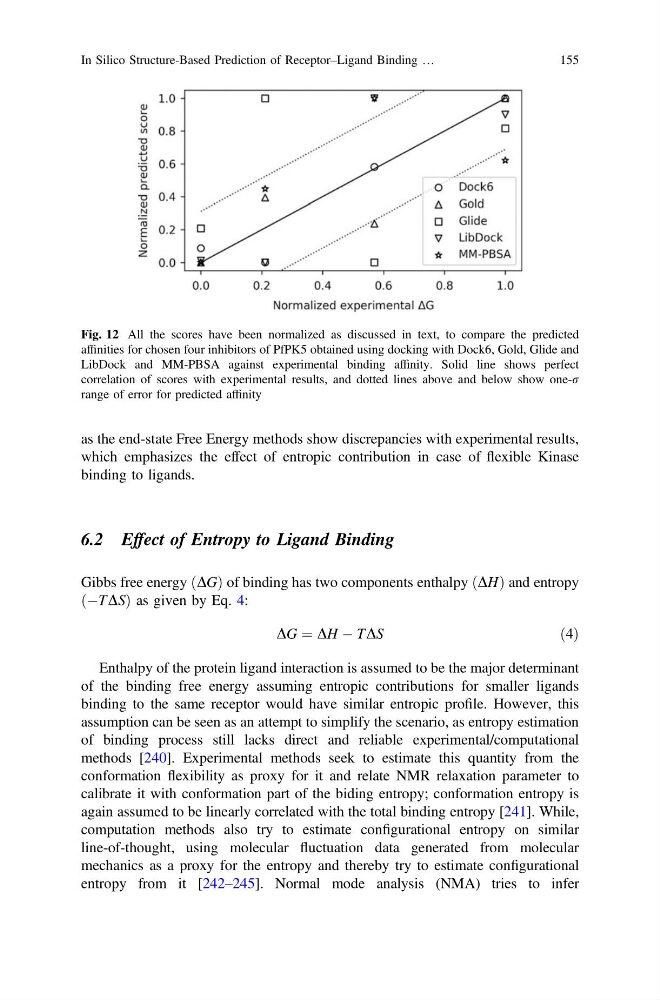
as the end-state Free Energy methods show discrepancies with experimental results,
which emphasizes the effect of entropic contribution in case of flexible Kinase
binding to ligands.
6.2 Effect of Entropy to Ligand Binding
Gibbs free energy ðDGÞ of binding has two components enthalpy ðDHÞ and entropy
ðÀTDSÞ as given by Eq. 4:
DG ¼ DH À TDS
ð4Þ
Enthalpy of the protein ligand interaction is assumed to be the major determinant
of the binding free energy assuming entropic contributions for smaller ligands
binding to the same receptor would have similar entropic profile. However, this
assumption can be seen as an attempt to simplify the scenario, as entropy estimation
of binding process still lacks direct and reliable experimental/computational
methods [240]. Experimental methods seek to estimate this quantity from the
conformation flexibility as proxy for it and relate NMR relaxation parameter to
calibrate it with conformation part of the biding entropy; conformation entropy is
again assumed to be linearly correlated with the total binding entropy [241]. While,
computation methods also try to estimate configurational entropy on similar
line-of-thought, using molecular fluctuation data generated from molecular
mechanics as a proxy for the entropy and thereby try to estimate configurational
entropy from it [242–245]. Normal mode analysis (NMA) tries to infer
Fig. 12 All the scores have been normalized as discussed in text, to compare the predicted
affinities for chosen four inhibitors of PfPK5 obtained using docking with Dock6, Gold, Glide and
LibDock and MM-PBSA against experimental binding affinity. Solid line shows perfect
correlation of scores with experimental results, and dotted lines above and below show one-r
range of error for predicted affinity
In Silico Structure-Based Prediction of Receptor–Ligand Binding …
155
which emphasizes the effect of entropic contribution in case of flexible Kinase
binding to ligands.
6.2 Effect of Entropy to Ligand Binding
Gibbs free energy ðDGÞ of binding has two components enthalpy ðDHÞ and entropy
ðÀTDSÞ as given by Eq. 4:
DG ¼ DH À TDS
ð4Þ
Enthalpy of the protein ligand interaction is assumed to be the major determinant
of the binding free energy assuming entropic contributions for smaller ligands
binding to the same receptor would have similar entropic profile. However, this
assumption can be seen as an attempt to simplify the scenario, as entropy estimation
of binding process still lacks direct and reliable experimental/computational
methods [240]. Experimental methods seek to estimate this quantity from the
conformation flexibility as proxy for it and relate NMR relaxation parameter to
calibrate it with conformation part of the biding entropy; conformation entropy is
again assumed to be linearly correlated with the total binding entropy [241]. While,
computation methods also try to estimate configurational entropy on similar
line-of-thought, using molecular fluctuation data generated from molecular
mechanics as a proxy for the entropy and thereby try to estimate configurational
entropy from it [242–245]. Normal mode analysis (NMA) tries to infer
Fig. 12 All the scores have been normalized as discussed in text, to compare the predicted
affinities for chosen four inhibitors of PfPK5 obtained using docking with Dock6, Gold, Glide and
LibDock and MM-PBSA against experimental binding affinity. Solid line shows perfect
correlation of scores with experimental results, and dotted lines above and below show one-r
range of error for predicted affinity
In Silico Structure-Based Prediction of Receptor–Ligand Binding …
155