

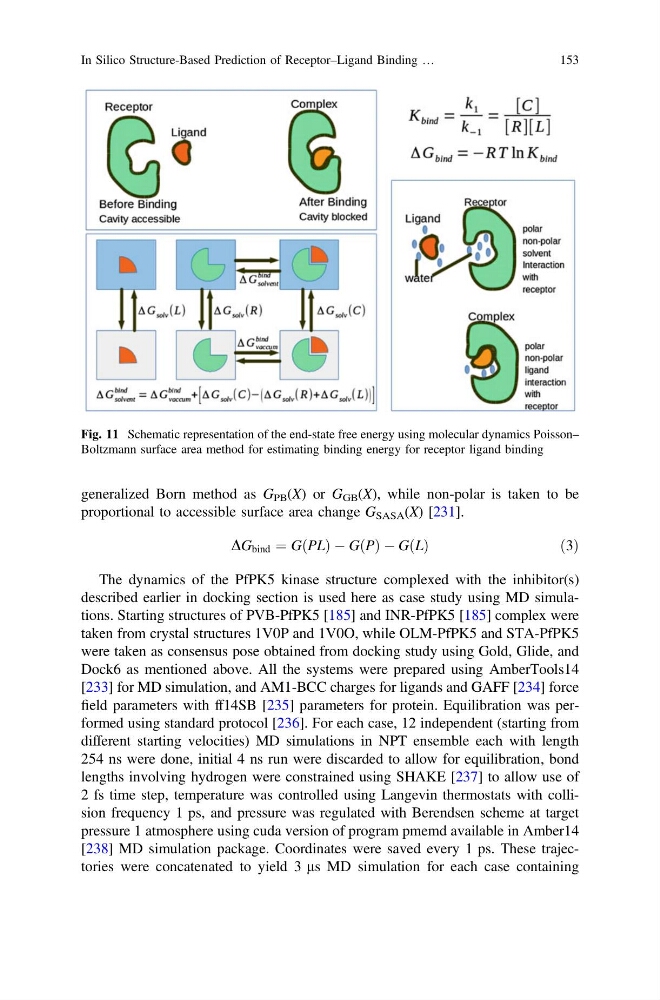
generalized Born method as G PB (X) or G GB (X), while non-polar is taken to be
proportional to accessible surface area change G SASA (X) [231].
DG bind ¼ GðPLÞ À GðPÞ À GðLÞ
ð 3Þ
The dynamics of the PfPK5 kinase structure complexed with the inhibitor(s)
described earlier in docking section is used here as case study using MD simulations. Starting structures of PVB-PfPK5 [185] and INR-PfPK5 [185] complex were
taken from crystal structures 1V0P and 1V0O, while OLM-PfPK5 and STA-PfPK5
were taken as consensus pose obtained from docking study using Gold, Glide, and
Dock6 as mentioned above. All the systems were prepared using AmberTools14
[233] for MD simulation, and AM1-BCC charges for ligands and GAFF [234] force
field parameters with ff14SB [235] parameters for protein. Equilibration was performed using standard protocol [236]. For each case, 12 independent (starting from
different starting velocities) MD simulations in NPT ensemble each with length
254 ns were done, initial 4 ns run were discarded to allow for equilibration, bond
lengths involving hydrogen were constrained using SHAKE [237] to allow use of
2 fs time step, temperature was controlled using Langevin thermostats with collision frequency 1 ps, and pressure was regulated with Berendsen scheme at target
pressure 1 atmosphere using cuda version of program pmemd available in Amber14
[238] MD simulation package. Coordinates were saved every 1 ps. These trajectories were concatenated to yield 3 ls MD simulation for each case containing
Fig. 11 Schematic representation of the end-state free energy using molecular dynamics Poisson–
Boltzmann surface area method for estimating binding energy for receptor ligand binding
In Silico Structure-Based Prediction of Receptor–Ligand Binding …
153
proportional to accessible surface area change G SASA (X) [231].
DG bind ¼ GðPLÞ À GðPÞ À GðLÞ
ð 3Þ
The dynamics of the PfPK5 kinase structure complexed with the inhibitor(s)
described earlier in docking section is used here as case study using MD simulations. Starting structures of PVB-PfPK5 [185] and INR-PfPK5 [185] complex were
taken from crystal structures 1V0P and 1V0O, while OLM-PfPK5 and STA-PfPK5
were taken as consensus pose obtained from docking study using Gold, Glide, and
Dock6 as mentioned above. All the systems were prepared using AmberTools14
[233] for MD simulation, and AM1-BCC charges for ligands and GAFF [234] force
field parameters with ff14SB [235] parameters for protein. Equilibration was performed using standard protocol [236]. For each case, 12 independent (starting from
different starting velocities) MD simulations in NPT ensemble each with length
254 ns were done, initial 4 ns run were discarded to allow for equilibration, bond
lengths involving hydrogen were constrained using SHAKE [237] to allow use of
2 fs time step, temperature was controlled using Langevin thermostats with collision frequency 1 ps, and pressure was regulated with Berendsen scheme at target
pressure 1 atmosphere using cuda version of program pmemd available in Amber14
[238] MD simulation package. Coordinates were saved every 1 ps. These trajectories were concatenated to yield 3 ls MD simulation for each case containing
Fig. 11 Schematic representation of the end-state free energy using molecular dynamics Poisson–
Boltzmann surface area method for estimating binding energy for receptor ligand binding
In Silico Structure-Based Prediction of Receptor–Ligand Binding …
153