

5.6 Consensus Scoring
Despite availability of variety of scoring functions, none of them is universally
good for assessment of all receptor ligand binding using docking. Therefore, several
attempts [174, 199, 207] have been made by researchers to investigate several
scoring functions and their combinations using different consensus schemes. In
particular, Oda et al. used two force field-based (Dock score and GOLD score), two
knowledge-based (DrugScore and PMF score), and five empirical (FlexX score,
ChemScore, PLP, Screen Score, and X-Score) scoring functions and systematically
assessed performances of all 511 (2
9
−1) consensus scores over a test set where
structures were available in PDB for all chosen 220 protein–ligand complexes. For
the sake of comparison, either all the candidate poses scored by a scoring function
were ranked assigning best-scoring pose a rank 1 or the scores were scaled to span
range 0–1, with best-scoring pose assigned 0 and worst assigned 1. These schemes
were consistently used for all the scoring functions, except for X-Score, since it
assigns a higher value to better pose in contrast to rest of others. Therefore, S-Score
was multiplied by −1 before scaling or ranking [207]. Oda et al. [207] used six
different averaging schemes for consensus score with three different ways of model
selection (selecting models with consensus score x threshold , top y threshold models
from sorted list of consensus scores in increasing order, and top z threshold % models
from sorted list of consensus score in increasing order) combined with two ways
(by rank and by scaled score) of mapping score to common scale. Prefixes
number-by-, rank-by-, and percent-by- were used to denote way of model selection,
and suffix rank and number were used to denote ways of mapping scores.
Apart from these six, three more double thresholds (one for model selection from
x threshold , y threshold , and z threshold and other number of minimum votes for electing the
model)-based vote-by-consensus scores were also evaluated [207]. Considering the
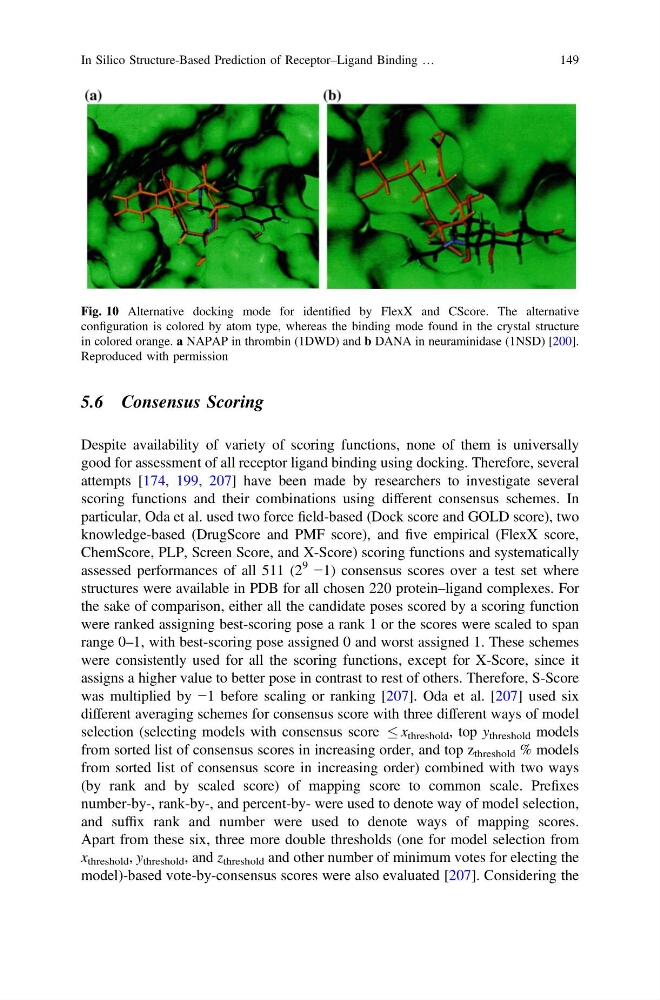
Fig. 10 Alternative docking mode for identified by FlexX and CScore. The alternative
configuration is colored by atom type, whereas the binding mode found in the crystal structure
in colored orange. a NAPAP in thrombin (1DWD) and b DANA in neuraminidase (1NSD) [200].
Reproduced with permission
In Silico Structure-Based Prediction of Receptor–Ligand Binding …
149
Despite availability of variety of scoring functions, none of them is universally
good for assessment of all receptor ligand binding using docking. Therefore, several
attempts [174, 199, 207] have been made by researchers to investigate several
scoring functions and their combinations using different consensus schemes. In
particular, Oda et al. used two force field-based (Dock score and GOLD score), two
knowledge-based (DrugScore and PMF score), and five empirical (FlexX score,
ChemScore, PLP, Screen Score, and X-Score) scoring functions and systematically
assessed performances of all 511 (2
9
−1) consensus scores over a test set where
structures were available in PDB for all chosen 220 protein–ligand complexes. For
the sake of comparison, either all the candidate poses scored by a scoring function
were ranked assigning best-scoring pose a rank 1 or the scores were scaled to span
range 0–1, with best-scoring pose assigned 0 and worst assigned 1. These schemes
were consistently used for all the scoring functions, except for X-Score, since it
assigns a higher value to better pose in contrast to rest of others. Therefore, S-Score
was multiplied by −1 before scaling or ranking [207]. Oda et al. [207] used six
different averaging schemes for consensus score with three different ways of model
selection (selecting models with consensus score x threshold , top y threshold models
from sorted list of consensus scores in increasing order, and top z threshold % models
from sorted list of consensus score in increasing order) combined with two ways
(by rank and by scaled score) of mapping score to common scale. Prefixes
number-by-, rank-by-, and percent-by- were used to denote way of model selection,
and suffix rank and number were used to denote ways of mapping scores.
Apart from these six, three more double thresholds (one for model selection from
x threshold , y threshold , and z threshold and other number of minimum votes for electing the
model)-based vote-by-consensus scores were also evaluated [207]. Considering the
Fig. 10 Alternative docking mode for identified by FlexX and CScore. The alternative
configuration is colored by atom type, whereas the binding mode found in the crystal structure
in colored orange. a NAPAP in thrombin (1DWD) and b DANA in neuraminidase (1NSD) [200].
Reproduced with permission
In Silico Structure-Based Prediction of Receptor–Ligand Binding …
149