

potential function, and electrostatics interactions are calculated using Coulombic
formulation. Empirical scoring function [162] on other hand is based on the available
physicochemical properties which corresponding to hydrogen bonding interactions,
hydrophobic interactions, entropic changes, and interactions with metal ions [162].
Binding free energy is estimated using the sum of various uncorrelated (sometime
parameterized) terms derived from the regression analysis using experimentally
determined binding energies from the already known crystallized complex structures
[163]. ChemScore [163], LUDI [164], Glide score [165], X-score [166], etc., are
major tools implemented with such empirical scoring function. Knowledge-based
scoring functions [167] are derived from the crystallized protein–ligand complexes
using statistical regression principles. The binding free energy of the complex is
assumed to be the sum of free energies (potentials of mean force) of interatomic
contacts calculated from the frequencies of these interatomic distances in a database
of experimental structures from statistical methods [168]. As compared to empirical
scoring function, knowledge-based potential function does not require known binding
affinity and so are free to explore large and diverse structural complex information to
derive the more accurate and less biased scoring function parameters. These functions
are expected readily transferred to systems that have not been used in the development of the scoring function. Examples of knowledge-based scoring functions
include PMF [169] and DrugScore [170].
4.2 Nonlinear Relation Between IC 50 and Score Values
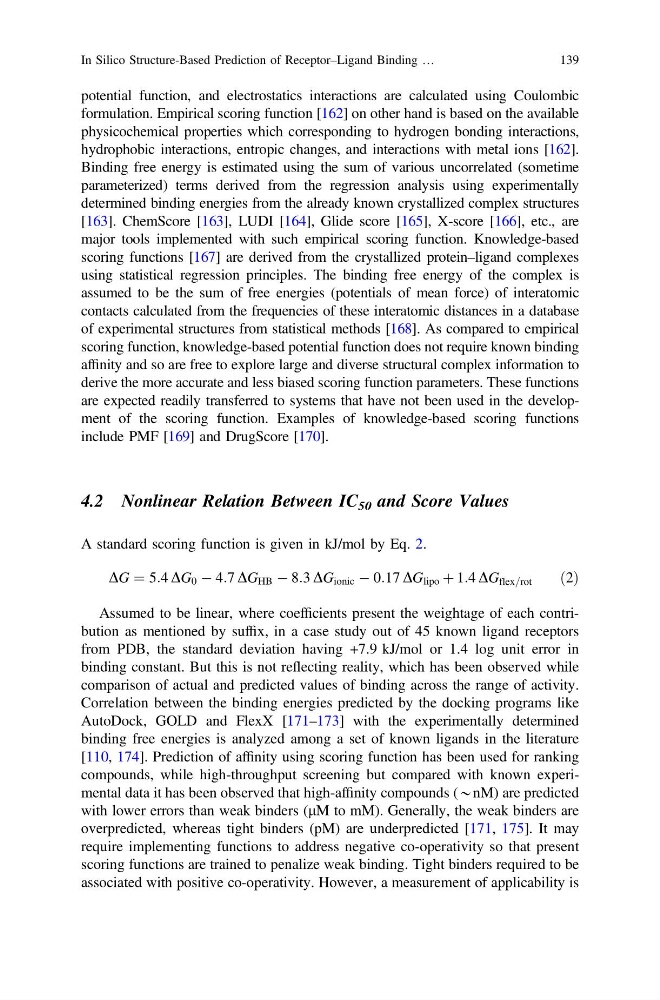
A standard scoring function is given in kJ/mol by Eq. 2.
DG ¼ 5:4 DG 0 À 4:7 DG HB À 8:3 DG ionic À 0:17 DG lipo þ 1:4 DG flex=rot
ð2Þ
Assumed to be linear, where coefficients present the weightage of each contribution as mentioned by suffix, in a case study out of 45 known ligand receptors
from PDB, the standard deviation having +7.9 kJ/mol or 1.4 log unit error in
binding constant. But this is not reflecting reality, which has been observed while
comparison of actual and predicted values of binding across the range of activity.
Correlation between the binding energies predicted by the docking programs like
AutoDock, GOLD and FlexX [171–173] with the experimentally determined
binding free energies is analyzed among a set of known ligands in the literature
[110, 174]. Prediction of affinity using scoring function has been used for ranking
compounds, while high-throughput screening but compared with known experimental data it has been observed that high-affinity compounds (*nM) are predicted
with lower errors than weak binders (lM to mM). Generally, the weak binders are
overpredicted, whereas tight binders (pM) are underpredicted [171, 175]. It may
require implementing functions to address negative co-operativity so that present
scoring functions are trained to penalize weak binding. Tight binders required to be
associated with positive co-operativity. However, a measurement of applicability is
In Silico Structure-Based Prediction of Receptor–Ligand Binding …
139
formulation. Empirical scoring function [162] on other hand is based on the available
physicochemical properties which corresponding to hydrogen bonding interactions,
hydrophobic interactions, entropic changes, and interactions with metal ions [162].
Binding free energy is estimated using the sum of various uncorrelated (sometime
parameterized) terms derived from the regression analysis using experimentally
determined binding energies from the already known crystallized complex structures
[163]. ChemScore [163], LUDI [164], Glide score [165], X-score [166], etc., are
major tools implemented with such empirical scoring function. Knowledge-based
scoring functions [167] are derived from the crystallized protein–ligand complexes
using statistical regression principles. The binding free energy of the complex is
assumed to be the sum of free energies (potentials of mean force) of interatomic
contacts calculated from the frequencies of these interatomic distances in a database
of experimental structures from statistical methods [168]. As compared to empirical
scoring function, knowledge-based potential function does not require known binding
affinity and so are free to explore large and diverse structural complex information to
derive the more accurate and less biased scoring function parameters. These functions
are expected readily transferred to systems that have not been used in the development of the scoring function. Examples of knowledge-based scoring functions
include PMF [169] and DrugScore [170].
4.2 Nonlinear Relation Between IC 50 and Score Values
A standard scoring function is given in kJ/mol by Eq. 2.
DG ¼ 5:4 DG 0 À 4:7 DG HB À 8:3 DG ionic À 0:17 DG lipo þ 1:4 DG flex=rot
ð2Þ
Assumed to be linear, where coefficients present the weightage of each contribution as mentioned by suffix, in a case study out of 45 known ligand receptors
from PDB, the standard deviation having +7.9 kJ/mol or 1.4 log unit error in
binding constant. But this is not reflecting reality, which has been observed while
comparison of actual and predicted values of binding across the range of activity.
Correlation between the binding energies predicted by the docking programs like
AutoDock, GOLD and FlexX [171–173] with the experimentally determined
binding free energies is analyzed among a set of known ligands in the literature
[110, 174]. Prediction of affinity using scoring function has been used for ranking
compounds, while high-throughput screening but compared with known experimental data it has been observed that high-affinity compounds (*nM) are predicted
with lower errors than weak binders (lM to mM). Generally, the weak binders are
overpredicted, whereas tight binders (pM) are underpredicted [171, 175]. It may
require implementing functions to address negative co-operativity so that present
scoring functions are trained to penalize weak binding. Tight binders required to be
associated with positive co-operativity. However, a measurement of applicability is
In Silico Structure-Based Prediction of Receptor–Ligand Binding …
139