

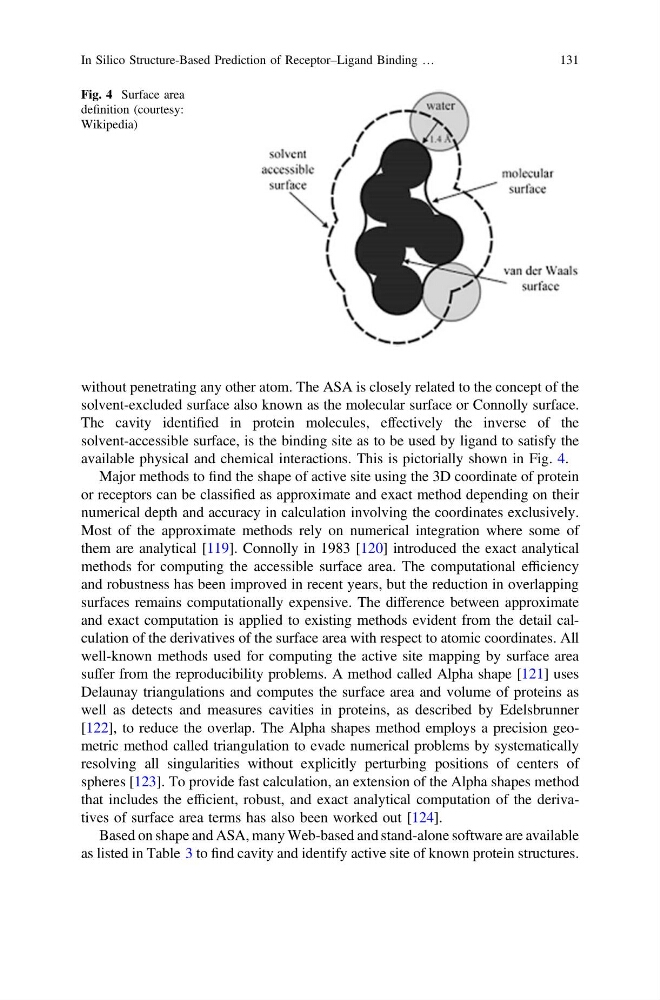
without penetrating any other atom. The ASA is closely related to the concept of the
solvent-excluded surface also known as the molecular surface or Connolly surface.
The cavity identified in protein molecules, effectively the inverse of the
solvent-accessible surface, is the binding site as to be used by ligand to satisfy the
available physical and chemical interactions. This is pictorially shown in Fig. 4.
Major methods to find the shape of active site using the 3D coordinate of protein
or receptors can be classified as approximate and exact method depending on their
numerical depth and accuracy in calculation involving the coordinates exclusively.
Most of the approximate methods rely on numerical integration where some of
them are analytical [119]. Connolly in 1983 [120] introduced the exact analytical
methods for computing the accessible surface area. The computational efficiency
and robustness has been improved in recent years, but the reduction in overlapping
surfaces remains computationally expensive. The difference between approximate
and exact computation is applied to existing methods evident from the detail calculation of the derivatives of the surface area with respect to atomic coordinates. All
well-known methods used for computing the active site mapping by surface area
suffer from the reproducibility problems. A method called Alpha shape [121] uses
Delaunay triangulations and computes the surface area and volume of proteins as
well as detects and measures cavities in proteins, as described by Edelsbrunner
[122], to reduce the overlap. The Alpha shapes method employs a precision geometric method called triangulation to evade numerical problems by systematically
resolving all singularities without explicitly perturbing positions of centers of
spheres [123]. To provide fast calculation, an extension of the Alpha shapes method
that includes the efficient, robust, and exact analytical computation of the derivatives of surface area terms has also been worked out [124].
Based on shape and ASA, many Web-based and stand-alone software are available
as listed in Table 3 to find cavity and identify active site of known protein structures.
Fig. 4 Surface area
definition (courtesy:
Wikipedia)
In Silico Structure-Based Prediction of Receptor–Ligand Binding …
131
solvent-excluded surface also known as the molecular surface or Connolly surface.
The cavity identified in protein molecules, effectively the inverse of the
solvent-accessible surface, is the binding site as to be used by ligand to satisfy the
available physical and chemical interactions. This is pictorially shown in Fig. 4.
Major methods to find the shape of active site using the 3D coordinate of protein
or receptors can be classified as approximate and exact method depending on their
numerical depth and accuracy in calculation involving the coordinates exclusively.
Most of the approximate methods rely on numerical integration where some of
them are analytical [119]. Connolly in 1983 [120] introduced the exact analytical
methods for computing the accessible surface area. The computational efficiency
and robustness has been improved in recent years, but the reduction in overlapping
surfaces remains computationally expensive. The difference between approximate
and exact computation is applied to existing methods evident from the detail calculation of the derivatives of the surface area with respect to atomic coordinates. All
well-known methods used for computing the active site mapping by surface area
suffer from the reproducibility problems. A method called Alpha shape [121] uses
Delaunay triangulations and computes the surface area and volume of proteins as
well as detects and measures cavities in proteins, as described by Edelsbrunner
[122], to reduce the overlap. The Alpha shapes method employs a precision geometric method called triangulation to evade numerical problems by systematically
resolving all singularities without explicitly perturbing positions of centers of
spheres [123]. To provide fast calculation, an extension of the Alpha shapes method
that includes the efficient, robust, and exact analytical computation of the derivatives of surface area terms has also been worked out [124].
Based on shape and ASA, many Web-based and stand-alone software are available
as listed in Table 3 to find cavity and identify active site of known protein structures.
Fig. 4 Surface area
definition (courtesy:
Wikipedia)
In Silico Structure-Based Prediction of Receptor–Ligand Binding …
131