

4 Conclusions and Future Prospect
The results obtained for different series of compounds using recently developed
graph theory-based drug design/drug discovery method by our group [15] for
combinatorial drug design from substructural topological information have been
described in this chapter. Its application and usefulness for different series of antitubercular compounds have already been reported [15]. In this chapter, we have
presented some new results for designing active compounds for barbiturates [18,
19] and nucleoside analogues [20, 21]. We have also reported some new results
obtained for discovering novel active compounds from a data set using rooted tree/
sub-tree searching/matching algorithms. In doing that, a data set (GTB) of 3779
potential antitubercular compounds [22, 23] has been taken for this study and the
method has helped search a number of potentially highly active antitubercular
compounds from this data set. Thus, to our knowledge, we have introduced here a
method that can be used for searching databases to discover novel drug molecules
using rooted tree and sub-tree matching algorithms. Furthermore, the usefulness of
newly proposed Molecular Priority Score (MPS) for prioritizing and screening
highly active compounds has also been described for the studies with a series of
convulsant–anticonvulsant barbiturates and a series on nucleoside analogues for
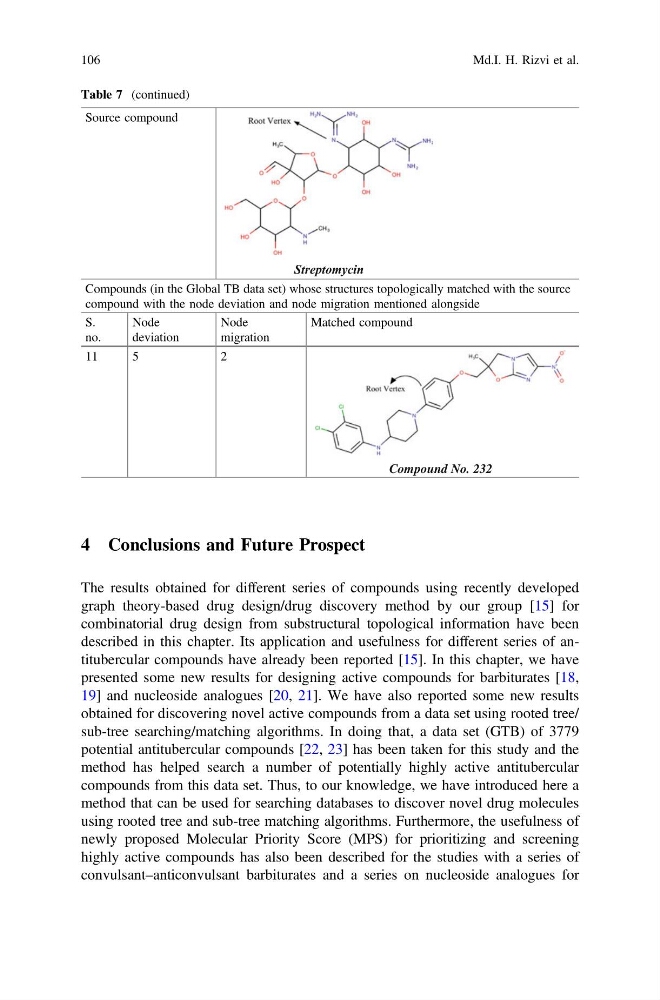
Table 7 (continued)
Source compound
Streptomycin
Compounds (in the Global TB data set) whose structures topologically matched with the source
compound with the node deviation and node migration mentioned alongside
S.
no.
Node
deviation
Node
migration
Matched compound
11
5
2
Compound No. 232
106
Md.I. H. Rizvi et al.
The results obtained for different series of compounds using recently developed
graph theory-based drug design/drug discovery method by our group [15] for
combinatorial drug design from substructural topological information have been
described in this chapter. Its application and usefulness for different series of antitubercular compounds have already been reported [15]. In this chapter, we have
presented some new results for designing active compounds for barbiturates [18,
19] and nucleoside analogues [20, 21]. We have also reported some new results
obtained for discovering novel active compounds from a data set using rooted tree/
sub-tree searching/matching algorithms. In doing that, a data set (GTB) of 3779
potential antitubercular compounds [22, 23] has been taken for this study and the
method has helped search a number of potentially highly active antitubercular
compounds from this data set. Thus, to our knowledge, we have introduced here a
method that can be used for searching databases to discover novel drug molecules
using rooted tree and sub-tree matching algorithms. Furthermore, the usefulness of
newly proposed Molecular Priority Score (MPS) for prioritizing and screening
highly active compounds has also been described for the studies with a series of
convulsant–anticonvulsant barbiturates and a series on nucleoside analogues for
Table 7 (continued)
Source compound
Streptomycin
Compounds (in the Global TB data set) whose structures topologically matched with the source
compound with the node deviation and node migration mentioned alongside
S.
no.
Node
deviation
Node
migration
Matched compound
11
5
2
Compound No. 232
106
Md.I. H. Rizvi et al.