

present here the results obtained using distance exponent index (D
−4 ) to see how
this index performs for this series of compounds. The activity prediction results
along with MPS values using D
−4 index, computed for the hydrogen-filled graphs
of the compounds, are shown in Table 2. It may, however, be noted that the indices
of only non-hydrogen atoms have been considered for ordering of index values,
range selection and activity prediction purposes. Thus, the indices computed for the
hydrogen atoms in the H-filled graphs have not been used for this purpose.
Activity Prediction and Compound Prioritization for Barbiturates
For the prediction of activity and prioritizing the compounds on the basis of MPS
values, we have considered the same set of compounds as well as the same training
set and test set for the present study as used earlier [18]. In may be noted that, in this
data set, the convulsant barbiturates are tagged active and the anticonvulsant barbiturates as inactive.
It can be observed that accuracy of activity prediction using D
−4 index in the
barbiturate data set is 100% for both training set and test set which equals the
prediction obtained using V
d
n index reported earlier [18]. This further substantiates
earlier findings [15] using this vertex index, rule-based method and MPS value
about the usefulness of the method for activity prediction and compound prioritization. This is believed to help scientists work on the crucial issues related to
convulsion and help drug designers find novel therapeutic agents in the area of
anticonvulsant drug discovery.
Structure Generation for Barbiturates
The structure generation exercise has been carried out for the barbiturate data set
with the same training set and test set split as considered earlier [18]. The index
computation for the non-hydrogen atoms (vertices) has been performed considering
hydrogen-filled graphs. As described in the method section, the D
−4 index values
computed for the training set compounds are arranged in an ascending order to find
active and inactive ranges in order to get a “strong” range to identify an
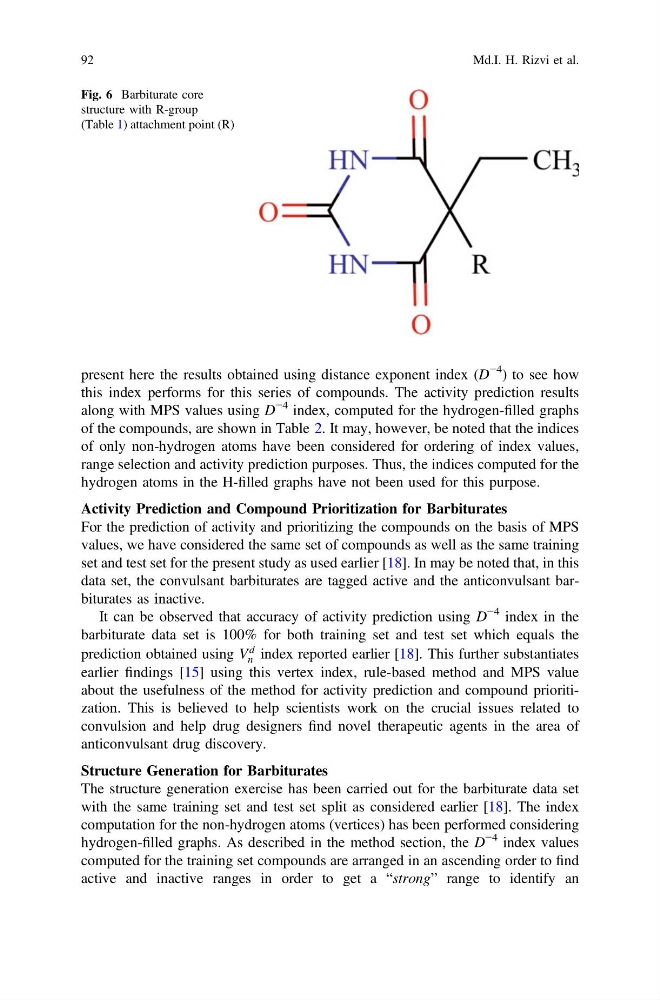
Fig. 6 Barbiturate core
structure with R-group
(Table 1) attachment point (R)
92
Md.I. H. Rizvi et al.
−4 ) to see how
this index performs for this series of compounds. The activity prediction results
along with MPS values using D
−4 index, computed for the hydrogen-filled graphs
of the compounds, are shown in Table 2. It may, however, be noted that the indices
of only non-hydrogen atoms have been considered for ordering of index values,
range selection and activity prediction purposes. Thus, the indices computed for the
hydrogen atoms in the H-filled graphs have not been used for this purpose.
Activity Prediction and Compound Prioritization for Barbiturates
For the prediction of activity and prioritizing the compounds on the basis of MPS
values, we have considered the same set of compounds as well as the same training
set and test set for the present study as used earlier [18]. In may be noted that, in this
data set, the convulsant barbiturates are tagged active and the anticonvulsant barbiturates as inactive.
It can be observed that accuracy of activity prediction using D
−4 index in the
barbiturate data set is 100% for both training set and test set which equals the
prediction obtained using V
d
n index reported earlier [18]. This further substantiates
earlier findings [15] using this vertex index, rule-based method and MPS value
about the usefulness of the method for activity prediction and compound prioritization. This is believed to help scientists work on the crucial issues related to
convulsion and help drug designers find novel therapeutic agents in the area of
anticonvulsant drug discovery.
Structure Generation for Barbiturates
The structure generation exercise has been carried out for the barbiturate data set
with the same training set and test set split as considered earlier [18]. The index
computation for the non-hydrogen atoms (vertices) has been performed considering
hydrogen-filled graphs. As described in the method section, the D
−4 index values
computed for the training set compounds are arranged in an ascending order to find
active and inactive ranges in order to get a “strong” range to identify an
Fig. 6 Barbiturate core
structure with R-group
(Table 1) attachment point (R)
92
Md.I. H. Rizvi et al.