

Biodiesel
57
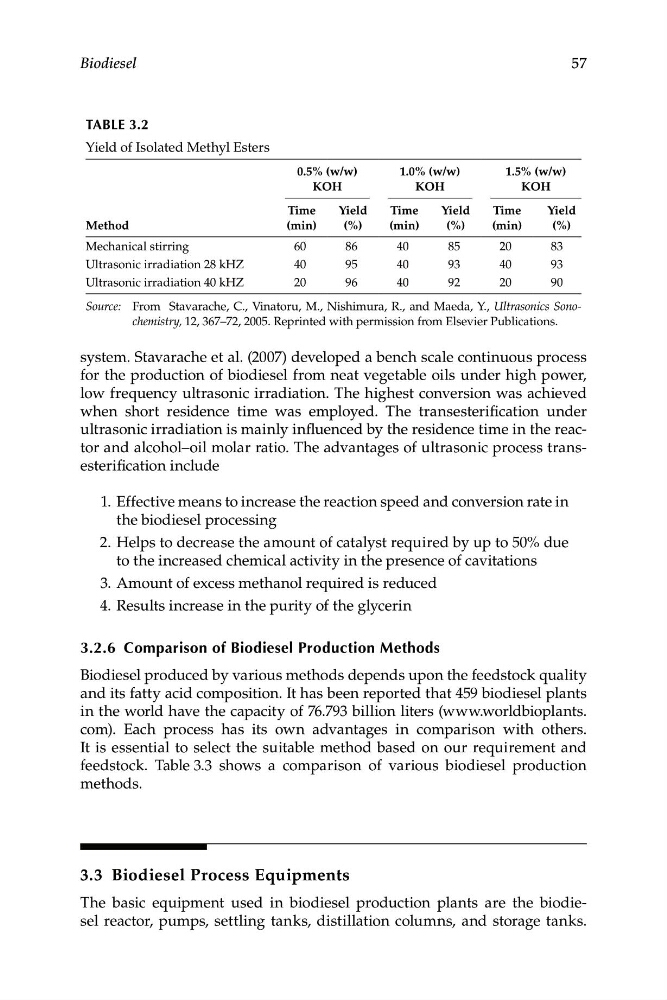
TABLe 3.2
Yield of Isolated Methyl Esters
0.5% (w/w)
1.0% (w/w)
1.5% (w/w)
KOH
KOH
KOH
Time
Yield
Time
Yield
Time
Yield
Method
(min)
(%)
(min)
(%)
(min)
(%)
Mechanical stirring
60
86
40
85
20
83
Ultrasonic irradiation 28 kHZ
40
95
40
93
40
93
Ultrasonic irradiation 40 kHZ
20
96
40
92
20
90
Source: From Stavarache, C., Vinatoru, M., Nishimura, R., and Maeda, Y., Ultrasonics Sonochemistry, 12, 367–72, 2005. Reprinted with permission from Elsevier Publications.
system. Stavarache et al. (2007) developed a bench scale continuous process
for the production of biodiesel from neat vegetable oils under high power,
low frequency ultrasonic irradiation. The highest conversion was achieved
when short residence time was employed. The transesterification under
ultrasonic irradiation is mainly influenced by the residence time in the reactor and alcohol–oil molar ratio. The advantages of ultrasonic process transesterification include
1. Effective means to increase the reaction speed and conversion rate in
the biodiesel processing
2. Helps to decrease the amount of catalyst required by up to 50% due
to the increased chemical activity in the presence of cavitations
3. Amount of excess methanol required is reduced
4. Results increase in the purity of the glycerin
3.2.6 Comparison of Biodiesel Production Methods
Biodiesel produced by various methods depends upon the feedstock quality
and its fatty acid composition. It has been reported that 459 biodiesel plants
in the world have the capacity of 76.793 billion liters (www.worldbioplants.
com). Each process has its own advantages in comparison with others.
It is essential to select the suitable method based on our requirement and
feedstock. Table 3.3 shows a comparison of various biodiesel production
methods.
3.3 Biodiesel Process Equipments
The basic equipment used in biodiesel production plants are the biodiesel reactor, pumps, settling tanks, distillation columns, and storage tanks.
57
TABLe 3.2
Yield of Isolated Methyl Esters
0.5% (w/w)
1.0% (w/w)
1.5% (w/w)
KOH
KOH
KOH
Time
Yield
Time
Yield
Time
Yield
Method
(min)
(%)
(min)
(%)
(min)
(%)
Mechanical stirring
60
86
40
85
20
83
Ultrasonic irradiation 28 kHZ
40
95
40
93
40
93
Ultrasonic irradiation 40 kHZ
20
96
40
92
20
90
Source: From Stavarache, C., Vinatoru, M., Nishimura, R., and Maeda, Y., Ultrasonics Sonochemistry, 12, 367–72, 2005. Reprinted with permission from Elsevier Publications.
system. Stavarache et al. (2007) developed a bench scale continuous process
for the production of biodiesel from neat vegetable oils under high power,
low frequency ultrasonic irradiation. The highest conversion was achieved
when short residence time was employed. The transesterification under
ultrasonic irradiation is mainly influenced by the residence time in the reactor and alcohol–oil molar ratio. The advantages of ultrasonic process transesterification include
1. Effective means to increase the reaction speed and conversion rate in
the biodiesel processing
2. Helps to decrease the amount of catalyst required by up to 50% due
to the increased chemical activity in the presence of cavitations
3. Amount of excess methanol required is reduced
4. Results increase in the purity of the glycerin
3.2.6 Comparison of Biodiesel Production Methods
Biodiesel produced by various methods depends upon the feedstock quality
and its fatty acid composition. It has been reported that 459 biodiesel plants
in the world have the capacity of 76.793 billion liters (www.worldbioplants.
com). Each process has its own advantages in comparison with others.
It is essential to select the suitable method based on our requirement and
feedstock. Table 3.3 shows a comparison of various biodiesel production
methods.
3.3 Biodiesel Process Equipments
The basic equipment used in biodiesel production plants are the biodiesel reactor, pumps, settling tanks, distillation columns, and storage tanks.