

52
Alternative Fuels for Transportation
transesterification process, which completes in a very short time, about a
few minutes. Because of the noncatalytic process, the purification products
after the transesterification reaction is much simpler and environmentally
friendly compared to that of conventional process. Saka and Kusdiana (2001),
Warabi, Kusdiana, and Saka (2004), Kusdiana and Saka (2004), Demirbas
(2003) developed noncatalytic transesterification with supercritical methanol
for producing biodiesel from vegetable oils to overcome these problems.
Saka and Kusdiana (2001) developed a biodiesel production process without the aid of catalysts. Rapeseed oil, methanol mixture (molar ratio up to
42) heated at its supercritical temperature (350–500°C) for different time periods (1–4 minutes). The product (biodiesel) is evaporated at 90°C for about 20
minutes to remove the excess methanol and water produced by esterification.
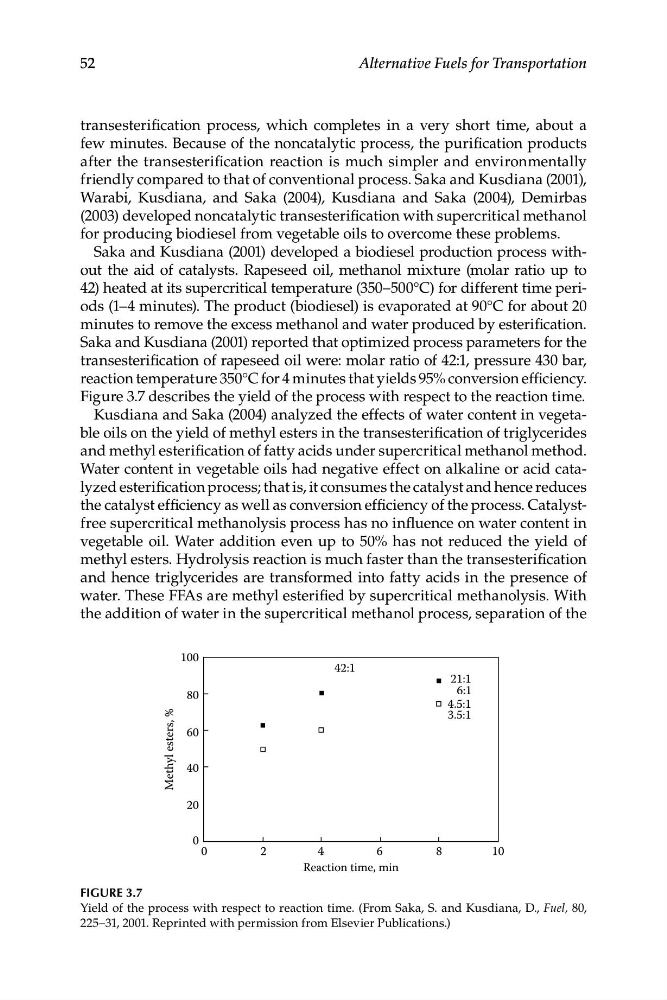
Saka and Kusdiana (2001) reported that optimized process parameters for the
transesterification of rapeseed oil were: molar ratio of 42:1, pressure 430 bar,
reaction temperature 350°C for 4 minutes that yields 95% conversion efficiency.
Figure 3.7 describes the yield of the process with respect to the reaction time.
Kusdiana and Saka (2004) analyzed the effects of water content in vegetable oils on the yield of methyl esters in the transesterification of triglycerides
and methyl esterification of fatty acids under supercritical methanol method.
Water content in vegetable oils had negative effect on alkaline or acid catalyzed esterification process; that is, it consumes the catalyst and hence reduces
the catalyst efficiency as well as conversion efficiency of the process. Catalystfree supercritical methanolysis process has no influence on water content in
vegetable oil. Water addition even up to 50% has not reduced the yield of
methyl esters. Hydrolysis reaction is much faster than the transesterification
and hence triglycerides are transformed into fatty acids in the presence of
water. These FFAs are methyl esterified by supercritical methanolysis. With
the addition of water in the supercritical methanol process, separation of the
100
80
60
40
20
0 0
42:1
21:1
6:1
4.5:1
3.5:1
2
4
6
8
10
Reaction time, min
Methyl esters, %
Figure 3.7
Yield of the process with respect to reaction time. (From Saka, S. and Kusdiana, D., Fuel, 80,
225–31, 2001. Reprinted with permission from Elsevier Publications.)
Alternative Fuels for Transportation
transesterification process, which completes in a very short time, about a
few minutes. Because of the noncatalytic process, the purification products
after the transesterification reaction is much simpler and environmentally
friendly compared to that of conventional process. Saka and Kusdiana (2001),
Warabi, Kusdiana, and Saka (2004), Kusdiana and Saka (2004), Demirbas
(2003) developed noncatalytic transesterification with supercritical methanol
for producing biodiesel from vegetable oils to overcome these problems.
Saka and Kusdiana (2001) developed a biodiesel production process without the aid of catalysts. Rapeseed oil, methanol mixture (molar ratio up to
42) heated at its supercritical temperature (350–500°C) for different time periods (1–4 minutes). The product (biodiesel) is evaporated at 90°C for about 20
minutes to remove the excess methanol and water produced by esterification.
Saka and Kusdiana (2001) reported that optimized process parameters for the
transesterification of rapeseed oil were: molar ratio of 42:1, pressure 430 bar,
reaction temperature 350°C for 4 minutes that yields 95% conversion efficiency.
Figure 3.7 describes the yield of the process with respect to the reaction time.
Kusdiana and Saka (2004) analyzed the effects of water content in vegetable oils on the yield of methyl esters in the transesterification of triglycerides
and methyl esterification of fatty acids under supercritical methanol method.
Water content in vegetable oils had negative effect on alkaline or acid catalyzed esterification process; that is, it consumes the catalyst and hence reduces
the catalyst efficiency as well as conversion efficiency of the process. Catalystfree supercritical methanolysis process has no influence on water content in
vegetable oil. Water addition even up to 50% has not reduced the yield of
methyl esters. Hydrolysis reaction is much faster than the transesterification
and hence triglycerides are transformed into fatty acids in the presence of
water. These FFAs are methyl esterified by supercritical methanolysis. With
the addition of water in the supercritical methanol process, separation of the
100
80
60
40
20
0 0
42:1
21:1
6:1
4.5:1
3.5:1
2
4
6
8
10
Reaction time, min
Methyl esters, %
Figure 3.7
Yield of the process with respect to reaction time. (From Saka, S. and Kusdiana, D., Fuel, 80,
225–31, 2001. Reprinted with permission from Elsevier Publications.)