

28
Alternative Fuels for Transportation
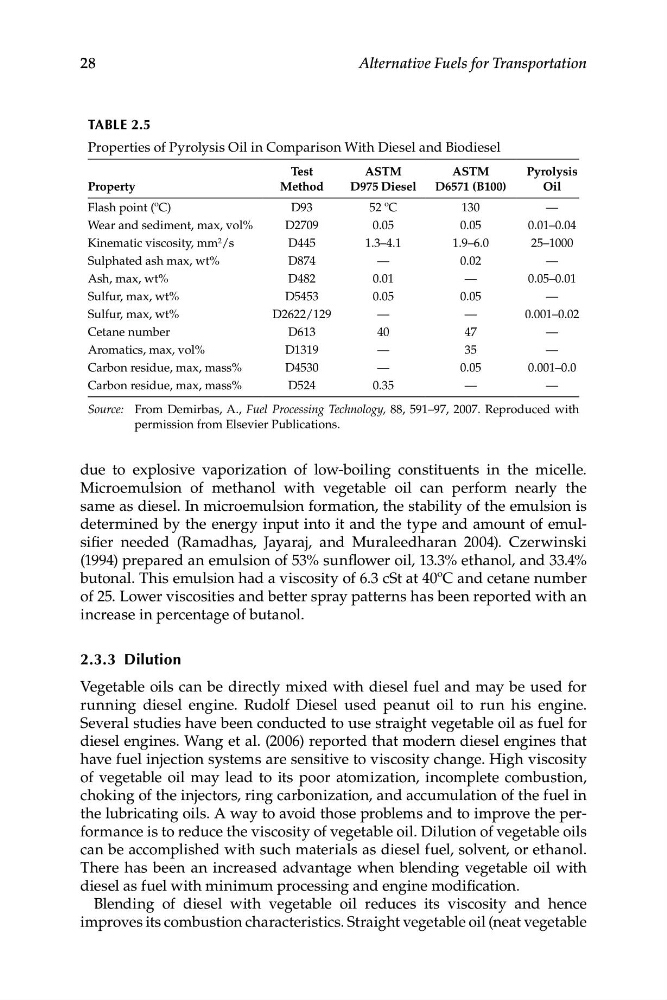
TABLe 2.5
Properties of Pyrolysis Oil in Comparison With Diesel and Biodiesel
Test
ASTM
ASTM
Pyrolysis
Property
Method
D975 Diesel
D6571 (B100)
Oil
Flash point (ºC)
D93
52 ºC
130
—
Wear and sediment, max, vol%
D2709
0.05
0.05
0.01–0.04
Kinematic viscosity, mm 2 /s
D445
1.3–4.1
1.9–6.0
25–1000
Sulphated ash max, wt%
D874
—
0.02
—
Ash, max, wt%
D482
0.01
—
0.05–0.01
Sulfur, max, wt%
D5453
0.05
0.05
—
Sulfur, max, wt%
D2622/129
—
—
0.001–0.02
Cetane number
D613
40
47
—
Aromatics, max, vol%
D1319
—
35
—
Carbon residue, max, mass%
D4530
—
0.05
0.001–0.0
Carbon residue, max, mass%
D524
0.35
—
—
Source: From Demirbas, A., Fuel Processing Technology, 88, 591–97, 2007. Reproduced with
permission from Elsevier Publications.
due to explosive vaporization of low-boiling constituents in the micelle.
Microemulsion of methanol with vegetable oil can perform nearly the
same as diesel. In microemulsion formation, the stability of the emulsion is
determined by the energy input into it and the type and amount of emulsifier needed (Ramadhas, Jayaraj, and Muraleedharan 2004). Czerwinski
(1994) prepared an emulsion of 53% sunflower oil, 13.3% ethanol, and 33.4%
butonal. This emulsion had a viscosity of 6.3 cSt at 40ºC and cetane number
of 25. Lower viscosities and better spray patterns has been reported with an
increase in percentage of butanol.
2.3.3 Dilution
Vegetable oils can be directly mixed with diesel fuel and may be used for
running diesel engine. Rudolf Diesel used peanut oil to run his engine.
Several studies have been conducted to use straight vegetable oil as fuel for
diesel engines. Wang et al. (2006) reported that modern diesel engines that
have fuel injection systems are sensitive to viscosity change. High viscosity
of vegetable oil may lead to its poor atomization, incomplete combustion,
choking of the injectors, ring carbonization, and accumulation of the fuel in
the lubricating oils. A way to avoid those problems and to improve the performance is to reduce the viscosity of vegetable oil. Dilution of vegetable oils
can be accomplished with such materials as diesel fuel, solvent, or ethanol.
There has been an increased advantage when blending vegetable oil with
diesel as fuel with minimum processing and engine modification.
Blending of diesel with vegetable oil reduces its viscosity and hence
improves its combustion characteristics. Straight vegetable oil (neat vegetable
Alternative Fuels for Transportation
TABLe 2.5
Properties of Pyrolysis Oil in Comparison With Diesel and Biodiesel
Test
ASTM
ASTM
Pyrolysis
Property
Method
D975 Diesel
D6571 (B100)
Oil
Flash point (ºC)
D93
52 ºC
130
—
Wear and sediment, max, vol%
D2709
0.05
0.05
0.01–0.04
Kinematic viscosity, mm 2 /s
D445
1.3–4.1
1.9–6.0
25–1000
Sulphated ash max, wt%
D874
—
0.02
—
Ash, max, wt%
D482
0.01
—
0.05–0.01
Sulfur, max, wt%
D5453
0.05
0.05
—
Sulfur, max, wt%
D2622/129
—
—
0.001–0.02
Cetane number
D613
40
47
—
Aromatics, max, vol%
D1319
—
35
—
Carbon residue, max, mass%
D4530
—
0.05
0.001–0.0
Carbon residue, max, mass%
D524
0.35
—
—
Source: From Demirbas, A., Fuel Processing Technology, 88, 591–97, 2007. Reproduced with
permission from Elsevier Publications.
due to explosive vaporization of low-boiling constituents in the micelle.
Microemulsion of methanol with vegetable oil can perform nearly the
same as diesel. In microemulsion formation, the stability of the emulsion is
determined by the energy input into it and the type and amount of emulsifier needed (Ramadhas, Jayaraj, and Muraleedharan 2004). Czerwinski
(1994) prepared an emulsion of 53% sunflower oil, 13.3% ethanol, and 33.4%
butonal. This emulsion had a viscosity of 6.3 cSt at 40ºC and cetane number
of 25. Lower viscosities and better spray patterns has been reported with an
increase in percentage of butanol.
2.3.3 Dilution
Vegetable oils can be directly mixed with diesel fuel and may be used for
running diesel engine. Rudolf Diesel used peanut oil to run his engine.
Several studies have been conducted to use straight vegetable oil as fuel for
diesel engines. Wang et al. (2006) reported that modern diesel engines that
have fuel injection systems are sensitive to viscosity change. High viscosity
of vegetable oil may lead to its poor atomization, incomplete combustion,
choking of the injectors, ring carbonization, and accumulation of the fuel in
the lubricating oils. A way to avoid those problems and to improve the performance is to reduce the viscosity of vegetable oil. Dilution of vegetable oils
can be accomplished with such materials as diesel fuel, solvent, or ethanol.
There has been an increased advantage when blending vegetable oil with
diesel as fuel with minimum processing and engine modification.
Blending of diesel with vegetable oil reduces its viscosity and hence
improves its combustion characteristics. Straight vegetable oil (neat vegetable