

366
Alternative Fuels for Transportation
ICEV
Micro hybrid
Mild hybrid
Full hybrid
PHEV
REV
BEV
Gasoline/
diesel
Battery
Motor
Engine
Energy
source
Propulsion
device
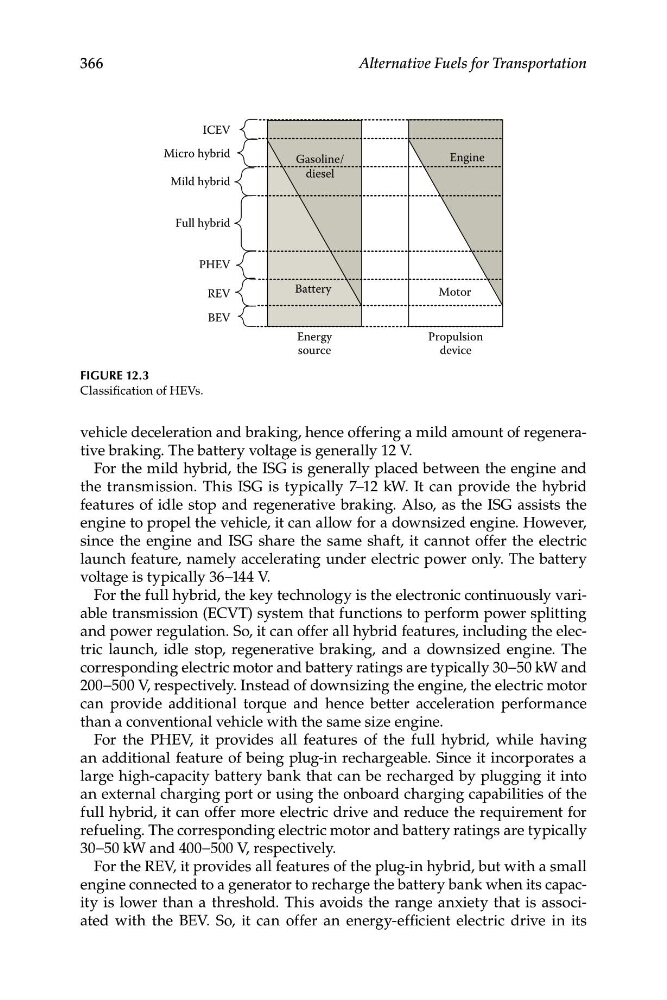
Figure 12.3
Classification of HEVs.
vehicle deceleration and braking, hence offering a mild amount of regenerative braking. The battery voltage is generally 12 V.
For the mild hybrid, the ISG is generally placed between the engine and
the transmission. This ISG is typically 7−12 kW. It can provide the hybrid
features of idle stop and regenerative braking. Also, as the ISG assists the
engine to propel the vehicle, it can allow for a downsized engine. However,
since the engine and ISG share the same shaft, it cannot offer the electric
launch feature, namely accelerating under electric power only. The battery
voltage is typically 36−144 V.
For the full hybrid, the key technology is the electronic continuously variable transmission (ECVT) system that functions to perform power splitting
and power regulation. So, it can offer all hybrid features, including the electric launch, idle stop, regenerative braking, and a downsized engine. The
corresponding electric motor and battery ratings are typically 30−50 kW and
200−500 V, respectively. Instead of downsizing the engine, the electric motor
can provide additional torque and hence better acceleration performance
than a conventional vehicle with the same size engine.
For the PHEV, it provides all features of the full hybrid, while having
an additional feature of being plug-in rechargeable. Since it incorporates a
large high-capacity battery bank that can be recharged by plugging it into
an external charging port or using the onboard charging capabilities of the
full hybrid, it can offer more electric drive and reduce the requirement for
refueling. The corresponding electric motor and battery ratings are typically
30−50 kW and 400−500 V, respectively.
For the REV, it provides all features of the plug-in hybrid, but with a small
engine connected to a generator to recharge the battery bank when its capacity is lower than a threshold. This avoids the range anxiety that is associated with the BEV. So, it can offer an energy-efficient electric drive in its
Alternative Fuels for Transportation
ICEV
Micro hybrid
Mild hybrid
Full hybrid
PHEV
REV
BEV
Gasoline/
diesel
Battery
Motor
Engine
Energy
source
Propulsion
device
Figure 12.3
Classification of HEVs.
vehicle deceleration and braking, hence offering a mild amount of regenerative braking. The battery voltage is generally 12 V.
For the mild hybrid, the ISG is generally placed between the engine and
the transmission. This ISG is typically 7−12 kW. It can provide the hybrid
features of idle stop and regenerative braking. Also, as the ISG assists the
engine to propel the vehicle, it can allow for a downsized engine. However,
since the engine and ISG share the same shaft, it cannot offer the electric
launch feature, namely accelerating under electric power only. The battery
voltage is typically 36−144 V.
For the full hybrid, the key technology is the electronic continuously variable transmission (ECVT) system that functions to perform power splitting
and power regulation. So, it can offer all hybrid features, including the electric launch, idle stop, regenerative braking, and a downsized engine. The
corresponding electric motor and battery ratings are typically 30−50 kW and
200−500 V, respectively. Instead of downsizing the engine, the electric motor
can provide additional torque and hence better acceleration performance
than a conventional vehicle with the same size engine.
For the PHEV, it provides all features of the full hybrid, while having
an additional feature of being plug-in rechargeable. Since it incorporates a
large high-capacity battery bank that can be recharged by plugging it into
an external charging port or using the onboard charging capabilities of the
full hybrid, it can offer more electric drive and reduce the requirement for
refueling. The corresponding electric motor and battery ratings are typically
30−50 kW and 400−500 V, respectively.
For the REV, it provides all features of the plug-in hybrid, but with a small
engine connected to a generator to recharge the battery bank when its capacity is lower than a threshold. This avoids the range anxiety that is associated with the BEV. So, it can offer an energy-efficient electric drive in its