

M
T
B
E
F
P
G
Series hybrid
D
M
T
B
E
F
P
G
Series-parallel hybrid
D
M
T
B
E
F
P
Parallel hybrid
D
M
T
B
E
F
P
MG
Complex hybrid
P
D
D
T
B: Battery
E: Engine
MG: Motor/generator
F: Fuel tank
M: Motor
T: Transmission
G: Generator
P: Power converter
D: Differential
Electrical link
Hydraulic link
Mechanical link
364
Alternative Fuels for Transportation
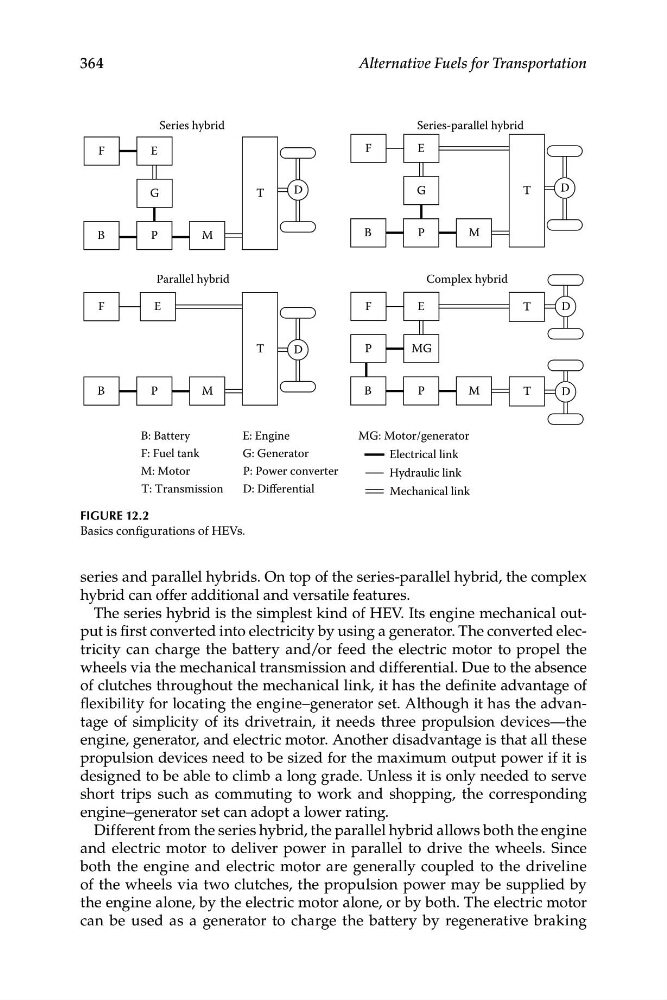
Figure 12.2
Basics configurations of HEVs.
series and parallel hybrids. On top of the series-parallel hybrid, the complex
hybrid can offer additional and versatile features.
The series hybrid is the simplest kind of HEV. Its engine mechanical output is first converted into electricity by using a generator. The converted electricity can charge the battery and/or feed the electric motor to propel the
wheels via the mechanical transmission and differential. Due to the absence
of clutches throughout the mechanical link, it has the definite advantage of
flexibility for locating the engine–generator set. Although it has the advantage of simplicity of its drivetrain, it needs three propulsion devices—the
engine, generator, and electric motor. Another disadvantage is that all these
propulsion devices need to be sized for the maximum output power if it is
designed to be able to climb a long grade. Unless it is only needed to serve
short trips such as commuting to work and shopping, the corresponding
engine–generator set can adopt a lower rating.
Different from the series hybrid, the parallel hybrid allows both the engine
and electric motor to deliver power in parallel to drive the wheels. Since
both the engine and electric motor are generally coupled to the driveline
of the wheels via two clutches, the propulsion power may be supplied by
the engine alone, by the electric motor alone, or by both. The electric motor
can be used as a generator to charge the battery by regenerative braking
T
B
E
F
P
G
Series hybrid
D
M
T
B
E
F
P
G
Series-parallel hybrid
D
M
T
B
E
F
P
Parallel hybrid
D
M
T
B
E
F
P
MG
Complex hybrid
P
D
D
T
B: Battery
E: Engine
MG: Motor/generator
F: Fuel tank
M: Motor
T: Transmission
G: Generator
P: Power converter
D: Differential
Electrical link
Hydraulic link
Mechanical link
364
Alternative Fuels for Transportation
Figure 12.2
Basics configurations of HEVs.
series and parallel hybrids. On top of the series-parallel hybrid, the complex
hybrid can offer additional and versatile features.
The series hybrid is the simplest kind of HEV. Its engine mechanical output is first converted into electricity by using a generator. The converted electricity can charge the battery and/or feed the electric motor to propel the
wheels via the mechanical transmission and differential. Due to the absence
of clutches throughout the mechanical link, it has the definite advantage of
flexibility for locating the engine–generator set. Although it has the advantage of simplicity of its drivetrain, it needs three propulsion devices—the
engine, generator, and electric motor. Another disadvantage is that all these
propulsion devices need to be sized for the maximum output power if it is
designed to be able to climb a long grade. Unless it is only needed to serve
short trips such as commuting to work and shopping, the corresponding
engine–generator set can adopt a lower rating.
Different from the series hybrid, the parallel hybrid allows both the engine
and electric motor to deliver power in parallel to drive the wheels. Since
both the engine and electric motor are generally coupled to the driveline
of the wheels via two clutches, the propulsion power may be supplied by
the engine alone, by the electric motor alone, or by both. The electric motor
can be used as a generator to charge the battery by regenerative braking