

362
Alternative Fuels for Transportation
source involves fuel cells working together with batteries and the propulsion
device is only an electric motor, they are termed the Fuel Cell EV (FCEV) or
simply called the fuel cell vehicle. When both batteries and gasoline/diesel
fuel are the energy sources as well as both the engine and electric motor are
the propulsion devices, they are termed the HEV or simply called the hybrid
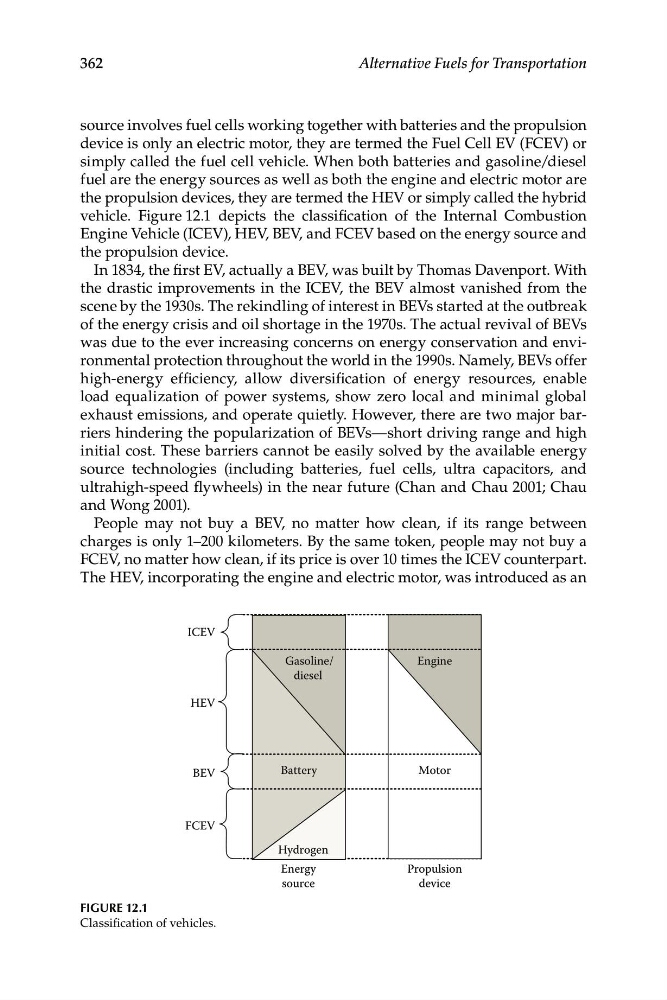
vehicle. Figure 12.1 depicts the classification of the Internal Combustion
Engine Vehicle (ICEV), HEV, BEV, and FCEV based on the energy source and
the propulsion device.
In 1834, the first EV, actually a BEV, was built by Thomas Davenport. With
the drastic improvements in the ICEV, the BEV almost vanished from the
scene by the 1930s. The rekindling of interest in BEVs started at the outbreak
of the energy crisis and oil shortage in the 1970s. The actual revival of BEVs
was due to the ever increasing concerns on energy conservation and environmental protection throughout the world in the 1990s. Namely, BEVs offer
high-energy efficiency, allow diversification of energy resources, enable
load equalization of power systems, show zero local and minimal global
exhaust emissions, and operate quietly. However, there are two major barriers hindering the popularization of BEVs—short driving range and high
initial cost. These barriers cannot be easily solved by the available energy
source technologies (including batteries, fuel cells, ultra capacitors, and
ultrahigh-speed flywheels) in the near future (Chan and Chau 2001; Chau
and Wong 2001).
People may not buy a BEV, no matter how clean, if its range between
charges is only 1–200 kilometers. By the same token, people may not buy a
FCEV, no matter how clean, if its price is over 10 times the ICEV counterpart.
The HEV, incorporating the engine and electric motor, was introduced as an
ICEV
HEV
BEV
FCEV
Gasoline/
diesel
Battery
Hydrogen
Motor
Engine
Energy
Propulsion
source
device
Figure 12.1
Classification of vehicles.
Alternative Fuels for Transportation
source involves fuel cells working together with batteries and the propulsion
device is only an electric motor, they are termed the Fuel Cell EV (FCEV) or
simply called the fuel cell vehicle. When both batteries and gasoline/diesel
fuel are the energy sources as well as both the engine and electric motor are
the propulsion devices, they are termed the HEV or simply called the hybrid
vehicle. Figure 12.1 depicts the classification of the Internal Combustion
Engine Vehicle (ICEV), HEV, BEV, and FCEV based on the energy source and
the propulsion device.
In 1834, the first EV, actually a BEV, was built by Thomas Davenport. With
the drastic improvements in the ICEV, the BEV almost vanished from the
scene by the 1930s. The rekindling of interest in BEVs started at the outbreak
of the energy crisis and oil shortage in the 1970s. The actual revival of BEVs
was due to the ever increasing concerns on energy conservation and environmental protection throughout the world in the 1990s. Namely, BEVs offer
high-energy efficiency, allow diversification of energy resources, enable
load equalization of power systems, show zero local and minimal global
exhaust emissions, and operate quietly. However, there are two major barriers hindering the popularization of BEVs—short driving range and high
initial cost. These barriers cannot be easily solved by the available energy
source technologies (including batteries, fuel cells, ultra capacitors, and
ultrahigh-speed flywheels) in the near future (Chan and Chau 2001; Chau
and Wong 2001).
People may not buy a BEV, no matter how clean, if its range between
charges is only 1–200 kilometers. By the same token, people may not buy a
FCEV, no matter how clean, if its price is over 10 times the ICEV counterpart.
The HEV, incorporating the engine and electric motor, was introduced as an
ICEV
HEV
BEV
FCEV
Gasoline/
diesel
Battery
Hydrogen
Motor
Engine
Energy
Propulsion
source
device
Figure 12.1
Classification of vehicles.