

Fuel Cells
343
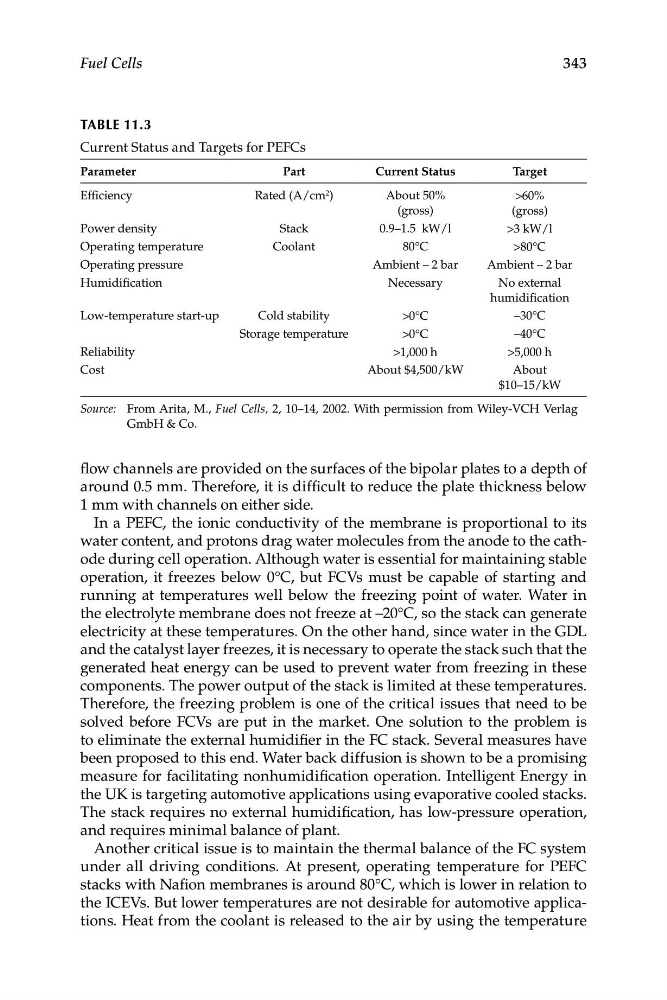
TABLe 11.3
Current Status and Targets for PEFCs
Parameter
Part
Current Status
Target
Efficiency
Rated (A/cm 2 )
About 50%
>60%
(gross)
(gross)
Power density
Stack
0.9–1.5 kW/l
>3 kW/l
Operating temperature
Coolant
80°C
>80°C
Operating pressure
Ambient – 2 bar
Ambient – 2 bar
Humidification
Necessary
No external
humidification
Low-temperature start-up
Cold stability
>0°C
–30°C
Storage temperature
>0°C
–40°C
Reliability
>1,000 h
>5,000 h
Cost
About $4,500/kW
About
$10–15/kW
Source: From Arita, M., Fuel Cells, 2, 10–14, 2002. With permission from Wiley-VCH Verlag
GmbH & Co.
flow channels are provided on the surfaces of the bipolar plates to a depth of
around 0.5 mm. Therefore, it is difficult to reduce the plate thickness below
1 mm with channels on either side.
In a PEFC, the ionic conductivity of the membrane is proportional to its
water content, and protons drag water molecules from the anode to the cathode during cell operation. Although water is essential for maintaining stable
operation, it freezes below 0°C, but FCVs must be capable of starting and
running at temperatures well below the freezing point of water. Water in
the electrolyte membrane does not freeze at –20°C, so the stack can generate
electricity at these temperatures. On the other hand, since water in the GDL
and the catalyst layer freezes, it is necessary to operate the stack such that the
generated heat energy can be used to prevent water from freezing in these
components. The power output of the stack is limited at these temperatures.
Therefore, the freezing problem is one of the critical issues that need to be
solved before FCVs are put in the market. One solution to the problem is
to eliminate the external humidifier in the FC stack. Several measures have
been proposed to this end. Water back diffusion is shown to be a promising
measure for facilitating nonhumidification operation. Intelligent Energy in
the UK is targeting automotive applications using evaporative cooled stacks.
The stack requires no external humidification, has low-pressure operation,
and requires minimal balance of plant.
Another critical issue is to maintain the thermal balance of the FC system
under all driving conditions. At present, operating temperature for PEFC
stacks with Nafion membranes is around 80°C, which is lower in relation to
the ICEVs. But lower temperatures are not desirable for automotive applications. Heat from the coolant is released to the air by using the temperature
343
TABLe 11.3
Current Status and Targets for PEFCs
Parameter
Part
Current Status
Target
Efficiency
Rated (A/cm 2 )
About 50%
>60%
(gross)
(gross)
Power density
Stack
0.9–1.5 kW/l
>3 kW/l
Operating temperature
Coolant
80°C
>80°C
Operating pressure
Ambient – 2 bar
Ambient – 2 bar
Humidification
Necessary
No external
humidification
Low-temperature start-up
Cold stability
>0°C
–30°C
Storage temperature
>0°C
–40°C
Reliability
>1,000 h
>5,000 h
Cost
About $4,500/kW
About
$10–15/kW
Source: From Arita, M., Fuel Cells, 2, 10–14, 2002. With permission from Wiley-VCH Verlag
GmbH & Co.
flow channels are provided on the surfaces of the bipolar plates to a depth of
around 0.5 mm. Therefore, it is difficult to reduce the plate thickness below
1 mm with channels on either side.
In a PEFC, the ionic conductivity of the membrane is proportional to its
water content, and protons drag water molecules from the anode to the cathode during cell operation. Although water is essential for maintaining stable
operation, it freezes below 0°C, but FCVs must be capable of starting and
running at temperatures well below the freezing point of water. Water in
the electrolyte membrane does not freeze at –20°C, so the stack can generate
electricity at these temperatures. On the other hand, since water in the GDL
and the catalyst layer freezes, it is necessary to operate the stack such that the
generated heat energy can be used to prevent water from freezing in these
components. The power output of the stack is limited at these temperatures.
Therefore, the freezing problem is one of the critical issues that need to be
solved before FCVs are put in the market. One solution to the problem is
to eliminate the external humidifier in the FC stack. Several measures have
been proposed to this end. Water back diffusion is shown to be a promising
measure for facilitating nonhumidification operation. Intelligent Energy in
the UK is targeting automotive applications using evaporative cooled stacks.
The stack requires no external humidification, has low-pressure operation,
and requires minimal balance of plant.
Another critical issue is to maintain the thermal balance of the FC system
under all driving conditions. At present, operating temperature for PEFC
stacks with Nafion membranes is around 80°C, which is lower in relation to
the ICEVs. But lower temperatures are not desirable for automotive applications. Heat from the coolant is released to the air by using the temperature