

Fuel Processor for
Automotive Applications
Industrial Hydrogen Plant
Process
GHSV (h –1 )
GHSV (h –1 )
Reformer
200,000
1000
Water gas shift reactor (HTS)
60,000
1000
Water gas shift reactor (LTS)
60,000
3000
CO removal
150,000
3000
Pressure (bar)
1–10
>30
Source: From Oosterkamp, P., Kraaj, G., Laag, P., Stobbe, E., and Wouters, D., WHEC 16,
June 13–16, 2006.
Fuel Cells
341
These requirements set a number of characteristics for the reformer system
and in particular for the catalysts used in different reactors as indicated
below (Oosterkamp et al. 2006):
• Higher catalytic activity than conventional palletized catalysts
• Good stability for dynamic operation and fast load changes
• Nonpyrophoric properties, ability to operate under air atmosphere
• Good sulfur resistance
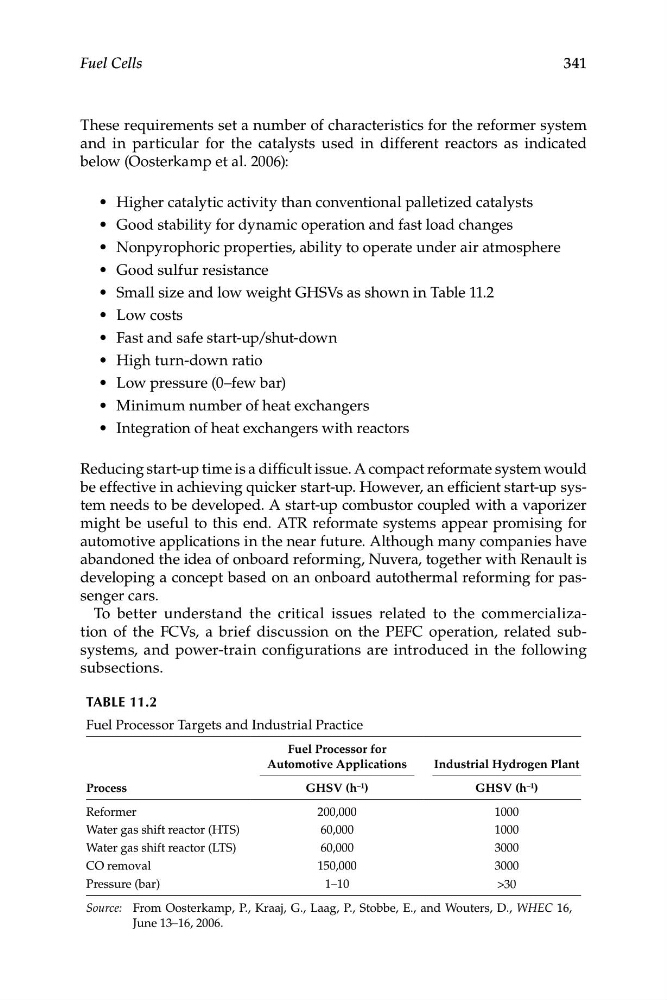
• Small size and low weight GHSVs as shown in Table 11.2
• Low costs
• Fast and safe start-up/shut-down
• High turn-down ratio
• Low pressure (0–few bar)
• Minimum number of heat exchangers
• Integration of heat exchangers with reactors
Reducing start-up time is a difficult issue. A compact reformate system would
be effective in achieving quicker start-up. However, an efficient start-up system needs to be developed. A start-up combustor coupled with a vaporizer
might be useful to this end. ATR reformate systems appear promising for
automotive applications in the near future. Although many companies have
abandoned the idea of onboard reforming, Nuvera, together with Renault is
developing a concept based on an onboard autothermal reforming for passenger cars.
To better understand the critical issues related to the commercialization of the FCVs, a brief discussion on the PEFC operation, related subsystems, and power-train configurations are introduced in the following
subsections.
TABLe 11.2
Fuel Processor Targets and Industrial Practice
Automotive Applications
Industrial Hydrogen Plant
Process
GHSV (h –1 )
GHSV (h –1 )
Reformer
200,000
1000
Water gas shift reactor (HTS)
60,000
1000
Water gas shift reactor (LTS)
60,000
3000
CO removal
150,000
3000
Pressure (bar)
1–10
>30
Source: From Oosterkamp, P., Kraaj, G., Laag, P., Stobbe, E., and Wouters, D., WHEC 16,
June 13–16, 2006.
Fuel Cells
341
These requirements set a number of characteristics for the reformer system
and in particular for the catalysts used in different reactors as indicated
below (Oosterkamp et al. 2006):
• Higher catalytic activity than conventional palletized catalysts
• Good stability for dynamic operation and fast load changes
• Nonpyrophoric properties, ability to operate under air atmosphere
• Good sulfur resistance
• Small size and low weight GHSVs as shown in Table 11.2
• Low costs
• Fast and safe start-up/shut-down
• High turn-down ratio
• Low pressure (0–few bar)
• Minimum number of heat exchangers
• Integration of heat exchangers with reactors
Reducing start-up time is a difficult issue. A compact reformate system would
be effective in achieving quicker start-up. However, an efficient start-up system needs to be developed. A start-up combustor coupled with a vaporizer
might be useful to this end. ATR reformate systems appear promising for
automotive applications in the near future. Although many companies have
abandoned the idea of onboard reforming, Nuvera, together with Renault is
developing a concept based on an onboard autothermal reforming for passenger cars.
To better understand the critical issues related to the commercialization of the FCVs, a brief discussion on the PEFC operation, related subsystems, and power-train configurations are introduced in the following
subsections.
TABLe 11.2
Fuel Processor Targets and Industrial Practice