

318
Alternative Fuels for Transportation
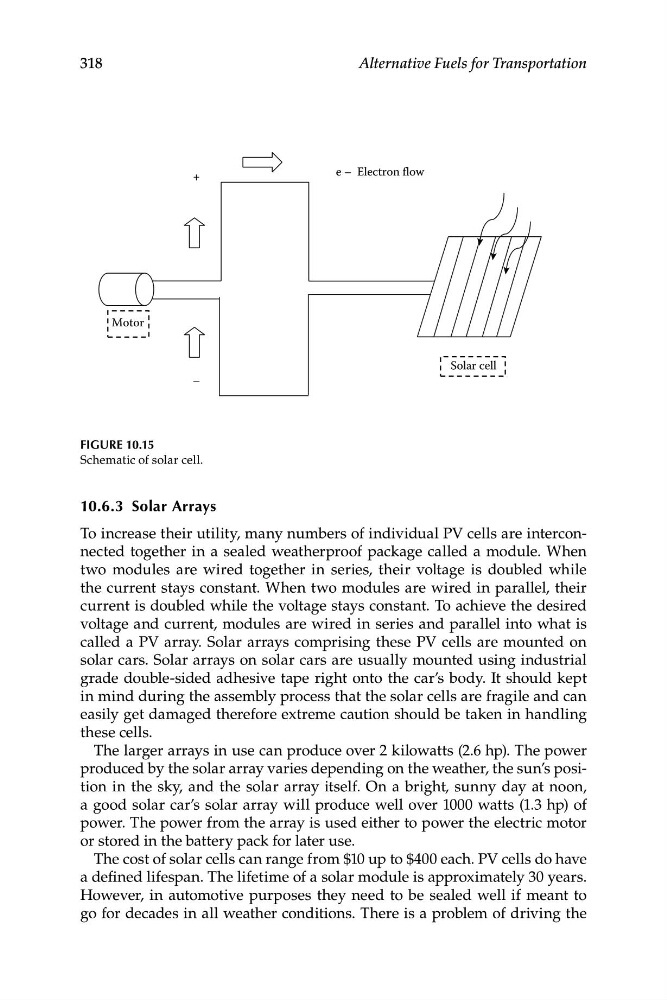
e – Electron flow
+
Motor
Solar cell
–
Figure 10.15
Schematic of solar cell.
10.6.3 Solar Arrays
To increase their utility, many numbers of individual PV cells are interconnected together in a sealed weatherproof package called a module. When
two modules are wired together in series, their voltage is doubled while
the current stays constant. When two modules are wired in parallel, their
current is doubled while the voltage stays constant. To achieve the desired
voltage and current, modules are wired in series and parallel into what is
called a PV array. Solar arrays comprising these PV cells are mounted on
solar cars. Solar arrays on solar cars are usually mounted using industrial
grade double-sided adhesive tape right onto the car’s body. It should kept
in mind during the assembly process that the solar cells are fragile and can
easily get damaged therefore extreme caution should be taken in handling
these cells.
The larger arrays in use can produce over 2 kilowatts (2.6 hp). The power
produced by the solar array varies depending on the weather, the sun’s position in the sky, and the solar array itself. On a bright, sunny day at noon,
a good solar car’s solar array will produce well over 1000 watts (1.3 hp) of
power. The power from the array is used either to power the electric motor
or stored in the battery pack for later use.
The cost of solar cells can range from $10 up to $400 each. PV cells do have
a defined lifespan. The lifetime of a solar module is approximately 30 years.
However, in automotive purposes they need to be sealed well if meant to
go for decades in all weather conditions. There is a problem of driving the
Alternative Fuels for Transportation
e – Electron flow
+
Motor
Solar cell
–
Figure 10.15
Schematic of solar cell.
10.6.3 Solar Arrays
To increase their utility, many numbers of individual PV cells are interconnected together in a sealed weatherproof package called a module. When
two modules are wired together in series, their voltage is doubled while
the current stays constant. When two modules are wired in parallel, their
current is doubled while the voltage stays constant. To achieve the desired
voltage and current, modules are wired in series and parallel into what is
called a PV array. Solar arrays comprising these PV cells are mounted on
solar cars. Solar arrays on solar cars are usually mounted using industrial
grade double-sided adhesive tape right onto the car’s body. It should kept
in mind during the assembly process that the solar cells are fragile and can
easily get damaged therefore extreme caution should be taken in handling
these cells.
The larger arrays in use can produce over 2 kilowatts (2.6 hp). The power
produced by the solar array varies depending on the weather, the sun’s position in the sky, and the solar array itself. On a bright, sunny day at noon,
a good solar car’s solar array will produce well over 1000 watts (1.3 hp) of
power. The power from the array is used either to power the electric motor
or stored in the battery pack for later use.
The cost of solar cells can range from $10 up to $400 each. PV cells do have
a defined lifespan. The lifetime of a solar module is approximately 30 years.
However, in automotive purposes they need to be sealed well if meant to
go for decades in all weather conditions. There is a problem of driving the