

311
t e nt iom e
Accelerator
at 50%
Batteries
96V
96 volts
0 volts
Thousands of pulses per second
48 volts
average
to motor
DC
controller
DC
motor
P
o
t
e
r
Electric Vehicles
or limiting the torque, and protecting against overloads and faults. Motor
controller can be DC or AC current operated therefore it is called DC or AC
controller based on the current it operates. Generally electric motors used in
EVs are DC operated as it is simple to use and control.
A method of controlling motor response in an electrically powered vehicle
having a motor and a manually operable accelerator, comprises these steps:
monitoring the temperature of the motor; determining the maximum available power output based upon the current motor temperature; and adjusting
the motor response to manipulation of the accelerator based upon determining the maximum power by increasing the gain of the motor control signal
as the determined heat increases, wherein the motor control signal corresponds to the manipulation of the accelerator.
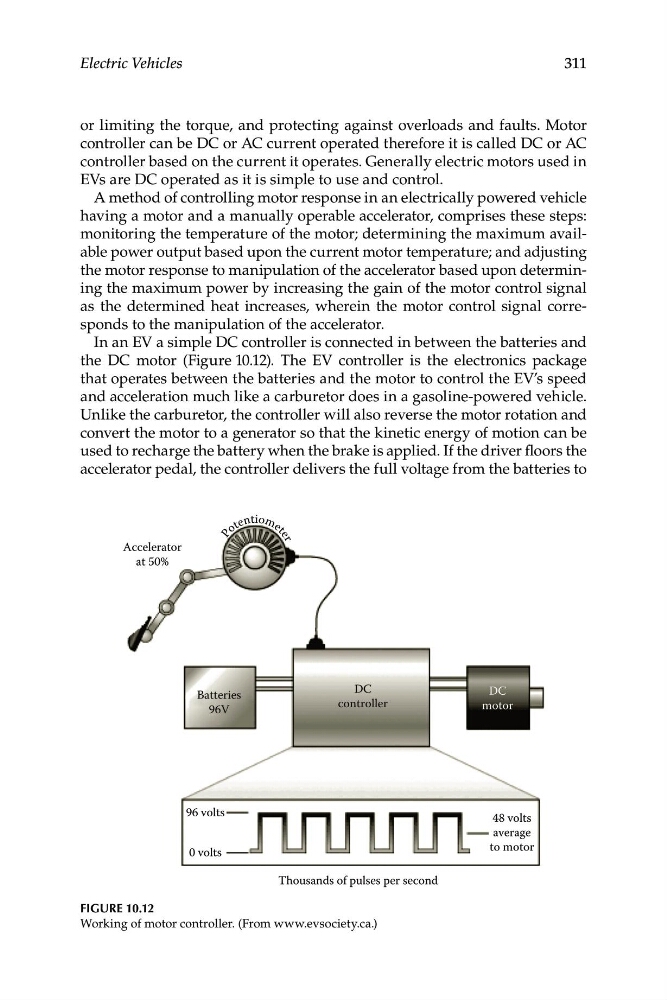
In an EV a simple DC controller is connected in between the batteries and
the DC motor (Figure 10.12). The EV controller is the electronics package
that operates between the batteries and the motor to control the EV’s speed
and acceleration much like a carburetor does in a gasoline-powered vehicle.
Unlike the carburetor, the controller will also reverse the motor rotation and
convert the motor to a generator so that the kinetic energy of motion can be
used to recharge the battery when the brake is applied. If the driver floors the
accelerator pedal, the controller delivers the full voltage from the batteries to
Figure 10.12
Working of motor controller. (From www.evsociety.ca.)
t e nt iom e
Accelerator
at 50%
Batteries
96V
96 volts
0 volts
Thousands of pulses per second
48 volts
average
to motor
DC
controller
DC
motor
P
o
t
e
r
Electric Vehicles
or limiting the torque, and protecting against overloads and faults. Motor
controller can be DC or AC current operated therefore it is called DC or AC
controller based on the current it operates. Generally electric motors used in
EVs are DC operated as it is simple to use and control.
A method of controlling motor response in an electrically powered vehicle
having a motor and a manually operable accelerator, comprises these steps:
monitoring the temperature of the motor; determining the maximum available power output based upon the current motor temperature; and adjusting
the motor response to manipulation of the accelerator based upon determining the maximum power by increasing the gain of the motor control signal
as the determined heat increases, wherein the motor control signal corresponds to the manipulation of the accelerator.
In an EV a simple DC controller is connected in between the batteries and
the DC motor (Figure 10.12). The EV controller is the electronics package
that operates between the batteries and the motor to control the EV’s speed
and acceleration much like a carburetor does in a gasoline-powered vehicle.
Unlike the carburetor, the controller will also reverse the motor rotation and
convert the motor to a generator so that the kinetic energy of motion can be
used to recharge the battery when the brake is applied. If the driver floors the
accelerator pedal, the controller delivers the full voltage from the batteries to
Figure 10.12
Working of motor controller. (From www.evsociety.ca.)