

309
Electric Vehicles
sulfur to the electrode, or lithium sulfide ions to the electrolyte. With recent
advancements, the battery can perform satisfactorily down to –20°C. The
power density of these batteries is around 100 W/kg, which makes it adequate for vehicle acceleration. The battery has a long lifetime with up to 2000
deep discharge cycles.
10.3.2.4.2 Nickel–Zinc
These batteries have an energy density of 70 Wh/kg and a power density of
150 W/kg. The fundamental problem lies with the dendrite growth, which is
common to all zinc-based batteries as it limits the maximum number of deep
discharge cycles to 300. Though a number of attempts have been made in the
past to increase the lifetime, the research and development on zinc-based
batteries slowed down significantly in recent years.
10.3.2.4.3 Nickel–Cadmium
A nickel–cadmium battery uses the same positive electrodes and electrolyte
as the nickel–iron battery, in combination with metallic cadmium negative
electrodes. This technology has seen enormous technical improvement, due
to high specific power over 220 W/kg, long cycle life in the order of 2000
cycles, and low-discharge rate. The disadvantages are the high initial cost,
relative low-cell voltage, and carcinogenicity of cadmium. There are two
types of nickel–cadmium batteries used currently, one is the vented type
and other is the sealed type. The vented sintered plate is a more recent development, which has a high specific energy but is more expensive. Sealed type
incorporates a specific cell design feature to prevent a build-up of pressure
in the cell caused by gassing during overcharge. As a result, the battery
requires no maintenance.
10.3.2.4.4 Nickel-Metal hydride
These batteries have been in use since 1992. The characteristics are similar
to those of the nickel–cadmium batteries. The principle difference between
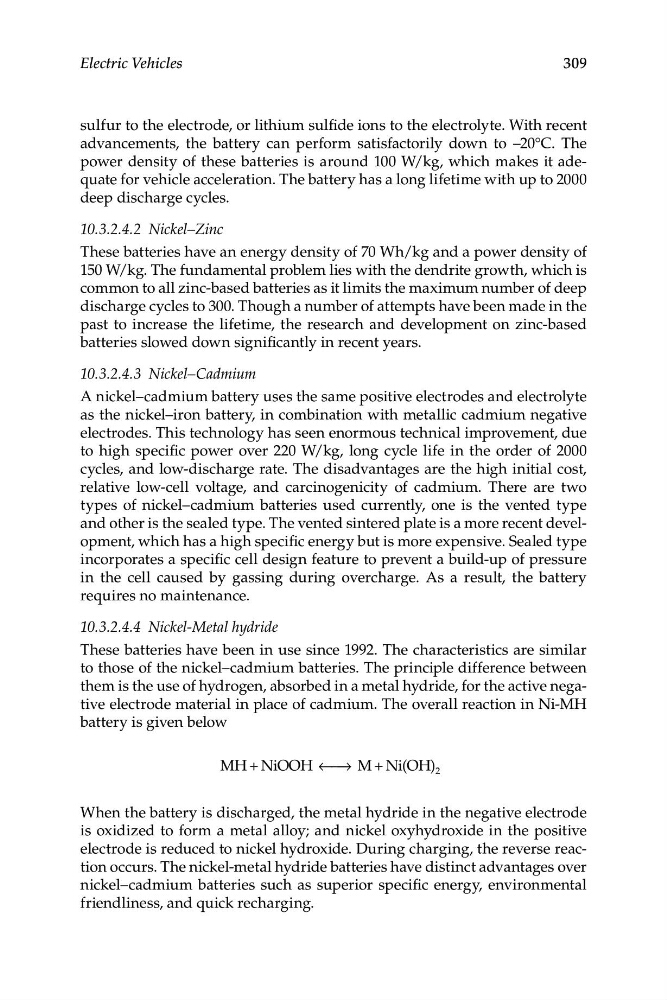
them is the use of hydrogen, absorbed in a metal hydride, for the active negative electrode material in place of cadmium. The overall reaction in Ni-MH
battery is given below
MH + NiOOH ← → +
M Ni(OH) 2
When the battery is discharged, the metal hydride in the negative electrode
is oxidized to form a metal alloy; and nickel oxyhydroxide in the positive
electrode is reduced to nickel hydroxide. During charging, the reverse reaction occurs. The nickel-metal hydride batteries have distinct advantages over
nickel–cadmium batteries such as superior specific energy, environmental
friendliness, and quick recharging.
Electric Vehicles
sulfur to the electrode, or lithium sulfide ions to the electrolyte. With recent
advancements, the battery can perform satisfactorily down to –20°C. The
power density of these batteries is around 100 W/kg, which makes it adequate for vehicle acceleration. The battery has a long lifetime with up to 2000
deep discharge cycles.
10.3.2.4.2 Nickel–Zinc
These batteries have an energy density of 70 Wh/kg and a power density of
150 W/kg. The fundamental problem lies with the dendrite growth, which is
common to all zinc-based batteries as it limits the maximum number of deep
discharge cycles to 300. Though a number of attempts have been made in the
past to increase the lifetime, the research and development on zinc-based
batteries slowed down significantly in recent years.
10.3.2.4.3 Nickel–Cadmium
A nickel–cadmium battery uses the same positive electrodes and electrolyte
as the nickel–iron battery, in combination with metallic cadmium negative
electrodes. This technology has seen enormous technical improvement, due
to high specific power over 220 W/kg, long cycle life in the order of 2000
cycles, and low-discharge rate. The disadvantages are the high initial cost,
relative low-cell voltage, and carcinogenicity of cadmium. There are two
types of nickel–cadmium batteries used currently, one is the vented type
and other is the sealed type. The vented sintered plate is a more recent development, which has a high specific energy but is more expensive. Sealed type
incorporates a specific cell design feature to prevent a build-up of pressure
in the cell caused by gassing during overcharge. As a result, the battery
requires no maintenance.
10.3.2.4.4 Nickel-Metal hydride
These batteries have been in use since 1992. The characteristics are similar
to those of the nickel–cadmium batteries. The principle difference between
them is the use of hydrogen, absorbed in a metal hydride, for the active negative electrode material in place of cadmium. The overall reaction in Ni-MH
battery is given below
MH + NiOOH ← → +
M Ni(OH) 2
When the battery is discharged, the metal hydride in the negative electrode
is oxidized to form a metal alloy; and nickel oxyhydroxide in the positive
electrode is reduced to nickel hydroxide. During charging, the reverse reaction occurs. The nickel-metal hydride batteries have distinct advantages over
nickel–cadmium batteries such as superior specific energy, environmental
friendliness, and quick recharging.