

284
Alternative Fuels for Transportation
depreciation of hysterisis, and safety features. Guo, Shang, and AgueyZinsou (2008) advocates that for optimum H-storage, an ideal storage
system should possess: a high H-storage capacity (>6 or 9 mass% hydrogen,
or 5.5 kg H 2 in a tank that can be fitted under the car seat), a low thermodynamic stability (leading to a low desorption temperature <150°C, under
a moderate pressure), high kinetics for hydrogen absorption/desorption
(<1–2 mass%/minute, e.g., 5 minutes re-filling time), high stability against
O 2 and moisture (hence a long cycle life >500 cycles), good thermal conductivity (for rapid conduction of sorption heat), and low cost <£2.5/kWh.
Hydrogen forms metal hydrides with some metals and alloys leading to
solid-state storage under moderate temperature and pressure that gives them
the important safety advantage over the gas and liquid storage methods.
Metal hydrides have a higher hydrogen-storage density (6.5 H atoms/cm 3
for MgH 2 ) than hydrogen gas (0.99 H atoms/cm 3 ) or liquid hydrogen (4.2
H atoms/cm 3 ). Metal hydrates hydrogen storage systems include Mg-based
metal hydrides, complex hydrides, alanates, and intermetallic compounds.
Magnesium and its alloys for onboard-hydrogen storage is more attractive
due to their high hydrogen storage capacity by weight and low cost. Mg-based
hydrides possess good-quality functional properties, such as heat-resistance,
vibration absorbing, reversibility, and recyclability. Magnesium hydride
has the highest energy density (9 MJ/kg Mg). The main disadvantages of
magnesium hydrates is the high temperature of hydrogen discharge, slow
desorption kinetics, and a high reactivity toward air and oxygen. The increased surface contact with catalyst during ball-milling leads to fast kinetics
of hydrogen transformations. Complex hydrides are known as “one-pass”
hydrogen-storage systems, which means that hydrogen evolves upon contact
with water. Low weight complex hydrides include alanates [AlH4]−, amides
[NH2]−, imides, and borohydrides [BH4]−. Hydrogen content of these complex hydrides can reach 18 mass% for LiBH4 and hydrogen release can occur
at temperatures as low as 150°C for LiAlH4 (Sakintuna and Lamari-Darkrim
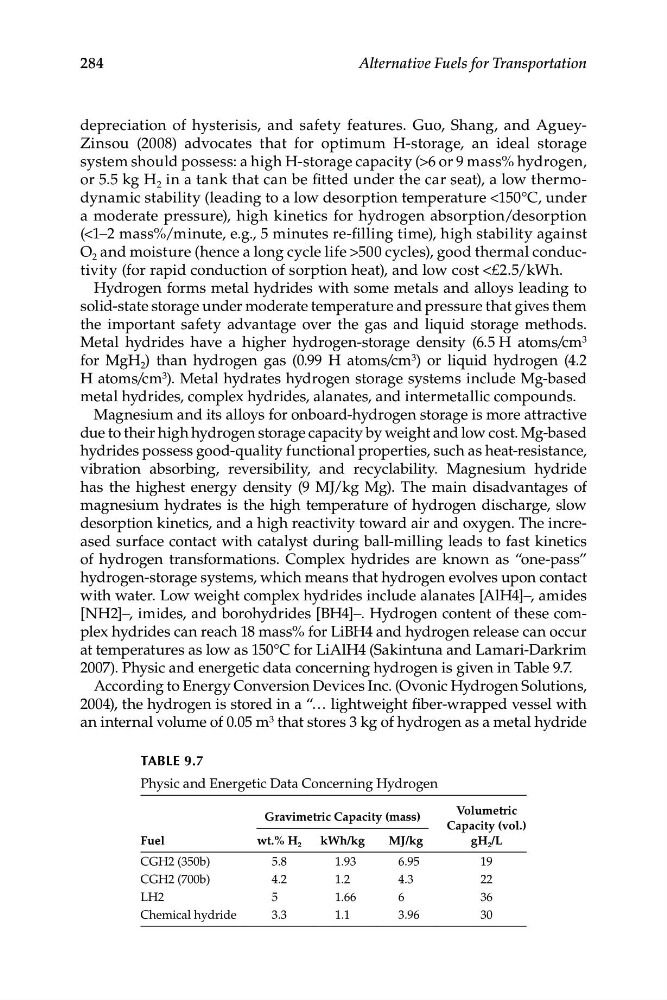
2007). Physic and energetic data concerning hydrogen is given in Table 9.7.
According to Energy Conversion Devices Inc. (Ovonic Hydrogen Solutions,
2004), the hydrogen is stored in a “… lightweight fiber-wrapped vessel with
an internal volume of 0.05 m 3 that stores 3 kg of hydrogen as a metal hydride
TABLe 9.7
Physic and Energetic Data Concerning Hydrogen
Gravimetric Capacity (mass)
Volumetric
Capacity (vol.)
Fuel
wt.% H 2
kWh/kg
MJ/kg
gH 2 /L
CGH2 (350b)
5.8
1.93
6.95
19
CGH2 (700b)
4.2
1.2
4.3
22
LH2
5
1.66
6
36
Chemical hydride
3.3
1.1
3.96
30