

%
16
14
12
10
8
6
4
2
0
HCNG10 λ = 1
HCNG10 λ = 1,4
HCNG15 λ = 1
HCNG15 λ = 1,4
2.99
4.29
8.96
10.18
8.21
10.55
12.69
14.91
Fuel reduction
CO 2 reduction
Hydrogen
281
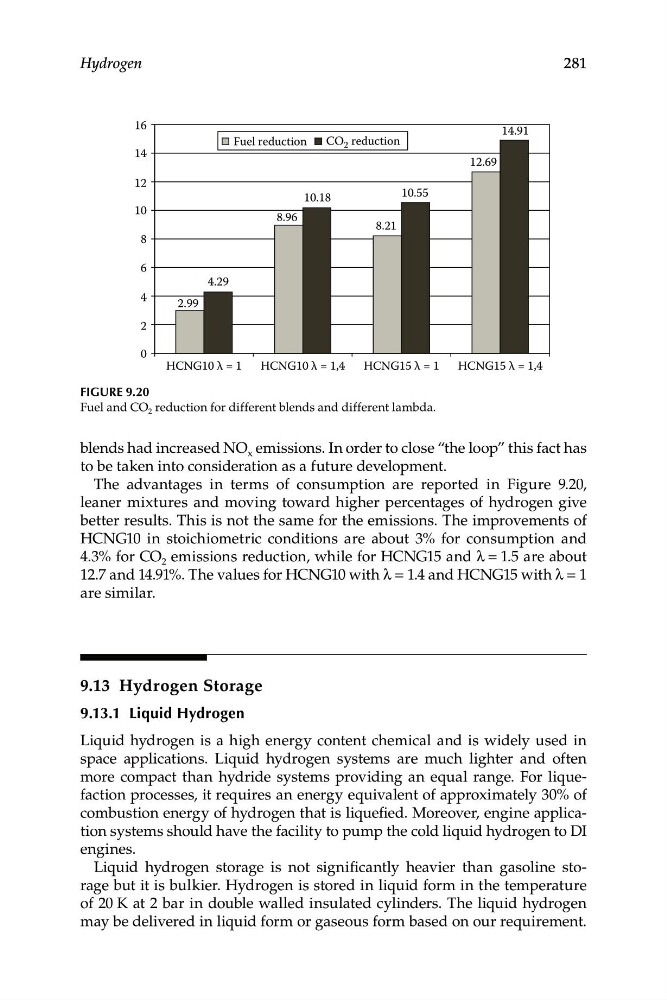
Figure 9.20
Fuel and CO 2 reduction for different blends and different lambda.
blends had increased NO x emissions. In order to close “the loop” this fact has
to be taken into consideration as a future development.
The advantages in terms of consumption are reported in Figure 9.20,
leaner mixtures and moving toward higher percentages of hydrogen give
better results. This is not the same for the emissions. The improvements of
HCNG10 in stoichiometric conditions are about 3% for consumption and
4.3% for CO 2 emissions reduction, while for HCNG15 and λ = 1.5 are about
12.7 and 14.91%. The values for HCNG10 with λ = 1.4 and HCNG15 with λ = 1
are similar.
9.13 Hydrogen Storage
9.13.1 Liquid Hydrogen
Liquid hydrogen is a high energy content chemical and is widely used in
space applications. Liquid hydrogen systems are much lighter and often
more compact than hydride systems providing an equal range. For liquefaction processes, it requires an energy equivalent of approximately 30% of
combustion energy of hydrogen that is liquefied. Moreover, engine application systems should have the facility to pump the cold liquid hydrogen to DI
engines.
Liquid hydrogen storage is not significantly heavier than gasoline storage but it is bulkier. Hydrogen is stored in liquid form in the temperature
of 20 K at 2 bar in double walled insulated cylinders. The liquid hydrogen
may be delivered in liquid form or gaseous form based on our requirement.
16
14
12
10
8
6
4
2
0
HCNG10 λ = 1
HCNG10 λ = 1,4
HCNG15 λ = 1
HCNG15 λ = 1,4
2.99
4.29
8.96
10.18
8.21
10.55
12.69
14.91
Fuel reduction
CO 2 reduction
Hydrogen
281
Figure 9.20
Fuel and CO 2 reduction for different blends and different lambda.
blends had increased NO x emissions. In order to close “the loop” this fact has
to be taken into consideration as a future development.
The advantages in terms of consumption are reported in Figure 9.20,
leaner mixtures and moving toward higher percentages of hydrogen give
better results. This is not the same for the emissions. The improvements of
HCNG10 in stoichiometric conditions are about 3% for consumption and
4.3% for CO 2 emissions reduction, while for HCNG15 and λ = 1.5 are about
12.7 and 14.91%. The values for HCNG10 with λ = 1.4 and HCNG15 with λ = 1
are similar.
9.13 Hydrogen Storage
9.13.1 Liquid Hydrogen
Liquid hydrogen is a high energy content chemical and is widely used in
space applications. Liquid hydrogen systems are much lighter and often
more compact than hydride systems providing an equal range. For liquefaction processes, it requires an energy equivalent of approximately 30% of
combustion energy of hydrogen that is liquefied. Moreover, engine application systems should have the facility to pump the cold liquid hydrogen to DI
engines.
Liquid hydrogen storage is not significantly heavier than gasoline storage but it is bulkier. Hydrogen is stored in liquid form in the temperature
of 20 K at 2 bar in double walled insulated cylinders. The liquid hydrogen
may be delivered in liquid form or gaseous form based on our requirement.