

Hydrogen
279
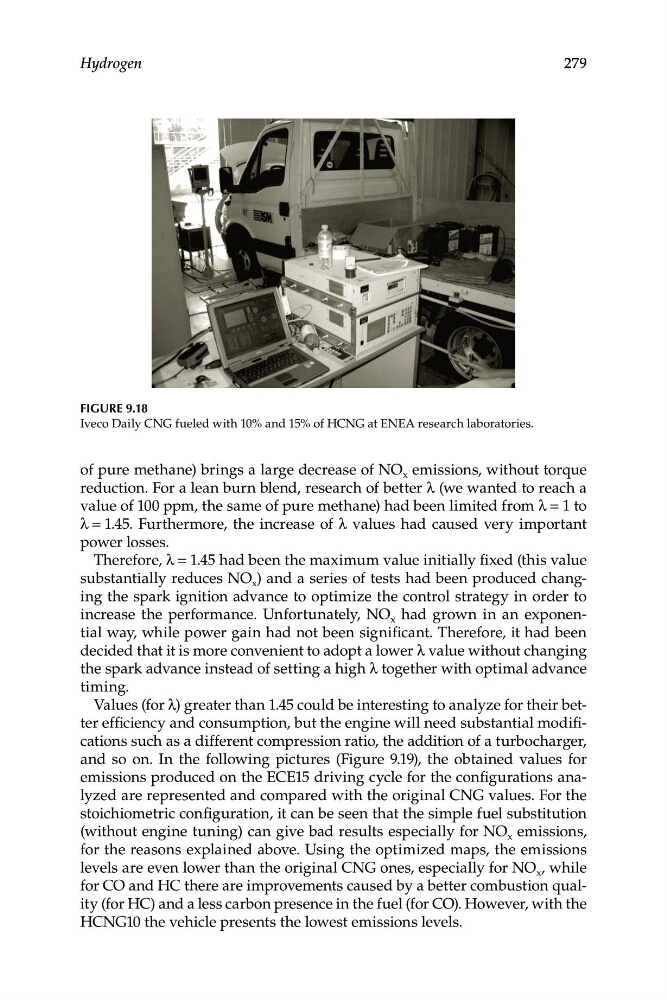
Figure 9.18
Iveco Daily CNG fueled with 10% and 15% of HCNG at ENEA research laboratories.
of pure methane) brings a large decrease of NO x emissions, without torque
reduction. For a lean burn blend, research of better λ (we wanted to reach a
value of 100 ppm, the same of pure methane) had been limited from λ = 1 to
λ = 1.45. Furthermore, the increase of λ values had caused very important
power losses.
Therefore, λ = 1.45 had been the maximum value initially fixed (this value
substantially reduces NO x ) and a series of tests had been produced changing the spark ignition advance to optimize the control strategy in order to
increase the performance. Unfortunately, NO x had grown in an exponential way, while power gain had not been significant. Therefore, it had been
decided that it is more convenient to adopt a lower λ value without changing
the spark advance instead of setting a high λ together with optimal advance
timing.
Values (for λ) greater than 1.45 could be interesting to analyze for their better efficiency and consumption, but the engine will need substantial modifications such as a different compression ratio, the addition of a turbocharger,
and so on. In the following pictures (Figure 9.19), the obtained values for
emissions produced on the ECE15 driving cycle for the configurations analyzed are represented and compared with the original CNG values. For the
stoichiometric configuration, it can be seen that the simple fuel substitution
(without engine tuning) can give bad results especially for NO x emissions,
for the reasons explained above. Using the optimized maps, the emissions
levels are even lower than the original CNG ones, especially for NO x , while
for CO and HC there are improvements caused by a better combustion quality (for HC) and a less carbon presence in the fuel (for CO). However, with the
HCNG10 the vehicle presents the lowest emissions levels.
279
Figure 9.18
Iveco Daily CNG fueled with 10% and 15% of HCNG at ENEA research laboratories.
of pure methane) brings a large decrease of NO x emissions, without torque
reduction. For a lean burn blend, research of better λ (we wanted to reach a
value of 100 ppm, the same of pure methane) had been limited from λ = 1 to
λ = 1.45. Furthermore, the increase of λ values had caused very important
power losses.
Therefore, λ = 1.45 had been the maximum value initially fixed (this value
substantially reduces NO x ) and a series of tests had been produced changing the spark ignition advance to optimize the control strategy in order to
increase the performance. Unfortunately, NO x had grown in an exponential way, while power gain had not been significant. Therefore, it had been
decided that it is more convenient to adopt a lower λ value without changing
the spark advance instead of setting a high λ together with optimal advance
timing.
Values (for λ) greater than 1.45 could be interesting to analyze for their better efficiency and consumption, but the engine will need substantial modifications such as a different compression ratio, the addition of a turbocharger,
and so on. In the following pictures (Figure 9.19), the obtained values for
emissions produced on the ECE15 driving cycle for the configurations analyzed are represented and compared with the original CNG values. For the
stoichiometric configuration, it can be seen that the simple fuel substitution
(without engine tuning) can give bad results especially for NO x emissions,
for the reasons explained above. Using the optimized maps, the emissions
levels are even lower than the original CNG ones, especially for NO x , while
for CO and HC there are improvements caused by a better combustion quality (for HC) and a less carbon presence in the fuel (for CO). However, with the
HCNG10 the vehicle presents the lowest emissions levels.