

Hydrogen
265
• Hydrogen Molten Carbonate Fuel Cells (MCFC): They operate at a
temperature of around 650°C and are currently being considered
mainly for stationary applications.
• Hydrogen Solid Oxide Fuel Cells (SOFC): They are the highest in
temperature (900–1000°C). As with the MCFC, they are currently
being considered mainly for stationary applications.
Fuel-cell based systems for vehicle propulsion have been considered in recent
years mainly for road applications (buses, cars, even scooters); for these the
most adequate typology is constituted by PEFCs, because of their lower
operating temperature; however, for application onboard trains it may happen that higher temperature options are competitive with the PEFC choice. A
single fuel cell is capable of delivering only very small amounts of energy: a
typical operating voltage is around 0.6 V, less than half of a common toy battery. However, they are easily stacked to reach higher voltages, and stacks of
up to 100 kW of nominal power have been built, although it is often preferred
to manufacture smaller stacks (up to 50–60 kW) and combine several stacks
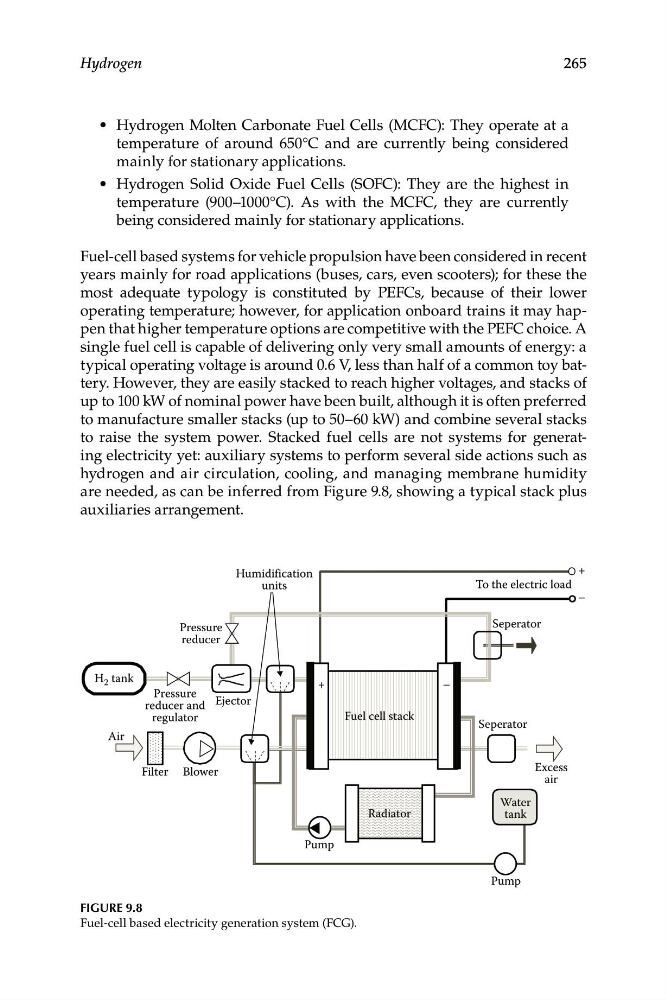
to raise the system power. Stacked fuel cells are not systems for generating electricity yet: auxiliary systems to perform several side actions such as
hydrogen and air circulation, cooling, and managing membrane humidity
are needed, as can be inferred from Figure 9.8, showing a typical stack plus
auxiliaries arrangement.
H 2 tank
Pressure
reducer and
regulator
Pressure
reducer
Fuel cell stack
Seperator
Seperator
+
–
Water
tank
Pump
Pump
Radiator
Ejector
Air
Filter Blower
+
Humidification
units
To the electric load
–
Excess
air
Figure 9.8
Fuel-cell based electricity generation system (FCG).
265
• Hydrogen Molten Carbonate Fuel Cells (MCFC): They operate at a
temperature of around 650°C and are currently being considered
mainly for stationary applications.
• Hydrogen Solid Oxide Fuel Cells (SOFC): They are the highest in
temperature (900–1000°C). As with the MCFC, they are currently
being considered mainly for stationary applications.
Fuel-cell based systems for vehicle propulsion have been considered in recent
years mainly for road applications (buses, cars, even scooters); for these the
most adequate typology is constituted by PEFCs, because of their lower
operating temperature; however, for application onboard trains it may happen that higher temperature options are competitive with the PEFC choice. A
single fuel cell is capable of delivering only very small amounts of energy: a
typical operating voltage is around 0.6 V, less than half of a common toy battery. However, they are easily stacked to reach higher voltages, and stacks of
up to 100 kW of nominal power have been built, although it is often preferred
to manufacture smaller stacks (up to 50–60 kW) and combine several stacks
to raise the system power. Stacked fuel cells are not systems for generating electricity yet: auxiliary systems to perform several side actions such as
hydrogen and air circulation, cooling, and managing membrane humidity
are needed, as can be inferred from Figure 9.8, showing a typical stack plus
auxiliaries arrangement.
H 2 tank
Pressure
reducer and
regulator
Pressure
reducer
Fuel cell stack
Seperator
Seperator
+
–
Water
tank
Pump
Pump
Radiator
Ejector
Air
Filter Blower
+
Humidification
units
To the electric load
–
Excess
air
Figure 9.8
Fuel-cell based electricity generation system (FCG).