

Activity matrix
Risk control
Phenomena
Application/
scenarios
Distribution Fires and
explosions
Mitigation
Risk
analysis
RC&S
Production
Transport
PIRT
Refueling
Street
vehicles
Other
vehicles
Portables
Stationary
Preliminary ranking
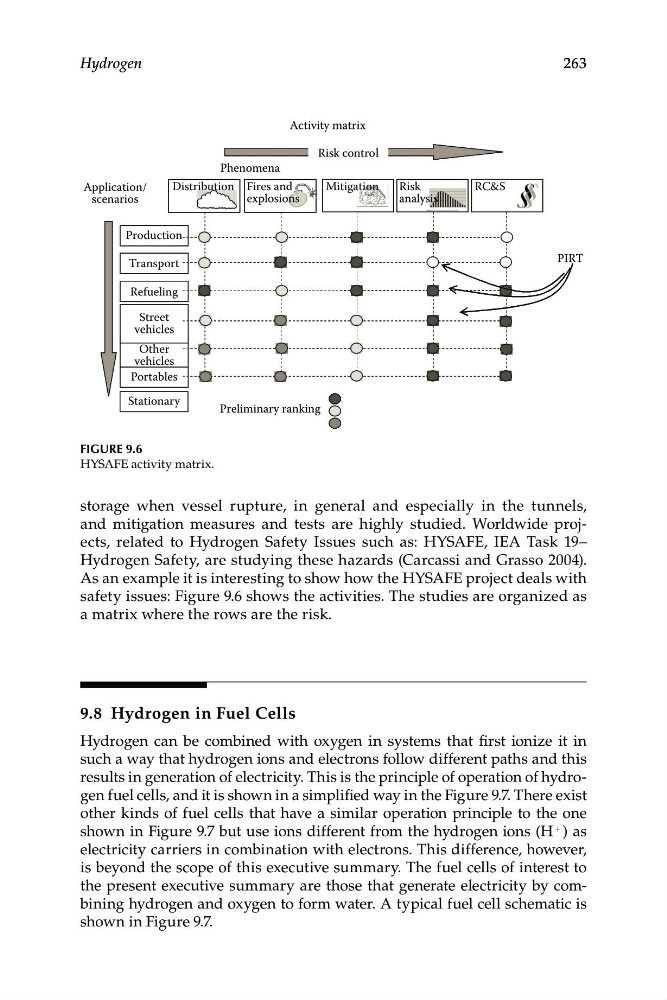
Figure 9.6
HYSAFE activity matrix.
Hydrogen
263
storage when vessel rupture, in general and especially in the tunnels,
and mitigation measures and tests are highly studied. Worldwide projects, related to Hydrogen Safety Issues such as: HYSAFE, IEA Task 19–
Hydrogen Safety, are studying these hazards (Carcassi and Grasso 2004).
As an example it is interesting to show how the HYSAFE project deals with
safety issues: Figure 9.6 shows the activities. The studies are organized as
a matrix where the rows are the risk.
9.8 Hydrogen in Fuel Cells
Hydrogen can be combined with oxygen in systems that first ionize it in
such a way that hydrogen ions and electrons follow different paths and this
results in generation of electricity. This is the principle of operation of hydrogen fuel cells, and it is shown in a simplified way in the Figure 9.7. There exist
other kinds of fuel cells that have a similar operation principle to the one
shown in Figure 9.7 but use ions different from the hydrogen ions (H + ) as
electricity carriers in combination with electrons. This difference, however,
is beyond the scope of this executive summary. The fuel cells of interest to
the present executive summary are those that generate electricity by combining hydrogen and oxygen to form water. A typical fuel cell schematic is
shown in Figure 9.7.
Risk control
Phenomena
Application/
scenarios
Distribution Fires and
explosions
Mitigation
Risk
analysis
RC&S
Production
Transport
PIRT
Refueling
Street
vehicles
Other
vehicles
Portables
Stationary
Preliminary ranking
Figure 9.6
HYSAFE activity matrix.
Hydrogen
263
storage when vessel rupture, in general and especially in the tunnels,
and mitigation measures and tests are highly studied. Worldwide projects, related to Hydrogen Safety Issues such as: HYSAFE, IEA Task 19–
Hydrogen Safety, are studying these hazards (Carcassi and Grasso 2004).
As an example it is interesting to show how the HYSAFE project deals with
safety issues: Figure 9.6 shows the activities. The studies are organized as
a matrix where the rows are the risk.
9.8 Hydrogen in Fuel Cells
Hydrogen can be combined with oxygen in systems that first ionize it in
such a way that hydrogen ions and electrons follow different paths and this
results in generation of electricity. This is the principle of operation of hydrogen fuel cells, and it is shown in a simplified way in the Figure 9.7. There exist
other kinds of fuel cells that have a similar operation principle to the one
shown in Figure 9.7 but use ions different from the hydrogen ions (H + ) as
electricity carriers in combination with electrons. This difference, however,
is beyond the scope of this executive summary. The fuel cells of interest to
the present executive summary are those that generate electricity by combining hydrogen and oxygen to form water. A typical fuel cell schematic is
shown in Figure 9.7.