

No
HC m on
2
2
2 H
6
2 H
6
3 H
8
3 H
8
2
2
H
4
2
2
2 H
6
2 H
6
3 H
8
3 H
8
2
2
H
4
2
2
2 H
6
2 H
6
3 H
8
3 H
8
2
2
H
4
2
2
2 H
6
2 H
6
3 H
8
3 H
8
2
2
H
4
CO m on
P
e issi s
emissions
s
relative to natural ga
x
s
relative to natural ga
1.4
1.3
1.2
1.1
1.0
0.9
0.8
0.7
0.6
1.8
1.6
1.4
1.2
1
0.8
0.6
0.4
0.2
0
20% N
20% N
40% N
6.7% C
40% N
6.7% C
8.6% C
8.6% C
2.2% C
2.2% C
3.8% C
3.8% C
15% H
15% H
0°ATDC 5°ATDC 10°ATDC
35% H
100% C
35% H
100% C
e issi s
M total mass emissions
s
relative to natural gas
relative to natural ga
15°ATDC
1.2
1.0
0.8
0.6
0.4
0.2
0.0
3
2.5
2
1.5
1
0.5
0
20% N
20% N
40% N
40% N
6.7% C
6.7% C
8.6% C
8.6% C
2.2% C
2.2% C
3.8% C
3.8% C
15% H
15% H
35% H
35% H
100% C
100% C
239
Compressed Natural Gas
impact on emissions. The influence of fuel composition varies strongly with
combustion timing. With N 2 dilution, the increase at early timings has been
attributed to reaction zone impingement, while the relatively small reduction at late timings is a result of the emissions being primarily volatiles. Car
makers are making dual fuel engine CNG–gasoline for passenger cars.
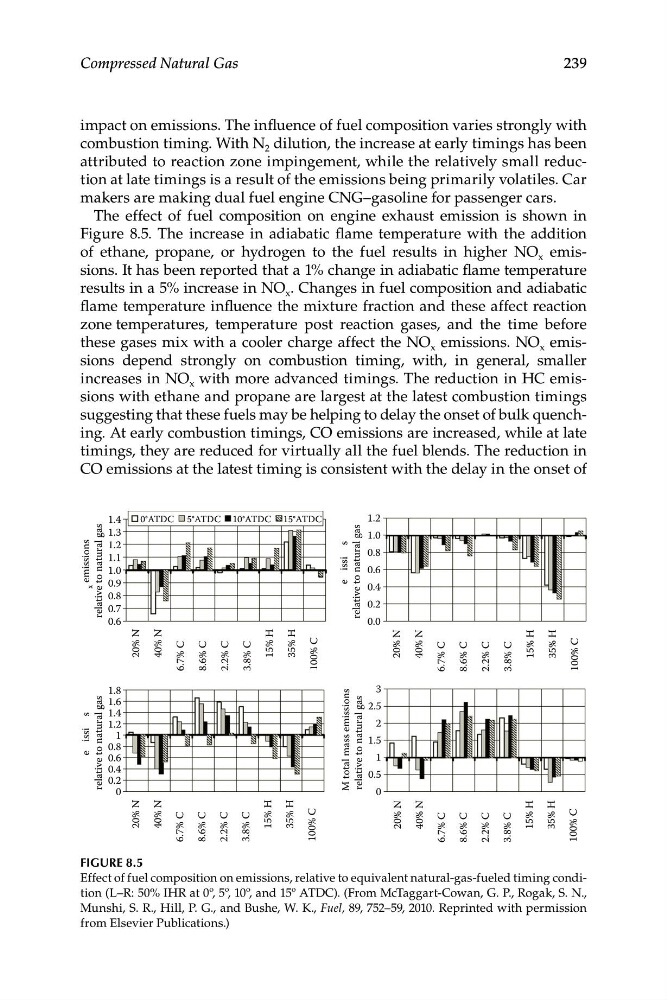
The effect of fuel composition on engine exhaust emission is shown in
Figure 8.5. The increase in adiabatic flame temperature with the addition
of ethane, propane, or hydrogen to the fuel results in higher NO x emissions. It has been reported that a 1% change in adiabatic flame temperature
results in a 5% increase in NO x . Changes in fuel composition and adiabatic
flame temperature influence the mixture fraction and these affect reaction
zone temperatures, temperature post reaction gases, and the time before
these gases mix with a cooler charge affect the NO x emissions. NO x emissions depend strongly on combustion timing, with, in general, smaller
increases in NO x with more advanced timings. The reduction in HC emissions with ethane and propane are largest at the latest combustion timings
suggesting that these fuels may be helping to delay the onset of bulk quenching. At early combustion timings, CO emissions are increased, while at late
timings, they are reduced for virtually all the fuel blends. The reduction in
CO emissions at the latest timing is consistent with the delay in the onset of
Figure 8.5
Effect of fuel composition on emissions, relative to equivalent natural-gas-fueled timing condition (L–R: 50% IHR at 0º, 5º, 10º, and 15º ATDC). (From McTaggart-Cowan, G. P., Rogak, S. N.,
Munshi, S. R., Hill, P. G., and Bushe, W. K., Fuel, 89, 752–59, 2010. Reprinted with permission
from Elsevier Publications.)
HC m on
2
2
2 H
6
2 H
6
3 H
8
3 H
8
2
2
H
4
2
2
2 H
6
2 H
6
3 H
8
3 H
8
2
2
H
4
2
2
2 H
6
2 H
6
3 H
8
3 H
8
2
2
H
4
2
2
2 H
6
2 H
6
3 H
8
3 H
8
2
2
H
4
CO m on
P
e issi s
emissions
s
relative to natural ga
x
s
relative to natural ga
1.4
1.3
1.2
1.1
1.0
0.9
0.8
0.7
0.6
1.8
1.6
1.4
1.2
1
0.8
0.6
0.4
0.2
0
20% N
20% N
40% N
6.7% C
40% N
6.7% C
8.6% C
8.6% C
2.2% C
2.2% C
3.8% C
3.8% C
15% H
15% H
0°ATDC 5°ATDC 10°ATDC
35% H
100% C
35% H
100% C
e issi s
M total mass emissions
s
relative to natural gas
relative to natural ga
15°ATDC
1.2
1.0
0.8
0.6
0.4
0.2
0.0
3
2.5
2
1.5
1
0.5
0
20% N
20% N
40% N
40% N
6.7% C
6.7% C
8.6% C
8.6% C
2.2% C
2.2% C
3.8% C
3.8% C
15% H
15% H
35% H
35% H
100% C
100% C
239
Compressed Natural Gas
impact on emissions. The influence of fuel composition varies strongly with
combustion timing. With N 2 dilution, the increase at early timings has been
attributed to reaction zone impingement, while the relatively small reduction at late timings is a result of the emissions being primarily volatiles. Car
makers are making dual fuel engine CNG–gasoline for passenger cars.
The effect of fuel composition on engine exhaust emission is shown in
Figure 8.5. The increase in adiabatic flame temperature with the addition
of ethane, propane, or hydrogen to the fuel results in higher NO x emissions. It has been reported that a 1% change in adiabatic flame temperature
results in a 5% increase in NO x . Changes in fuel composition and adiabatic
flame temperature influence the mixture fraction and these affect reaction
zone temperatures, temperature post reaction gases, and the time before
these gases mix with a cooler charge affect the NO x emissions. NO x emissions depend strongly on combustion timing, with, in general, smaller
increases in NO x with more advanced timings. The reduction in HC emissions with ethane and propane are largest at the latest combustion timings
suggesting that these fuels may be helping to delay the onset of bulk quenching. At early combustion timings, CO emissions are increased, while at late
timings, they are reduced for virtually all the fuel blends. The reduction in
CO emissions at the latest timing is consistent with the delay in the onset of
Figure 8.5
Effect of fuel composition on emissions, relative to equivalent natural-gas-fueled timing condition (L–R: 50% IHR at 0º, 5º, 10º, and 15º ATDC). (From McTaggart-Cowan, G. P., Rogak, S. N.,
Munshi, S. R., Hill, P. G., and Bushe, W. K., Fuel, 89, 752–59, 2010. Reprinted with permission
from Elsevier Publications.)