

231
Compressed Natural Gas
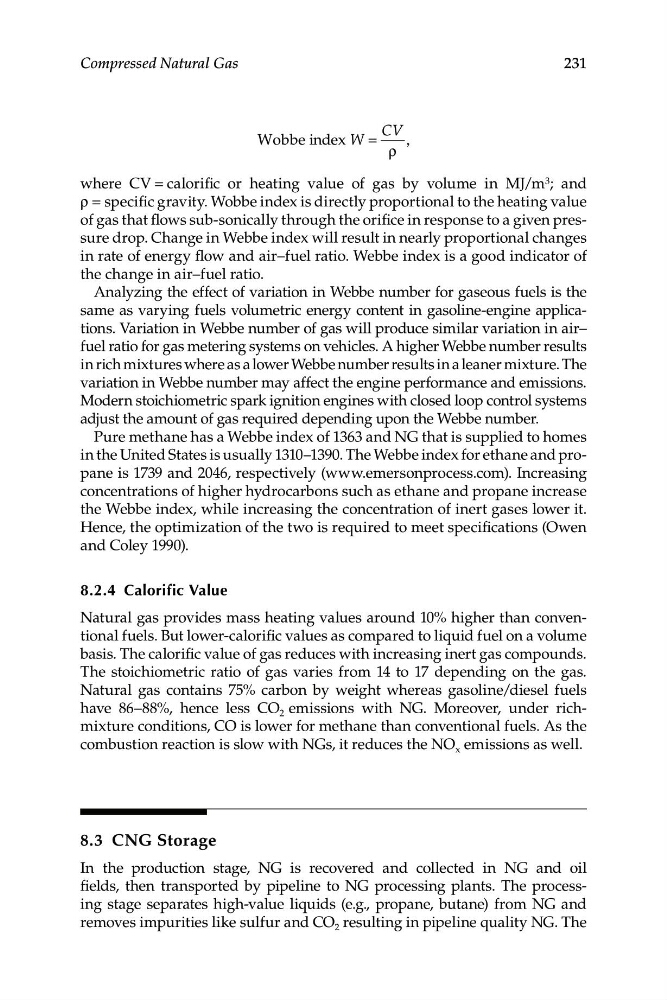
CV
Wobbe index W =
,
ρ
where CV = calorific or heating value of gas by volume in MJ/m 3 ; and
ρ = specific gravity. Wobbe index is directly proportional to the heating value
of gas that flows sub-sonically through the orifice in response to a given pressure drop. Change in Webbe index will result in nearly proportional changes
in rate of energy flow and air–fuel ratio. Webbe index is a good indicator of
the change in air–fuel ratio.
Analyzing the effect of variation in Webbe number for gaseous fuels is the
same as varying fuels volumetric energy content in gasoline-engine applications. Variation in Webbe number of gas will produce similar variation in air–
fuel ratio for gas metering systems on vehicles. A higher Webbe number results
in rich mixtures where as a lower Webbe number results in a leaner mixture. The
variation in Webbe number may affect the engine performance and emissions.
Modern stoichiometric spark ignition engines with closed loop control systems
adjust the amount of gas required depending upon the Webbe number.
Pure methane has a Webbe index of 1363 and NG that is supplied to homes
in the United States is usually 1310–1390. The Webbe index for ethane and propane is 1739 and 2046, respectively (www.emersonprocess.com). Increasing
concentrations of higher hydrocarbons such as ethane and propane increase
the Webbe index, while increasing the concentration of inert gases lower it.
Hence, the optimization of the two is required to meet specifications (Owen
and Coley 1990).
8.2.4 Calorific Value
Natural gas provides mass heating values around 10% higher than conventional fuels. But lower-calorific values as compared to liquid fuel on a volume
basis. The calorific value of gas reduces with increasing inert gas compounds.
The stoichiometric ratio of gas varies from 14 to 17 depending on the gas.
Natural gas contains 75% carbon by weight whereas gasoline/diesel fuels
have 86–88%, hence less CO 2 emissions with NG. Moreover, under richmixture conditions, CO is lower for methane than conventional fuels. As the
combustion reaction is slow with NGs, it reduces the NO x emissions as well.
8.3 CNG Storage
In the production stage, NG is recovered and collected in NG and oil
fields, then transported by pipeline to NG processing plants. The processing stage separates high-value liquids (e.g., propane, butane) from NG and
removes impurities like sulfur and CO 2 resulting in pipeline quality NG. The