

Natural gas
Direct
Indirect
CNG
Fischer tropsch liquids
Gasoline
LNG
Diesel
Methanol
Biodiesel
MTBE
228
Alternative Fuels for Transportation
where almost 300,000 vehicles are fueled by NG. However, the acceptance of
NG for vehicles somewhat reduce the fuel dependency. Compressed Natural
Gas (CNG) was successfully applied to over 1,000,000 vehicles in many parts
of the world such as Argentina, Russia, and Italy and is gaining increasing
acceptance particularly for transport vehicles such as taxis, buses, and garbage tippers. Currently more than 1,000,000 vehicles worldwide are powered
by NG (Carvalho 1985).
Natural gas occurs as gas under pressure in rocks beneath the earth’s
surface or often in solution with crude oil as a volatile fraction of petroleum. It does not require elaborate processing or refining as petroleum
liquid fuels. It is a natural hydrocarbon energy formed in the earth’s crust
by millions of years of biological action on organic matter. It occurs along
with oil deep in the earth’s crust and is recovered from wells under very
high pressure.
Natural gas can be used in combined cycle power plants, as the efficiency is much greater than conventional steam cycle plants. Natural gas
produces less than half the CO 2 emissions per unit of generated electricity compared to the conventional fuels, which is an important factor as
the emission of greenhouse gases, sulfur dioxide, and dust are becoming
increasingly unacceptable worldwide. Natural gas is difficult to store or
transport because of its physical nature and needs high pressures and/
or low temperatures to increase the bulk density, whereas oil is readily
stored in large, relatively simple, and cheap tanks and then transported
in huge tankers. Natural gas reaches the public for use for transportation
through pipelines, liquefied natural gas (LNG), gas to liquids (GTL), converted as electricity, CNG, and in metal hydrates (Thomas and Dawe 2003).
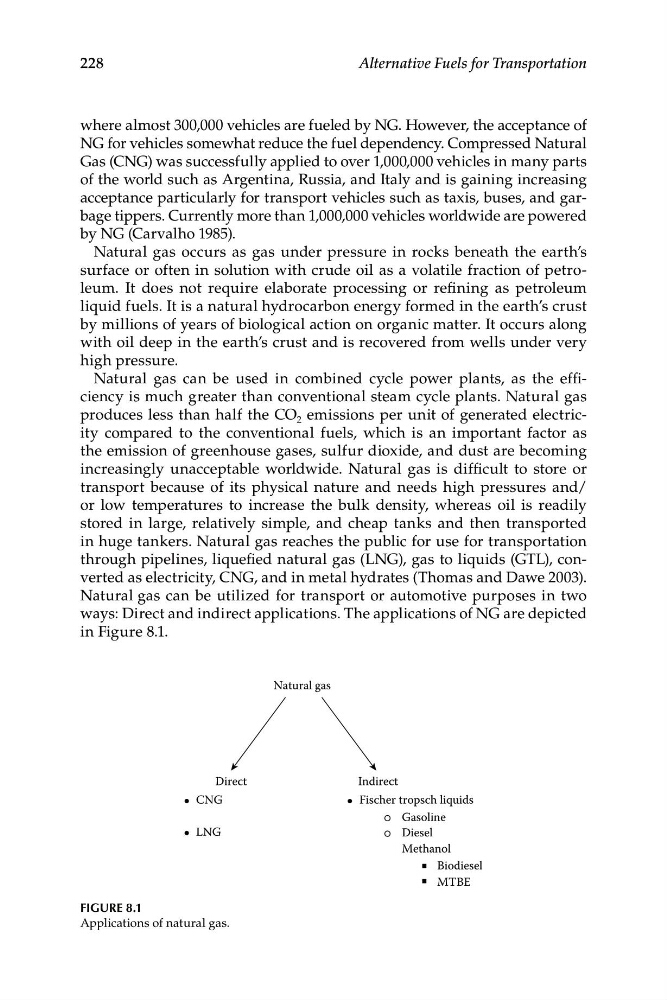
Natural gas can be utilized for transport or automotive purposes in two
ways: Direct and indirect applications. The applications of NG are depicted
in Figure 8.1.
Figure 8.1
Applications of natural gas.
Direct
Indirect
CNG
Fischer tropsch liquids
Gasoline
LNG
Diesel
Methanol
Biodiesel
MTBE
228
Alternative Fuels for Transportation
where almost 300,000 vehicles are fueled by NG. However, the acceptance of
NG for vehicles somewhat reduce the fuel dependency. Compressed Natural
Gas (CNG) was successfully applied to over 1,000,000 vehicles in many parts
of the world such as Argentina, Russia, and Italy and is gaining increasing
acceptance particularly for transport vehicles such as taxis, buses, and garbage tippers. Currently more than 1,000,000 vehicles worldwide are powered
by NG (Carvalho 1985).
Natural gas occurs as gas under pressure in rocks beneath the earth’s
surface or often in solution with crude oil as a volatile fraction of petroleum. It does not require elaborate processing or refining as petroleum
liquid fuels. It is a natural hydrocarbon energy formed in the earth’s crust
by millions of years of biological action on organic matter. It occurs along
with oil deep in the earth’s crust and is recovered from wells under very
high pressure.
Natural gas can be used in combined cycle power plants, as the efficiency is much greater than conventional steam cycle plants. Natural gas
produces less than half the CO 2 emissions per unit of generated electricity compared to the conventional fuels, which is an important factor as
the emission of greenhouse gases, sulfur dioxide, and dust are becoming
increasingly unacceptable worldwide. Natural gas is difficult to store or
transport because of its physical nature and needs high pressures and/
or low temperatures to increase the bulk density, whereas oil is readily
stored in large, relatively simple, and cheap tanks and then transported
in huge tankers. Natural gas reaches the public for use for transportation
through pipelines, liquefied natural gas (LNG), gas to liquids (GTL), converted as electricity, CNG, and in metal hydrates (Thomas and Dawe 2003).
Natural gas can be utilized for transport or automotive purposes in two
ways: Direct and indirect applications. The applications of NG are depicted
in Figure 8.1.
Figure 8.1
Applications of natural gas.