

222
Alternative Fuels for Transportation
Cylindrical
shell
Shell
a
b
c
L
t
Torispherical end
ID
Weld zone
Weld zone
Weld zone
Crown
Knuckle
Flange
R k
R c
t
d
Torispherical
head
Torispherical
head
Cylindrical body
Label
Knuckle
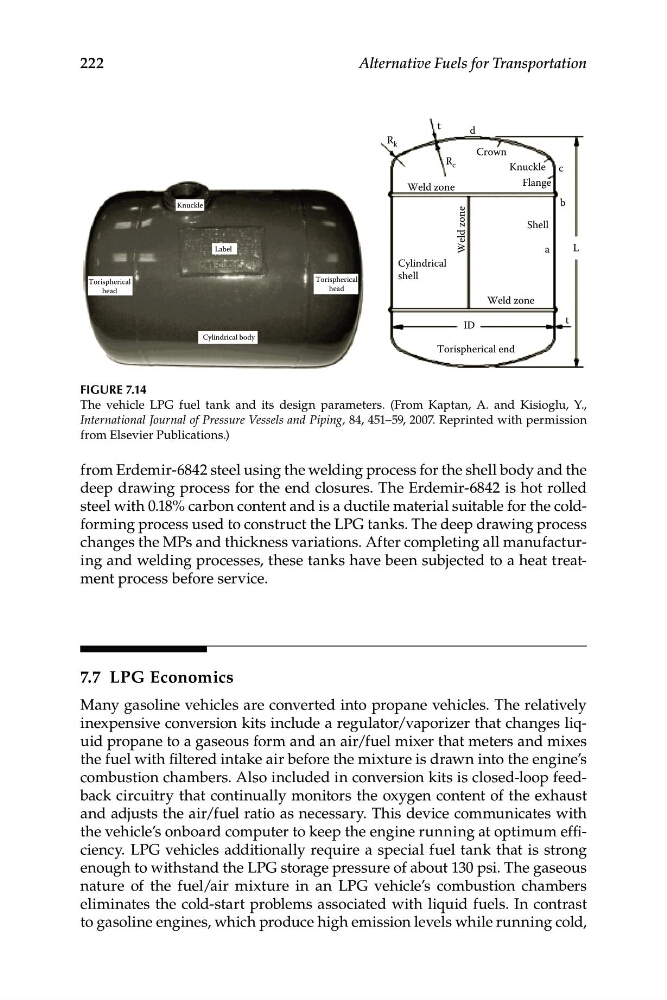
Figure 7.14
The vehicle LPG fuel tank and its design parameters. (From Kaptan, A. and Kisioglu, Y.,
International Journal of Pressure Vessels and Piping, 84, 451–59, 2007. Reprinted with permission
from Elsevier Publications.)
from Erdemir-6842 steel using the welding process for the shell body and the
deep drawing process for the end closures. The Erdemir-6842 is hot rolled
steel with 0.18% carbon content and is a ductile material suitable for the coldforming process used to construct the LPG tanks. The deep drawing process
changes the MPs and thickness variations. After completing all manufacturing and welding processes, these tanks have been subjected to a heat treatment process before service.
7.7 LPG Economics
Many gasoline vehicles are converted into propane vehicles. The relatively
inexpensive conversion kits include a regulator/vaporizer that changes liquid propane to a gaseous form and an air/fuel mixer that meters and mixes
the fuel with filtered intake air before the mixture is drawn into the engine’s
combustion chambers. Also included in conversion kits is closed-loop feedback circuitry that continually monitors the oxygen content of the exhaust
and adjusts the air/fuel ratio as necessary. This device communicates with
the vehicle’s onboard computer to keep the engine running at optimum efficiency. LPG vehicles additionally require a special fuel tank that is strong
enough to withstand the LPG storage pressure of about 130 psi. The gaseous
nature of the fuel/air mixture in an LPG vehicle’s combustion chambers
eliminates the cold-start problems associated with liquid fuels. In contrast
to gasoline engines, which produce high emission levels while running cold,
Alternative Fuels for Transportation
Cylindrical
shell
Shell
a
b
c
L
t
Torispherical end
ID
Weld zone
Weld zone
Weld zone
Crown
Knuckle
Flange
R k
R c
t
d
Torispherical
head
Torispherical
head
Cylindrical body
Label
Knuckle
Figure 7.14
The vehicle LPG fuel tank and its design parameters. (From Kaptan, A. and Kisioglu, Y.,
International Journal of Pressure Vessels and Piping, 84, 451–59, 2007. Reprinted with permission
from Elsevier Publications.)
from Erdemir-6842 steel using the welding process for the shell body and the
deep drawing process for the end closures. The Erdemir-6842 is hot rolled
steel with 0.18% carbon content and is a ductile material suitable for the coldforming process used to construct the LPG tanks. The deep drawing process
changes the MPs and thickness variations. After completing all manufacturing and welding processes, these tanks have been subjected to a heat treatment process before service.
7.7 LPG Economics
Many gasoline vehicles are converted into propane vehicles. The relatively
inexpensive conversion kits include a regulator/vaporizer that changes liquid propane to a gaseous form and an air/fuel mixer that meters and mixes
the fuel with filtered intake air before the mixture is drawn into the engine’s
combustion chambers. Also included in conversion kits is closed-loop feedback circuitry that continually monitors the oxygen content of the exhaust
and adjusts the air/fuel ratio as necessary. This device communicates with
the vehicle’s onboard computer to keep the engine running at optimum efficiency. LPG vehicles additionally require a special fuel tank that is strong
enough to withstand the LPG storage pressure of about 130 psi. The gaseous
nature of the fuel/air mixture in an LPG vehicle’s combustion chambers
eliminates the cold-start problems associated with liquid fuels. In contrast
to gasoline engines, which produce high emission levels while running cold,