

215
Liquefied Petroleum Gas
is injected near the end of the compression stroke, which initiates the combustion of the gas–air mixture. Diesel fuel autoignites and creates ignition
sources for the surrounding gaseous fuel mixture.
There are other advantages for dual fuel engines using gaseous fuels.
Gaseous fuel satisfies the previous requirements as a result of its worldwide
usage. It has a high octane number and therefore it is suitable for engines
with relatively high compressions ratios. Moreover, it mixes uniformly with
air, resulting in efficient combustion and substantial reduction of emissions
in the exhaust gas. Further, the exhaust smoke density of dual fuel engines
is much lower than for diesel engines. However, some disadvantages of the
two fuels currently prevent them from achieving widespread use. Gaseous
fuel has a lower energy density relative to gasoline, so vehicles have to carry
large gaseous fuel tanks in order to obtain acceptable mileage range. Large
tanks occupy a lot of useful space and their additional weight requires significant power. The volume of gaseous fuels displaces some portion of intake
air in the engine resulting in a loss of power and torque.
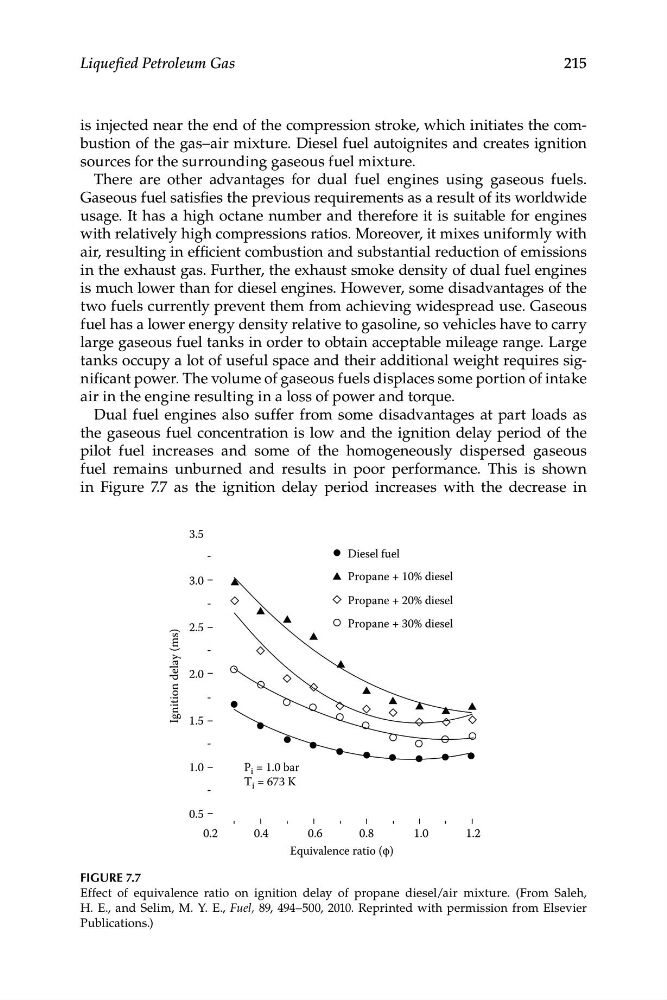
Dual fuel engines also suffer from some disadvantages at part loads as
the gaseous fuel concentration is low and the ignition delay period of the
pilot fuel increases and some of the homogeneously dispersed gaseous
fuel remains unburned and results in poor performance. This is shown
in Figure 7.7 as the ignition delay period increases with the decrease in
3.5
3.0
2.5
2.0
1.5
1.0
0.5
Ignition delay (ms)
P i = 1.0 bar
T i = 673 K
Diesel fuel
Propane + 10% diesel
Propane + 20% diesel
Propane + 30% diesel
0.2
0.4
0.6
0.8
1.0
1.2
Equivalence ratio (φ)
Figure 7.7
Effect of equivalence ratio on ignition delay of propane diesel/air mixture. (From Saleh,
H. E., and Selim, M. Y. E., Fuel, 89, 494–500, 2010. Reprinted with permission from Elsevier
Publications.)
Liquefied Petroleum Gas
is injected near the end of the compression stroke, which initiates the combustion of the gas–air mixture. Diesel fuel autoignites and creates ignition
sources for the surrounding gaseous fuel mixture.
There are other advantages for dual fuel engines using gaseous fuels.
Gaseous fuel satisfies the previous requirements as a result of its worldwide
usage. It has a high octane number and therefore it is suitable for engines
with relatively high compressions ratios. Moreover, it mixes uniformly with
air, resulting in efficient combustion and substantial reduction of emissions
in the exhaust gas. Further, the exhaust smoke density of dual fuel engines
is much lower than for diesel engines. However, some disadvantages of the
two fuels currently prevent them from achieving widespread use. Gaseous
fuel has a lower energy density relative to gasoline, so vehicles have to carry
large gaseous fuel tanks in order to obtain acceptable mileage range. Large
tanks occupy a lot of useful space and their additional weight requires significant power. The volume of gaseous fuels displaces some portion of intake
air in the engine resulting in a loss of power and torque.
Dual fuel engines also suffer from some disadvantages at part loads as
the gaseous fuel concentration is low and the ignition delay period of the
pilot fuel increases and some of the homogeneously dispersed gaseous
fuel remains unburned and results in poor performance. This is shown
in Figure 7.7 as the ignition delay period increases with the decrease in
3.5
3.0
2.5
2.0
1.5
1.0
0.5
Ignition delay (ms)
P i = 1.0 bar
T i = 673 K
Diesel fuel
Propane + 10% diesel
Propane + 20% diesel
Propane + 30% diesel
0.2
0.4
0.6
0.8
1.0
1.2
Equivalence ratio (φ)
Figure 7.7
Effect of equivalence ratio on ignition delay of propane diesel/air mixture. (From Saleh,
H. E., and Selim, M. Y. E., Fuel, 89, 494–500, 2010. Reprinted with permission from Elsevier
Publications.)