

213
Liquefied Petroleum Gas
Brake thermal efficiency (%)
0.40
0.38
0.36
0.34
0.32
0.30
0.28
0.26
0.24
0.22
0.20
0
1000
2000
3000
4000
5000
LPG only
mw/mf = 0.125
mw/mf = 0.25
mw/mf = 0.33
mw/mf = 0.50
Engine speed (RPM)
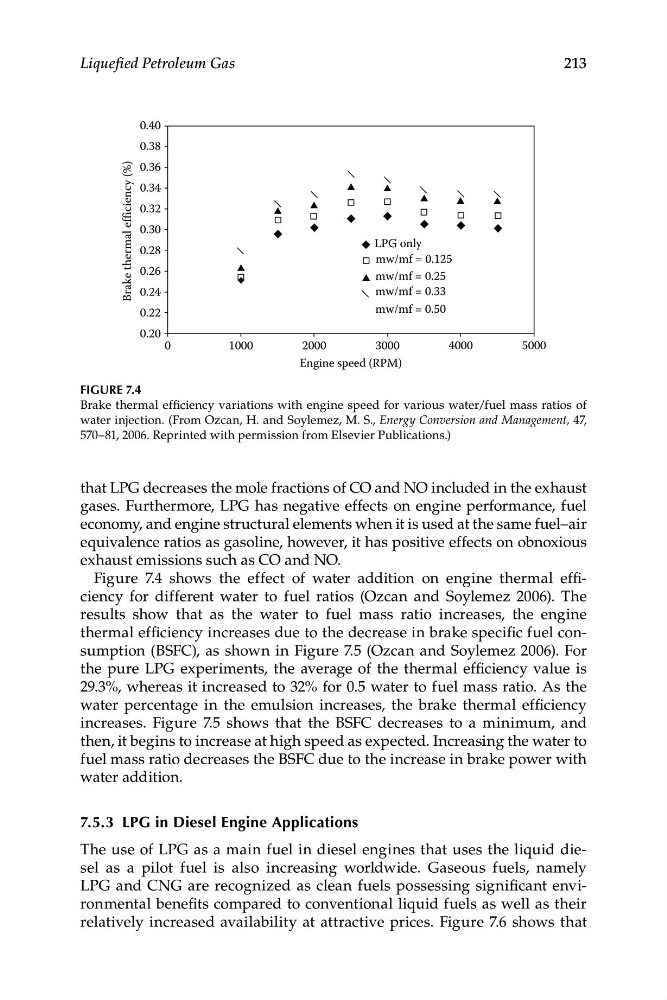
Figure 7.4
Brake thermal efficiency variations with engine speed for various water/fuel mass ratios of
water injection. (From Ozcan, H. and Soylemez, M. S., Energy Conversion and Management, 47,
570–81, 2006. Reprinted with permission from Elsevier Publications.)
that LPG decreases the mole fractions of CO and NO included in the exhaust
gases. Furthermore, LPG has negative effects on engine performance, fuel
economy, and engine structural elements when it is used at the same fuel–air
equivalence ratios as gasoline, however, it has positive effects on obnoxious
exhaust emissions such as CO and NO.
Figure 7.4 shows the effect of water addition on engine thermal efficiency for different water to fuel ratios (Ozcan and Soylemez 2006). The
results show that as the water to fuel mass ratio increases, the engine
thermal efficiency increases due to the decrease in brake specific fuel consumption (BSFC), as shown in Figure 7.5 (Ozcan and Soylemez 2006). For
the pure LPG experiments, the average of the thermal efficiency value is
29.3%, whereas it increased to 32% for 0.5 water to fuel mass ratio. As the
water percentage in the emulsion increases, the brake thermal efficiency
increases. Figure 7.5 shows that the BSFC decreases to a minimum, and
then, it begins to increase at high speed as expected. Increasing the water to
fuel mass ratio decreases the BSFC due to the increase in brake power with
water addition.
7.5.3 LPg in Diesel engine Applications
The use of LPG as a main fuel in diesel engines that uses the liquid diesel as a pilot fuel is also increasing worldwide. Gaseous fuels, namely
LPG and CNG are recognized as clean fuels possessing significant environmental benefits compared to conventional liquid fuels as well as their
relatively increased availability at attractive prices. Figure 7.6 shows that
Liquefied Petroleum Gas
Brake thermal efficiency (%)
0.40
0.38
0.36
0.34
0.32
0.30
0.28
0.26
0.24
0.22
0.20
0
1000
2000
3000
4000
5000
LPG only
mw/mf = 0.125
mw/mf = 0.25
mw/mf = 0.33
mw/mf = 0.50
Engine speed (RPM)
Figure 7.4
Brake thermal efficiency variations with engine speed for various water/fuel mass ratios of
water injection. (From Ozcan, H. and Soylemez, M. S., Energy Conversion and Management, 47,
570–81, 2006. Reprinted with permission from Elsevier Publications.)
that LPG decreases the mole fractions of CO and NO included in the exhaust
gases. Furthermore, LPG has negative effects on engine performance, fuel
economy, and engine structural elements when it is used at the same fuel–air
equivalence ratios as gasoline, however, it has positive effects on obnoxious
exhaust emissions such as CO and NO.
Figure 7.4 shows the effect of water addition on engine thermal efficiency for different water to fuel ratios (Ozcan and Soylemez 2006). The
results show that as the water to fuel mass ratio increases, the engine
thermal efficiency increases due to the decrease in brake specific fuel consumption (BSFC), as shown in Figure 7.5 (Ozcan and Soylemez 2006). For
the pure LPG experiments, the average of the thermal efficiency value is
29.3%, whereas it increased to 32% for 0.5 water to fuel mass ratio. As the
water percentage in the emulsion increases, the brake thermal efficiency
increases. Figure 7.5 shows that the BSFC decreases to a minimum, and
then, it begins to increase at high speed as expected. Increasing the water to
fuel mass ratio decreases the BSFC due to the increase in brake power with
water addition.
7.5.3 LPg in Diesel engine Applications
The use of LPG as a main fuel in diesel engines that uses the liquid diesel as a pilot fuel is also increasing worldwide. Gaseous fuels, namely
LPG and CNG are recognized as clean fuels possessing significant environmental benefits compared to conventional liquid fuels as well as their
relatively increased availability at attractive prices. Figure 7.6 shows that