

Liquefied Petroleum Gas
207
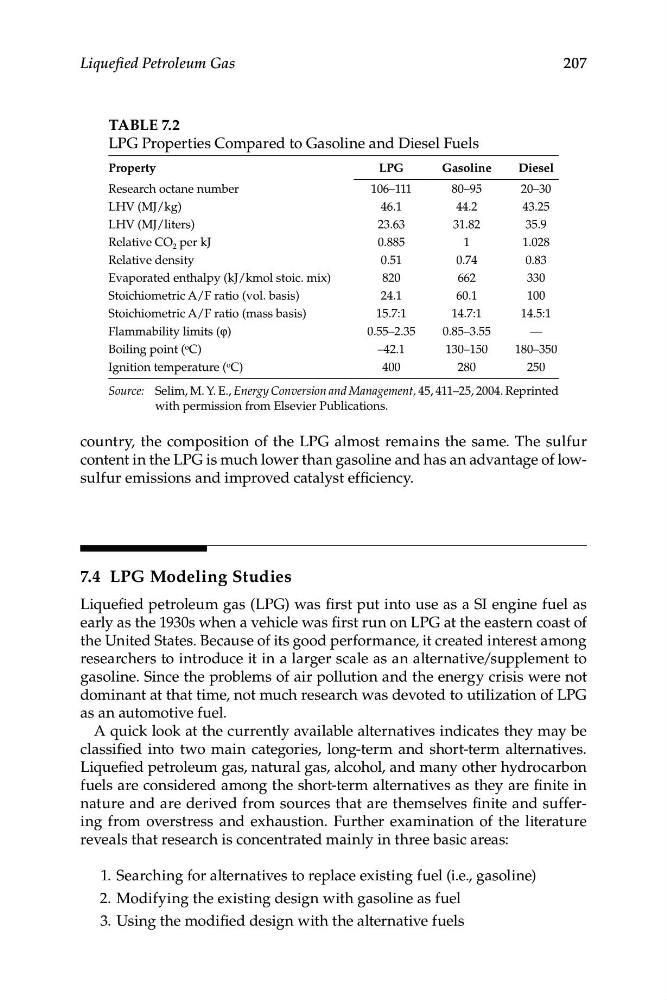
TABLE 7.2
LPG Properties Compared to Gasoline and Diesel Fuels
Property
LPG
Gasoline
Diesel
Research octane number
106–111
80–95
20–30
LHV (MJ/kg)
46.1
44.2
43.25
LHV (MJ/liters)
23.63
31.82
35.9
Relative CO 2 per kJ
0.885
1
1.028
Relative density
0.51
0.74
0.83
Evaporated enthalpy (kJ/kmol stoic. mix)
820
662
330
Stoichiometric A/F ratio (vol. basis)
24.1
60.1
100
Stoichiometric A/F ratio (mass basis)
15.7:1
14.7:1
14.5:1
Flammability limits (φ)
0.55–2.35
0.85–3.55
—
Boiling point ( o C)
–42.1
130–150
180–350
Ignition temperature ( o C)
400
280
250
Source: Selim, M. Y. E., Energy Conversion and Management, 45, 411–25, 2004. Reprinted
with permission from Elsevier Publications.
country, the composition of the LPG almost remains the same. The sulfur
content in the LPG is much lower than gasoline and has an advantage of lowsulfur emissions and improved catalyst efficiency.
7.4 LPG Modeling Studies
Liquefied petroleum gas (LPG) was first put into use as a SI engine fuel as
early as the 1930s when a vehicle was first run on LPG at the eastern coast of
the United States. Because of its good performance, it created interest among
researchers to introduce it in a larger scale as an alternative/supplement to
gasoline. Since the problems of air pollution and the energy crisis were not
dominant at that time, not much research was devoted to utilization of LPG
as an automotive fuel.
A quick look at the currently available alternatives indicates they may be
classified into two main categories, long-term and short-term alternatives.
Liquefied petroleum gas, natural gas, alcohol, and many other hydrocarbon
fuels are considered among the short-term alternatives as they are finite in
nature and are derived from sources that are themselves finite and suffering from overstress and exhaustion. Further examination of the literature
reveals that research is concentrated mainly in three basic areas:
1. Searching for alternatives to replace existing fuel (i.e., gasoline)
2. Modifying the existing design with gasoline as fuel
3. Using the modified design with the alternative fuels
207
TABLE 7.2
LPG Properties Compared to Gasoline and Diesel Fuels
Property
LPG
Gasoline
Diesel
Research octane number
106–111
80–95
20–30
LHV (MJ/kg)
46.1
44.2
43.25
LHV (MJ/liters)
23.63
31.82
35.9
Relative CO 2 per kJ
0.885
1
1.028
Relative density
0.51
0.74
0.83
Evaporated enthalpy (kJ/kmol stoic. mix)
820
662
330
Stoichiometric A/F ratio (vol. basis)
24.1
60.1
100
Stoichiometric A/F ratio (mass basis)
15.7:1
14.7:1
14.5:1
Flammability limits (φ)
0.55–2.35
0.85–3.55
—
Boiling point ( o C)
–42.1
130–150
180–350
Ignition temperature ( o C)
400
280
250
Source: Selim, M. Y. E., Energy Conversion and Management, 45, 411–25, 2004. Reprinted
with permission from Elsevier Publications.
country, the composition of the LPG almost remains the same. The sulfur
content in the LPG is much lower than gasoline and has an advantage of lowsulfur emissions and improved catalyst efficiency.
7.4 LPG Modeling Studies
Liquefied petroleum gas (LPG) was first put into use as a SI engine fuel as
early as the 1930s when a vehicle was first run on LPG at the eastern coast of
the United States. Because of its good performance, it created interest among
researchers to introduce it in a larger scale as an alternative/supplement to
gasoline. Since the problems of air pollution and the energy crisis were not
dominant at that time, not much research was devoted to utilization of LPG
as an automotive fuel.
A quick look at the currently available alternatives indicates they may be
classified into two main categories, long-term and short-term alternatives.
Liquefied petroleum gas, natural gas, alcohol, and many other hydrocarbon
fuels are considered among the short-term alternatives as they are finite in
nature and are derived from sources that are themselves finite and suffering from overstress and exhaustion. Further examination of the literature
reveals that research is concentrated mainly in three basic areas:
1. Searching for alternatives to replace existing fuel (i.e., gasoline)
2. Modifying the existing design with gasoline as fuel
3. Using the modified design with the alternative fuels