

184
Alternative Fuels for Transportation
the comparison of prices of different fuels would be the increase in price of
stranded gas, and it is most difficult to try and estimate this figure, as the
result depends on negotiations between buyer and seller in a long-term contract, which would probably be related in some way to oil price.
In a newer study for Asian conditions, it was estimated that for the production of DME from coal in China, the delivered price of DME would be about
$10.5/MMBtu (Fryer 2006). Between 2004 and 2006, the oil price went from
about $45/bbl to about $70/bbl ($7.8/MMBtu–$12/MMBtu) and the delivered oil price from about $440/ton to $690/ton ($9.4/MMBtu–$15/MMBtu).
It was concluded that DME from coal would be competitive with diesel with
a crude oil price of $45/bbl or more. The oil price has been at or above this
level since 2005. The relation between the coal-based price and the natural
gas-based price was not discussed.
The Japanese study also showed the relative importance of different factors in the production of DME. Two cases were considered, the first being
production of DME from natural gas and the second production from coal.
The natural gas was assumed to be stranded gas. Transportation costs
were estimated to Japan. Sites considered for the Japanese situation were
Indonesia, Western Australia, and the Middle East. Transport costs are
to be expected for Japan, but need to be considered for other parts of the
world as well, at least in the case of DME from natural gas. This is due to
the need for low price natural gas, and by nature, this gas is located away
from markets and pipelines. So the DME would be manufactured at the
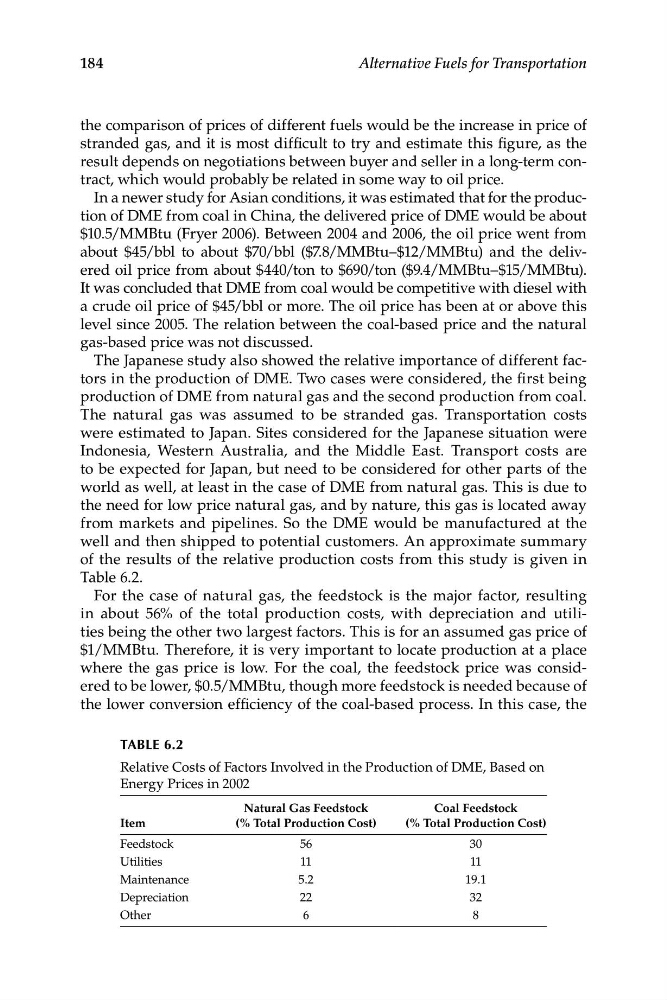
well and then shipped to potential customers. An approximate summary
of the results of the relative production costs from this study is given in
Table 6.2.
For the case of natural gas, the feedstock is the major factor, resulting
in about 56% of the total production costs, with depreciation and utilities being the other two largest factors. This is for an assumed gas price of
$1/MMBtu. Therefore, it is very important to locate production at a place
where the gas price is low. For the coal, the feedstock price was considered to be lower, $0.5/MMBtu, though more feedstock is needed because of
the lower conversion efficiency of the coal-based process. In this case, the
TABLe 6.2
Relative Costs of Factors Involved in the Production of DME, Based on
Energy Prices in 2002
Natural Gas Feedstock
Coal Feedstock
Item
(% Total Production Cost)
(% Total Production Cost)
Feedstock
56
30
Utilities
11
11
Maintenance
5.2
19.1
Depreciation
22
32
Other
6
8
Alternative Fuels for Transportation
the comparison of prices of different fuels would be the increase in price of
stranded gas, and it is most difficult to try and estimate this figure, as the
result depends on negotiations between buyer and seller in a long-term contract, which would probably be related in some way to oil price.
In a newer study for Asian conditions, it was estimated that for the production of DME from coal in China, the delivered price of DME would be about
$10.5/MMBtu (Fryer 2006). Between 2004 and 2006, the oil price went from
about $45/bbl to about $70/bbl ($7.8/MMBtu–$12/MMBtu) and the delivered oil price from about $440/ton to $690/ton ($9.4/MMBtu–$15/MMBtu).
It was concluded that DME from coal would be competitive with diesel with
a crude oil price of $45/bbl or more. The oil price has been at or above this
level since 2005. The relation between the coal-based price and the natural
gas-based price was not discussed.
The Japanese study also showed the relative importance of different factors in the production of DME. Two cases were considered, the first being
production of DME from natural gas and the second production from coal.
The natural gas was assumed to be stranded gas. Transportation costs
were estimated to Japan. Sites considered for the Japanese situation were
Indonesia, Western Australia, and the Middle East. Transport costs are
to be expected for Japan, but need to be considered for other parts of the
world as well, at least in the case of DME from natural gas. This is due to
the need for low price natural gas, and by nature, this gas is located away
from markets and pipelines. So the DME would be manufactured at the
well and then shipped to potential customers. An approximate summary
of the results of the relative production costs from this study is given in
Table 6.2.
For the case of natural gas, the feedstock is the major factor, resulting
in about 56% of the total production costs, with depreciation and utilities being the other two largest factors. This is for an assumed gas price of
$1/MMBtu. Therefore, it is very important to locate production at a place
where the gas price is low. For the coal, the feedstock price was considered to be lower, $0.5/MMBtu, though more feedstock is needed because of
the lower conversion efficiency of the coal-based process. In this case, the
TABLe 6.2
Relative Costs of Factors Involved in the Production of DME, Based on
Energy Prices in 2002
Natural Gas Feedstock
Coal Feedstock
Item
(% Total Production Cost)
(% Total Production Cost)
Feedstock
56
30
Utilities
11
11
Maintenance
5.2
19.1
Depreciation
22
32
Other
6
8