

0
5
10
15
20
0
5
10
15
20
Mass % methanol
Unsatisfactory ignition
2 liquid phases
Satisfactory ignition
Mass % water
181
Dimethyl Ether
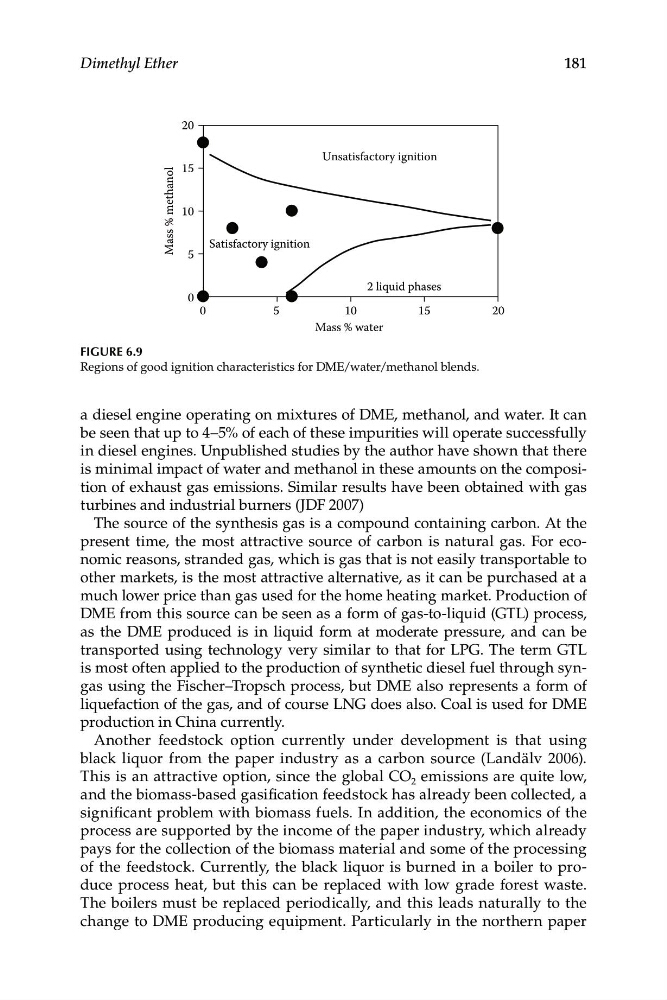
Figure 6.9
Regions of good ignition characteristics for DME/water/methanol blends.
a diesel engine operating on mixtures of DME, methanol, and water. It can
be seen that up to 4–5% of each of these impurities will operate successfully
in diesel engines. Unpublished studies by the author have shown that there
is minimal impact of water and methanol in these amounts on the composition of exhaust gas emissions. Similar results have been obtained with gas
turbines and industrial burners (JDF 2007)
The source of the synthesis gas is a compound containing carbon. At the
present time, the most attractive source of carbon is natural gas. For economic reasons, stranded gas, which is gas that is not easily transportable to
other markets, is the most attractive alternative, as it can be purchased at a
much lower price than gas used for the home heating market. Production of
DME from this source can be seen as a form of gas-to-liquid (GTL) process,
as the DME produced is in liquid form at moderate pressure, and can be
transported using technology very similar to that for LPG. The term GTL
is most often applied to the production of synthetic diesel fuel through syngas using the Fischer–Tropsch process, but DME also represents a form of
liquefaction of the gas, and of course LNG does also. Coal is used for DME
production in China currently.
Another feedstock option currently under development is that using
black liquor from the paper industry as a carbon source (Landälv 2006).
This is an attractive option, since the global CO 2 emissions are quite low,
and the biomass-based gasification feedstock has already been collected, a
significant problem with biomass fuels. In addition, the economics of the
process are supported by the income of the paper industry, which already
pays for the collection of the biomass material and some of the processing
of the feedstock. Currently, the black liquor is burned in a boiler to produce process heat, but this can be replaced with low grade forest waste.
The boilers must be replaced periodically, and this leads naturally to the
change to DME producing equipment. Particularly in the northern paper
5
10
15
20
0
5
10
15
20
Mass % methanol
Unsatisfactory ignition
2 liquid phases
Satisfactory ignition
Mass % water
181
Dimethyl Ether
Figure 6.9
Regions of good ignition characteristics for DME/water/methanol blends.
a diesel engine operating on mixtures of DME, methanol, and water. It can
be seen that up to 4–5% of each of these impurities will operate successfully
in diesel engines. Unpublished studies by the author have shown that there
is minimal impact of water and methanol in these amounts on the composition of exhaust gas emissions. Similar results have been obtained with gas
turbines and industrial burners (JDF 2007)
The source of the synthesis gas is a compound containing carbon. At the
present time, the most attractive source of carbon is natural gas. For economic reasons, stranded gas, which is gas that is not easily transportable to
other markets, is the most attractive alternative, as it can be purchased at a
much lower price than gas used for the home heating market. Production of
DME from this source can be seen as a form of gas-to-liquid (GTL) process,
as the DME produced is in liquid form at moderate pressure, and can be
transported using technology very similar to that for LPG. The term GTL
is most often applied to the production of synthetic diesel fuel through syngas using the Fischer–Tropsch process, but DME also represents a form of
liquefaction of the gas, and of course LNG does also. Coal is used for DME
production in China currently.
Another feedstock option currently under development is that using
black liquor from the paper industry as a carbon source (Landälv 2006).
This is an attractive option, since the global CO 2 emissions are quite low,
and the biomass-based gasification feedstock has already been collected, a
significant problem with biomass fuels. In addition, the economics of the
process are supported by the income of the paper industry, which already
pays for the collection of the biomass material and some of the processing
of the feedstock. Currently, the black liquor is burned in a boiler to produce process heat, but this can be replaced with low grade forest waste.
The boilers must be replaced periodically, and this leads naturally to the
change to DME producing equipment. Particularly in the northern paper