

–
0
+
Start of
injection
Ignition
Ignition
delay
Diffusion combustion
Total energy release
Premixed combustion
Rate of energy release, J/deg. (ft–lb/deg.)
340
360
380
400
Crankshaft position, degrees
Ethanol
145
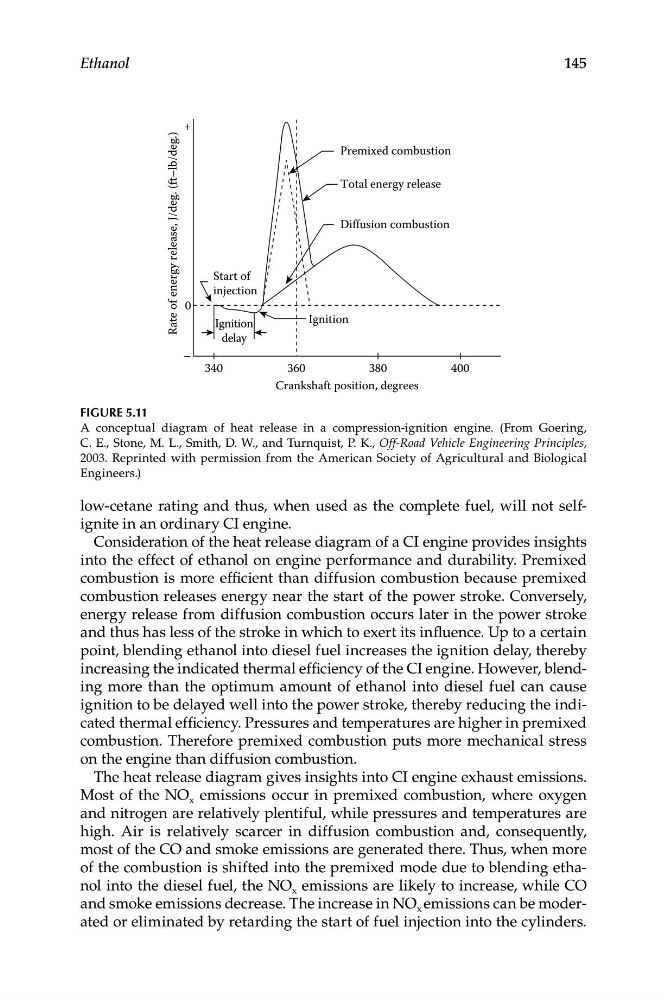
Figure 5.11
A conceptual diagram of heat release in a compression-ignition engine. (From Goering,
C. E., Stone, M. L., Smith, D. W., and Turnquist, P. K., Off-Road Vehicle Engineering Principles,
2003. Reprinted with permission from the American Society of Agricultural and Biological
Engineers.)
low-cetane rating and thus, when used as the complete fuel, will not selfignite in an ordinary CI engine.
Consideration of the heat release diagram of a CI engine provides insights
into the effect of ethanol on engine performance and durability. Premixed
combustion is more efficient than diffusion combustion because premixed
combustion releases energy near the start of the power stroke. Conversely,
energy release from diffusion combustion occurs later in the power stroke
and thus has less of the stroke in which to exert its influence. Up to a certain
point, blending ethanol into diesel fuel increases the ignition delay, thereby
increasing the indicated thermal efficiency of the CI engine. However, blending more than the optimum amount of ethanol into diesel fuel can cause
ignition to be delayed well into the power stroke, thereby reducing the indicated thermal efficiency. Pressures and temperatures are higher in premixed
combustion. Therefore premixed combustion puts more mechanical stress
on the engine than diffusion combustion.
The heat release diagram gives insights into CI engine exhaust emissions.
Most of the NO x emissions occur in premixed combustion, where oxygen
and nitrogen are relatively plentiful, while pressures and temperatures are
high. Air is relatively scarcer in diffusion combustion and, consequently,
most of the CO and smoke emissions are generated there. Thus, when more
of the combustion is shifted into the premixed mode due to blending ethanol into the diesel fuel, the NO x emissions are likely to increase, while CO
and smoke emissions decrease. The increase in NO x emissions can be moderated or eliminated by retarding the start of fuel injection into the cylinders.
0
+
Start of
injection
Ignition
Ignition
delay
Diffusion combustion
Total energy release
Premixed combustion
Rate of energy release, J/deg. (ft–lb/deg.)
340
360
380
400
Crankshaft position, degrees
Ethanol
145
Figure 5.11
A conceptual diagram of heat release in a compression-ignition engine. (From Goering,
C. E., Stone, M. L., Smith, D. W., and Turnquist, P. K., Off-Road Vehicle Engineering Principles,
2003. Reprinted with permission from the American Society of Agricultural and Biological
Engineers.)
low-cetane rating and thus, when used as the complete fuel, will not selfignite in an ordinary CI engine.
Consideration of the heat release diagram of a CI engine provides insights
into the effect of ethanol on engine performance and durability. Premixed
combustion is more efficient than diffusion combustion because premixed
combustion releases energy near the start of the power stroke. Conversely,
energy release from diffusion combustion occurs later in the power stroke
and thus has less of the stroke in which to exert its influence. Up to a certain
point, blending ethanol into diesel fuel increases the ignition delay, thereby
increasing the indicated thermal efficiency of the CI engine. However, blending more than the optimum amount of ethanol into diesel fuel can cause
ignition to be delayed well into the power stroke, thereby reducing the indicated thermal efficiency. Pressures and temperatures are higher in premixed
combustion. Therefore premixed combustion puts more mechanical stress
on the engine than diffusion combustion.
The heat release diagram gives insights into CI engine exhaust emissions.
Most of the NO x emissions occur in premixed combustion, where oxygen
and nitrogen are relatively plentiful, while pressures and temperatures are
high. Air is relatively scarcer in diffusion combustion and, consequently,
most of the CO and smoke emissions are generated there. Thus, when more
of the combustion is shifted into the premixed mode due to blending ethanol into the diesel fuel, the NO x emissions are likely to increase, while CO
and smoke emissions decrease. The increase in NO x emissions can be moderated or eliminated by retarding the start of fuel injection into the cylinders.