

Fuel
Percent
Sucrose
100
Ethanol
58
Oxydiesel
50
Diesel
28
Source: From Speidel, H. K. and Ahmed, I., SAE
1999–01-3518, in SAE SP-1482, 1999.
Ethanol
137
latent heat of evaporation of alcohol is more than three times higher than
that of gasoline. This leads to a reduction in the intake temperature in the
manifold and hence increases the volumetric efficiency. The calorific value
of ethanol is lower than that of gasoline and hence more ethanol is required
to achieve the same energy output. Since the ethanol itself contains oxygen,
the amount of air required for complete combustion is lesser for alcohol. The
stoichiometric air–fuel ratio (AFR) of alcohol is about 9 as compared to gasoline, which is 14.7.
Gasoline-alcohol mixtures may be prepared by addition of a certain amount
of ethanol to the gasoline. Gasoline-ethanol mixtures, which contain up to
20% v ethanol, can be safely used without causing any damage to the engine.
To use gasoline-ethanol mixtures as a motor fuel, the mixture must be stable
and a separation of phases should not occur. In gasoline-ethanol-water systems, the phase separation depends on the ethanol and water content of the
blend, the environmental temperature, and the composition of gasoline. In
order to lower the phase separation temperature, higher aliphatic alcohols
such as tertiary butyl alcohol, benzyl alcohol, cyclohexanol, or toluene are
usually added to the gasoline-alcohol blends (Ferfecki and Sorenson 1983;
Fikret and Yuksel 2004).
Environmentalists prefer low-carbon fuels to help reduce the emission of
carbon into the atmosphere. Ethanol fuel contains a lower percentage of carbon than gasoline or diesel fuel. However, much of that advantage is lost
because the lesser heating value of ethanol, compared to gasoline or diesel
fuel, requires the ethanol to be consumed at a higher rate to achieve the same
power output as from the petroleum fuel.
Biodegradability is a useful fuel property when fuel is inadvertently
spilled. Speidel and Ahmad (1999) studied the biodegradability of a number
of fuels. Their technique was to inoculate the fuel with microbes, seal the
fuel in a closed chamber, and monitor the CO 2 production as the microbes
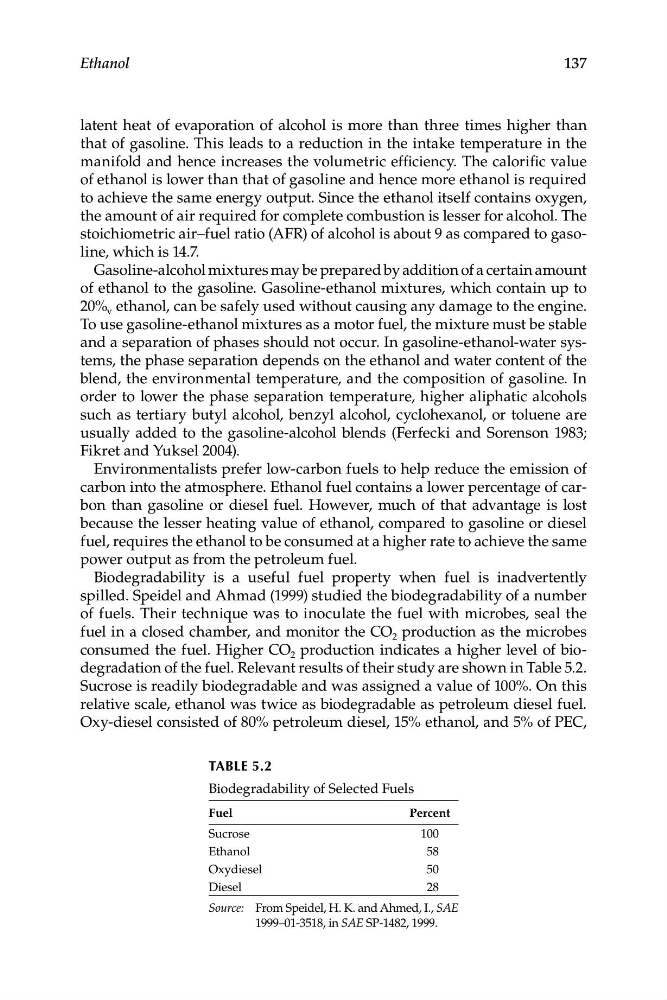
consumed the fuel. Higher CO 2 production indicates a higher level of biodegradation of the fuel. Relevant results of their study are shown in Table 5.2.
Sucrose is readily biodegradable and was assigned a value of 100%. On this
relative scale, ethanol was twice as biodegradable as petroleum diesel fuel.
Oxy-diesel consisted of 80% petroleum diesel, 15% ethanol, and 5% of PEC,
TABLe 5.2
Biodegradability of Selected Fuels
Percent
Sucrose
100
Ethanol
58
Oxydiesel
50
Diesel
28
Source: From Speidel, H. K. and Ahmed, I., SAE
1999–01-3518, in SAE SP-1482, 1999.
Ethanol
137
latent heat of evaporation of alcohol is more than three times higher than
that of gasoline. This leads to a reduction in the intake temperature in the
manifold and hence increases the volumetric efficiency. The calorific value
of ethanol is lower than that of gasoline and hence more ethanol is required
to achieve the same energy output. Since the ethanol itself contains oxygen,
the amount of air required for complete combustion is lesser for alcohol. The
stoichiometric air–fuel ratio (AFR) of alcohol is about 9 as compared to gasoline, which is 14.7.
Gasoline-alcohol mixtures may be prepared by addition of a certain amount
of ethanol to the gasoline. Gasoline-ethanol mixtures, which contain up to
20% v ethanol, can be safely used without causing any damage to the engine.
To use gasoline-ethanol mixtures as a motor fuel, the mixture must be stable
and a separation of phases should not occur. In gasoline-ethanol-water systems, the phase separation depends on the ethanol and water content of the
blend, the environmental temperature, and the composition of gasoline. In
order to lower the phase separation temperature, higher aliphatic alcohols
such as tertiary butyl alcohol, benzyl alcohol, cyclohexanol, or toluene are
usually added to the gasoline-alcohol blends (Ferfecki and Sorenson 1983;
Fikret and Yuksel 2004).
Environmentalists prefer low-carbon fuels to help reduce the emission of
carbon into the atmosphere. Ethanol fuel contains a lower percentage of carbon than gasoline or diesel fuel. However, much of that advantage is lost
because the lesser heating value of ethanol, compared to gasoline or diesel
fuel, requires the ethanol to be consumed at a higher rate to achieve the same
power output as from the petroleum fuel.
Biodegradability is a useful fuel property when fuel is inadvertently
spilled. Speidel and Ahmad (1999) studied the biodegradability of a number
of fuels. Their technique was to inoculate the fuel with microbes, seal the
fuel in a closed chamber, and monitor the CO 2 production as the microbes
consumed the fuel. Higher CO 2 production indicates a higher level of biodegradation of the fuel. Relevant results of their study are shown in Table 5.2.
Sucrose is readily biodegradable and was assigned a value of 100%. On this
relative scale, ethanol was twice as biodegradable as petroleum diesel fuel.
Oxy-diesel consisted of 80% petroleum diesel, 15% ethanol, and 5% of PEC,
TABLe 5.2
Biodegradability of Selected Fuels