

86
Alternative Fuels for Transportation
sulfur compounds. The purified natural gas is saturated with heated water.
The mixed natural gas and water vapor then goes to the reformer to be partially converted to synthesis gas, a mixture of CO 2 , carbon monoxide (CO),
and hydrogen (H 2 ). The synthesis gas undergoes a second step under high
temperatures and pressures to combine CO and H 2 to produce methanol.
Often times additional CO 2 is added in this step for more methanol end
product (http://www.methanol.org 2004; Bradley 2000; Roan et al. 2004). In
principle, many carbon-containing materials may be substituted for natural gas as starting materials. These include coal, lignite, and even municipal wastes in addition to wood. Each of these raw materials, however, must
first be converted to synthesis gas; for this step, each alternative feedstock
requires process modifications that increase capital investment costs over
those required for natural gas (National Research Council 1983).
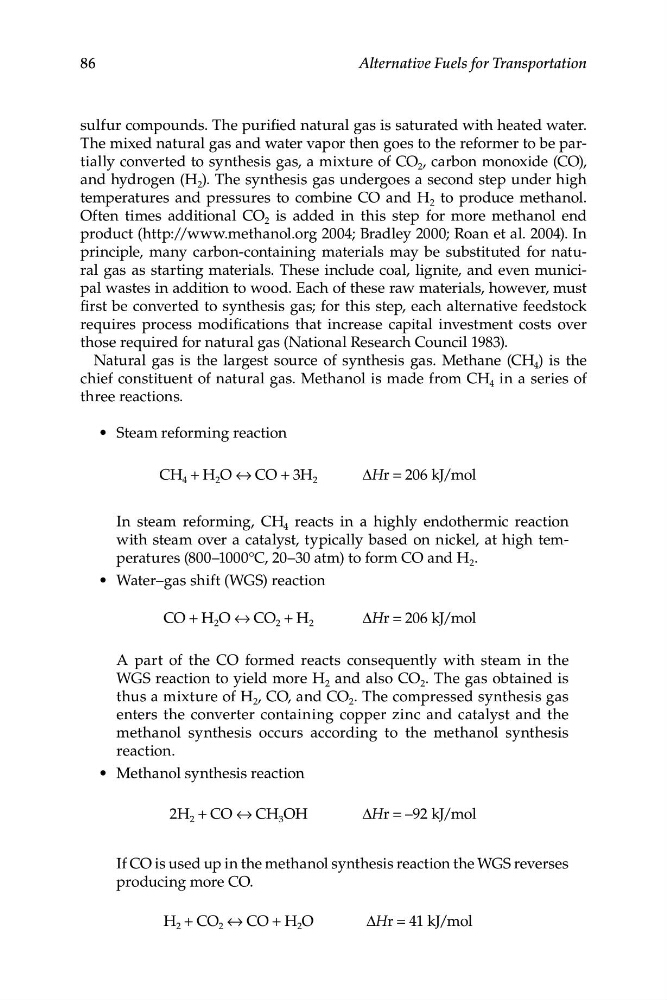
Natural gas is the largest source of synthesis gas. Methane (CH 4 ) is the
chief constituent of natural gas. Methanol is made from CH 4 in a series of
three reactions.
• Steam reforming reaction
CH 4 + H 2 O ↔ CO + 3H 2
ΔHr = 206 kJ/mol
In steam reforming, CH 4 reacts in a highly endothermic reaction
with steam over a catalyst, typically based on nickel, at high temperatures (800–1000°C, 20–30 atm) to form CO and H 2 .
• Water–gas shift (WGS) reaction
CO + H 2 O ↔ CO 2 + H 2
ΔHr = 206 kJ/mol
A part of the CO formed reacts consequently with steam in the
WGS reaction to yield more H 2 and also CO 2 . The gas obtained is
thus a mixture of H 2 , CO, and CO 2 . The compressed synthesis gas
enters the converter containing copper zinc and catalyst and the
methanol synthesis occurs according to the methanol synthesis
reaction.
• Methanol synthesis reaction
2H 2 + CO ↔ CH 3 OH
ΔHr = –92 kJ/mol
If CO is used up in the methanol synthesis reaction the WGS reverses
producing more CO.
H 2 + CO 2 ↔ CO + H 2 O
ΔHr = 41 kJ/mol
Alternative Fuels for Transportation
sulfur compounds. The purified natural gas is saturated with heated water.
The mixed natural gas and water vapor then goes to the reformer to be partially converted to synthesis gas, a mixture of CO 2 , carbon monoxide (CO),
and hydrogen (H 2 ). The synthesis gas undergoes a second step under high
temperatures and pressures to combine CO and H 2 to produce methanol.
Often times additional CO 2 is added in this step for more methanol end
product (http://www.methanol.org 2004; Bradley 2000; Roan et al. 2004). In
principle, many carbon-containing materials may be substituted for natural gas as starting materials. These include coal, lignite, and even municipal wastes in addition to wood. Each of these raw materials, however, must
first be converted to synthesis gas; for this step, each alternative feedstock
requires process modifications that increase capital investment costs over
those required for natural gas (National Research Council 1983).
Natural gas is the largest source of synthesis gas. Methane (CH 4 ) is the
chief constituent of natural gas. Methanol is made from CH 4 in a series of
three reactions.
• Steam reforming reaction
CH 4 + H 2 O ↔ CO + 3H 2
ΔHr = 206 kJ/mol
In steam reforming, CH 4 reacts in a highly endothermic reaction
with steam over a catalyst, typically based on nickel, at high temperatures (800–1000°C, 20–30 atm) to form CO and H 2 .
• Water–gas shift (WGS) reaction
CO + H 2 O ↔ CO 2 + H 2
ΔHr = 206 kJ/mol
A part of the CO formed reacts consequently with steam in the
WGS reaction to yield more H 2 and also CO 2 . The gas obtained is
thus a mixture of H 2 , CO, and CO 2 . The compressed synthesis gas
enters the converter containing copper zinc and catalyst and the
methanol synthesis occurs according to the methanol synthesis
reaction.
• Methanol synthesis reaction
2H 2 + CO ↔ CH 3 OH
ΔHr = –92 kJ/mol
If CO is used up in the methanol synthesis reaction the WGS reverses
producing more CO.
H 2 + CO 2 ↔ CO + H 2 O
ΔHr = 41 kJ/mol