

84
F. Cheng
Table 5.2 (continued)
Name of
databases
Description
Webs
References
GWAS Catalog A database contains
unbiased SNP-trait
associations with
genome-wide significance
https://www.ebi.ac.uk/
gwas/
[82]
GWASdb
A data curation and
knowledge database for
SNP-trait associations from
GWAS for PubMed
http://jjwanglab.org/gwasdb [83]
PheWAS
Catalog
A catalog contains
SNP-trait associations
identified by the
phenome-wide association
study (PheWAS)
http://phewas.mc.
vanderbilt.edu
[84]
HuGE
navigator
An integrated disease
candidate gene database
based on the core data from
PubMed abstracts using text
mining algorithms
https://phgkb.cdc.gov/
PHGKB/
[85]
DisGeNET
A disease-gene database by
assembling expert-curated
databases and text-mined
data
http://www.disgenet.org/
[86]
Section 3. Network analysis and visualization tools
Cytoscape
An open-source software
platform for visualizing
complex networks
https://cytoscape.org/
[110]
Gephi
An open graph visualization
platform
https://gephi.org/
[111]
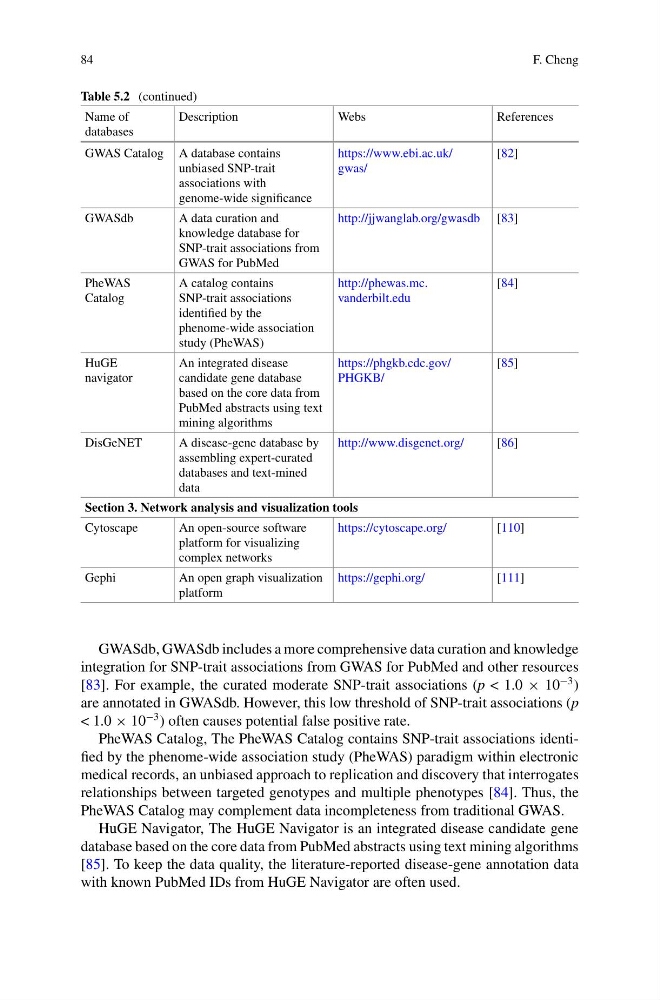
GWASdb, GWASdb includes a more comprehensive data curation and knowledge
integration for SNP-trait associations from GWAS for PubMed and other resources
[83]. For example, the curated moderate SNP-trait associations (p < 1.0 × 10
−3 )
are annotated in GWASdb. However, this low threshold of SNP-trait associations (p
< 1.0 × 10
−3 ) often causes potential false positive rate.
PheWAS Catalog, The PheWAS Catalog contains SNP-trait associations identified by the phenome-wide association study (PheWAS) paradigm within electronic
medical records, an unbiased approach to replication and discovery that interrogates
relationships between targeted genotypes and multiple phenotypes [84]. Thus, the
PheWAS Catalog may complement data incompleteness from traditional GWAS.
HuGE Navigator, The HuGE Navigator is an integrated disease candidate gene
database based on the core data from PubMed abstracts using text mining algorithms
[85]. To keep the data quality, the literature-reported disease-gene annotation data
with known PubMed IDs from HuGE Navigator are often used.
F. Cheng
Table 5.2 (continued)
Name of
databases
Description
Webs
References
GWAS Catalog A database contains
unbiased SNP-trait
associations with
genome-wide significance
https://www.ebi.ac.uk/
gwas/
[82]
GWASdb
A data curation and
knowledge database for
SNP-trait associations from
GWAS for PubMed
http://jjwanglab.org/gwasdb [83]
PheWAS
Catalog
A catalog contains
SNP-trait associations
identified by the
phenome-wide association
study (PheWAS)
http://phewas.mc.
vanderbilt.edu
[84]
HuGE
navigator
An integrated disease
candidate gene database
based on the core data from
PubMed abstracts using text
mining algorithms
https://phgkb.cdc.gov/
PHGKB/
[85]
DisGeNET
A disease-gene database by
assembling expert-curated
databases and text-mined
data
http://www.disgenet.org/
[86]
Section 3. Network analysis and visualization tools
Cytoscape
An open-source software
platform for visualizing
complex networks
https://cytoscape.org/
[110]
Gephi
An open graph visualization
platform
https://gephi.org/
[111]
GWASdb, GWASdb includes a more comprehensive data curation and knowledge
integration for SNP-trait associations from GWAS for PubMed and other resources
[83]. For example, the curated moderate SNP-trait associations (p < 1.0 × 10
−3 )
are annotated in GWASdb. However, this low threshold of SNP-trait associations (p
< 1.0 × 10
−3 ) often causes potential false positive rate.
PheWAS Catalog, The PheWAS Catalog contains SNP-trait associations identified by the phenome-wide association study (PheWAS) paradigm within electronic
medical records, an unbiased approach to replication and discovery that interrogates
relationships between targeted genotypes and multiple phenotypes [84]. Thus, the
PheWAS Catalog may complement data incompleteness from traditional GWAS.
HuGE Navigator, The HuGE Navigator is an integrated disease candidate gene
database based on the core data from PubMed abstracts using text mining algorithms
[85]. To keep the data quality, the literature-reported disease-gene annotation data
with known PubMed IDs from HuGE Navigator are often used.