

42
R. Williams et al.
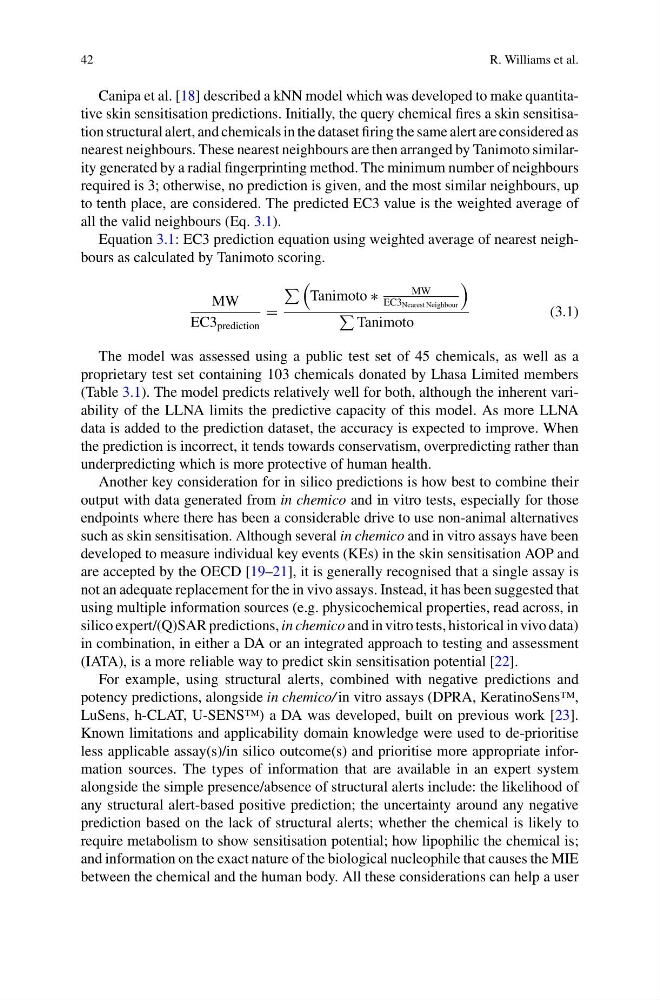
Canipa et al. [18] described a kNN model which was developed to make quantitative skin sensitisation predictions. Initially, the query chemical fires a skin sensitisation structural alert, and chemicals in the dataset firing the same alert are considered as
nearest neighbours. These nearest neighbours are then arranged by Tanimoto similarity generated by a radial fingerprinting method. The minimum number of neighbours
required is 3; otherwise, no prediction is given, and the most similar neighbours, up
to tenth place, are considered. The predicted EC3 value is the weighted average of
all the valid neighbours (Eq. 3.1).
Equation 3.1: EC3 prediction equation using weighted average of nearest neighbours as calculated by Tanimoto scoring.
MW
EC3 prediction
=
Tanimoto ∗
MW
EC3 Nearest Neighbour
Tanimoto
(3.1)
The model was assessed using a public test set of 45 chemicals, as well as a
proprietary test set containing 103 chemicals donated by Lhasa Limited members
(Table 3.1). The model predicts relatively well for both, although the inherent variability of the LLNA limits the predictive capacity of this model. As more LLNA
data is added to the prediction dataset, the accuracy is expected to improve. When
the prediction is incorrect, it tends towards conservatism, overpredicting rather than
underpredicting which is more protective of human health.
Another key consideration for in silico predictions is how best to combine their
output with data generated from in chemico and in vitro tests, especially for those
endpoints where there has been a considerable drive to use non-animal alternatives
such as skin sensitisation. Although several in chemico and in vitro assays have been
developed to measure individual key events (KEs) in the skin sensitisation AOP and
are accepted by the OECD [19–21], it is generally recognised that a single assay is
not an adequate replacement for the in vivo assays. Instead, it has been suggested that
using multiple information sources (e.g. physicochemical properties, read across, in
silico expert/(Q)SAR predictions, in chemico and in vitro tests, historical in vivo data)
in combination, in either a DA or an integrated approach to testing and assessment
(IATA), is a more reliable way to predict skin sensitisation potential [22].
For example, using structural alerts, combined with negative predictions and
potency predictions, alongside in chemico/ in vitro assays (DPRA, KeratinoSens™,
LuSens, h-CLAT, U-SENS™) a DA was developed, built on previous work [23].
Known limitations and applicability domain knowledge were used to de-prioritise
less applicable assay(s)/in silico outcome(s) and prioritise more appropriate information sources. The types of information that are available in an expert system
alongside the simple presence/absence of structural alerts include: the likelihood of
any structural alert-based positive prediction; the uncertainty around any negative
prediction based on the lack of structural alerts; whether the chemical is likely to
require metabolism to show sensitisation potential; how lipophilic the chemical is;
and information on the exact nature of the biological nucleophile that causes the MIE
between the chemical and the human body. All these considerations can help a user
R. Williams et al.
Canipa et al. [18] described a kNN model which was developed to make quantitative skin sensitisation predictions. Initially, the query chemical fires a skin sensitisation structural alert, and chemicals in the dataset firing the same alert are considered as
nearest neighbours. These nearest neighbours are then arranged by Tanimoto similarity generated by a radial fingerprinting method. The minimum number of neighbours
required is 3; otherwise, no prediction is given, and the most similar neighbours, up
to tenth place, are considered. The predicted EC3 value is the weighted average of
all the valid neighbours (Eq. 3.1).
Equation 3.1: EC3 prediction equation using weighted average of nearest neighbours as calculated by Tanimoto scoring.
MW
EC3 prediction
=
Tanimoto ∗
MW
EC3 Nearest Neighbour
Tanimoto
(3.1)
The model was assessed using a public test set of 45 chemicals, as well as a
proprietary test set containing 103 chemicals donated by Lhasa Limited members
(Table 3.1). The model predicts relatively well for both, although the inherent variability of the LLNA limits the predictive capacity of this model. As more LLNA
data is added to the prediction dataset, the accuracy is expected to improve. When
the prediction is incorrect, it tends towards conservatism, overpredicting rather than
underpredicting which is more protective of human health.
Another key consideration for in silico predictions is how best to combine their
output with data generated from in chemico and in vitro tests, especially for those
endpoints where there has been a considerable drive to use non-animal alternatives
such as skin sensitisation. Although several in chemico and in vitro assays have been
developed to measure individual key events (KEs) in the skin sensitisation AOP and
are accepted by the OECD [19–21], it is generally recognised that a single assay is
not an adequate replacement for the in vivo assays. Instead, it has been suggested that
using multiple information sources (e.g. physicochemical properties, read across, in
silico expert/(Q)SAR predictions, in chemico and in vitro tests, historical in vivo data)
in combination, in either a DA or an integrated approach to testing and assessment
(IATA), is a more reliable way to predict skin sensitisation potential [22].
For example, using structural alerts, combined with negative predictions and
potency predictions, alongside in chemico/ in vitro assays (DPRA, KeratinoSens™,
LuSens, h-CLAT, U-SENS™) a DA was developed, built on previous work [23].
Known limitations and applicability domain knowledge were used to de-prioritise
less applicable assay(s)/in silico outcome(s) and prioritise more appropriate information sources. The types of information that are available in an expert system
alongside the simple presence/absence of structural alerts include: the likelihood of
any structural alert-based positive prediction; the uncertainty around any negative
prediction based on the lack of structural alerts; whether the chemical is likely to
require metabolism to show sensitisation potential; how lipophilic the chemical is;
and information on the exact nature of the biological nucleophile that causes the MIE
between the chemical and the human body. All these considerations can help a user